
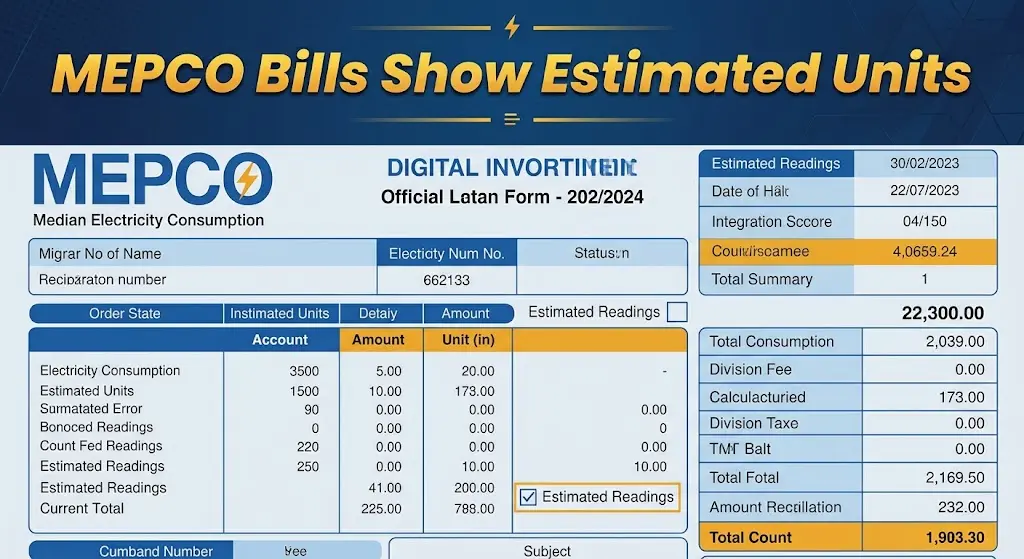
There’s a particular line on an electricity bill that tends to make people stop for a second: Estimated Units.
You look at the meter outside your house, look back at the bill, and the numbers don’t seem to match. Sometimes the difference is small. Sometimes the bill shows an estimate when you were expecting an actual meter reading, and that is where the confusion starts.
I’ve seen this question come up repeatedly while working around MEPCO billing information. Most people assume that an estimated bill means MEPCO simply guessed the number of units. That isn’t really what the term means.
There is a specific reason estimated consumption appears on a MEPCO bill, and in the most important cases it is connected to the condition of the meter and the availability of a reliable reading.
MEPCO’s own billing guidance describes total units consumed as the consumption during the billing period, or estimated consumption in the case of a defective meter. Its consumer FAQ also explains that when a meter is declared defective, the assessment is based on the previous year’s consumption for the same month, with a check meter intended to be installed to verify actual consumption.
That distinction matters because an estimated reading is not necessarily evidence that your electricity usage suddenly changed.
1. Estimated Units Usually Point to a Reading Problem
The first thing to understand is that estimated units and actual meter units are not the same thing.
With a normal working meter, the basic calculation is straightforward:
Present meter reading – Previous meter reading = Units consumed
For example, suppose your previous reading was 12,450 and the present reading is 12,730.
Your consumption would be:
12,730 – 12,450 = 280 units
That is an actual reading-based calculation.
An estimated bill works differently. When MEPCO does not have a reliable actual consumption figure, the bill can use an estimated consumption figure under the applicable billing procedure. MEPCO’s official material specifically identifies estimated consumption in cases involving defective meters.
This is why checking the reading section of your bill is so useful. The newer MEPCO bill format separates previous reading, present reading, reading date, total units and reading type, making it easier to see how the consumption figure was reached.
There is another detail people sometimes miss.
An estimated bill does not automatically mean the meter itself is physically broken. A consumer may simply see a billing figure that needs further checking because the normal reading process did not produce a reliable actual reading. MEPCO’s FAQ tells consumers that meters are normally read once a month on the date shown on the bill, and advises contacting the relevant subdivision if the meter was not read.
So the sensible response is not to panic over the word “estimated.”
First, find out why the estimate was used.
2. A Defective Meter Is the Most Important Reason
This is where the explanation becomes more specific.
MEPCO’s consumer FAQ has a dedicated explanation for defective meter readings. According to that guidance, when a meter is declared defective, the consumer can receive an assessed bill based on consumption during the same month of the previous year. MEPCO also states that a check meter is supposed to be installed promptly so actual consumption can be checked. If circumstances prevent installation of the check meter, an estimated bill can be issued with the “est def” indication.
That gives us a much clearer picture of what an estimated figure is doing.
It is acting as a temporary billing basis while the normal meter reading cannot reliably establish consumption.
A simple way to remember it is:
| Billing situation | What the units represent |
|---|---|
| Working meter with valid reading | Actual recorded consumption |
| Defective meter | Estimated/assessed consumption under the applicable procedure |
| Meter not read | Needs investigation and contact with the relevant subdivision |
| Accumulated readings | Billing may be adjusted through segregated bills |
The last row is worth mentioning because accumulated readings are another source of confusion. MEPCO’s billing manual says that when readings have accumulated, segregated bills should be prepared while considering the number of months for which readings accumulated, with the aim of giving consumers relief.
So if you suddenly receive a bill that looks very different from the previous month, don’t assume the meter has necessarily recorded an enormous jump in one billing cycle.
Check the reading history first.
That one habit catches a lot of billing confusion before it turns into a bigger problem.
3. Why Your Estimated Units May Look Higher or Lower Than Normal
This is where many consumers make the wrong assumption.
They see an estimate and immediately compare it with last month’s units.
But the estimate isn’t necessarily designed to reproduce last month’s exact consumption.
For a defective meter, MEPCO’s FAQ points to the same month of the previous year as the basis for the assessment. That means a household that used 180 units last month could receive an estimated figure that is quite different, depending on the applicable assessment basis and its previous consumption history.
For example, imagine this pattern:
| Period | Units |
|---|---|
| September 2025 | 310 |
| August 2026 | 185 |
| September 2026 estimated | 310 |
The consumer might look at the August bill and think, “I only used 185 units, so why am I being billed for 310?”
The answer could be that the September estimate is not simply based on the immediately preceding month’s consumption.
This is one of the places where people usually go wrong.
They compare an estimated month’s units with the wrong reference month.
Before deciding that the bill is incorrect, check the previous year’s corresponding month and look at the meter status or reading type shown on the bill.
There is still an important caveat: an estimate is an assessment, not proof that you physically consumed exactly that number of units. If the meter condition, readings or assessment appear incorrect, the issue should be raised with MEPCO for verification.
4. What Happens When the Meter Is Actually Defective
A defective meter creates a practical problem for both the consumer and the distribution company.
A meter that cannot reliably record consumption cannot simply be treated like a normal meter. Someone still has to determine how the electricity consumed during that period should be billed.
MEPCO’s published FAQ describes the use of a check meter for this purpose. The check meter is intended to help determine actual consumption and verify the billing position. If it cannot be installed because of unavoidable circumstances, the company may use an estimated basis, marked accordingly.
This is also why reporting a faulty meter matters.
Don’t wait for several bills to pass while assuming the problem will disappear by itself.
If the meter display is blank, the meter is damaged, the readings appear abnormal, or there is another obvious problem with the equipment, keep a record of what you observed and contact the relevant MEPCO office or customer service channel.
MEPCO’s customer service material says the company uses meter-reading technology and metering systems as part of its efforts toward accurate billing. Its annual report also describes the use of mobile meter reading and AMR meters in its billing operations.
The point is simple: a defective meter is a billing issue worth reporting, not something to ignore until the next bill.
5. Don’t Confuse Estimated Units With a Detection Bill
These two things are sometimes mixed together, but they are not the same situation.
An estimated bill relates to how consumption is assessed when a reliable normal meter reading is not available, particularly in the defective-meter situation described by MEPCO.
A detection bill is a different matter. It follows an inspection in which MEPCO identifies an irregularity or other issue requiring assessment. The resulting charges can relate to unrecorded consumption, meter tampering, unauthorized connections, connected-load issues or other findings described in the inspection process.
That difference is important because the response is different too.
If your ordinary monthly bill shows estimated consumption, start by checking the reading information, meter status and previous consumption.
If you’ve received a detection bill, look at the inspection details and assessment information instead.
I’ve written about detection bills separately because they involve a different process, and it is useful not to treat every unusual electricity bill as the same problem.
6. How to Check Whether an Estimated Bill Looks Reasonable
You don’t need complicated calculations to do an initial check.
Start with these five pieces of information:
- Previous meter reading
- Present meter reading, if shown
- Reading date
- Total units
- Reading type or meter status
The newer MEPCO bill layout places these details in the meter-reading section, which makes this comparison easier.
Then check your old bills.
If you have several months of bills available, don’t look only at the immediately previous one. Compare the same month from the previous year when the bill is based on an estimated defective-meter assessment.
A quick personal record can look like this:
Month        Units       Reading type
--------------------------------------
Sep 2025     310         Actual
Oct 2025     295         Actual
Nov 2025     270         Actual
...
Aug 2026     185         Actual
Sep 2026     310         Estimated
That small record gives you much more information than looking at one large number on the latest bill.
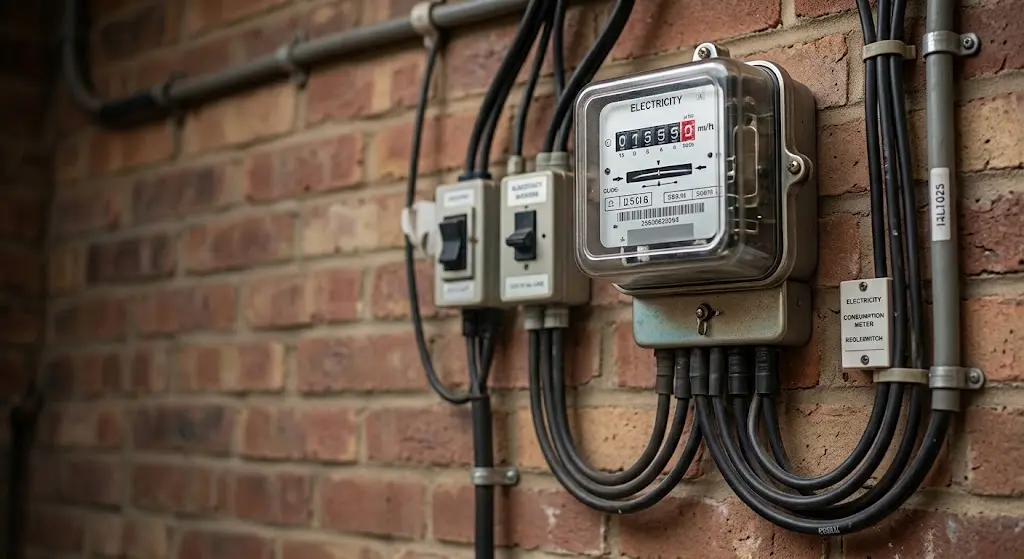
And if the meter reading printed on the bill doesn’t make sense, compare it with the number currently displayed on the physical meter, where applicable.
If there is a clear discrepancy, document it rather than relying on memory.
7. What You Should Do If the Estimated Units Seem Wrong
There isn’t much value in simply refusing to look at the bill because the word “estimated” appears on it.
Start with verification.
Take a photo of the meter reading if the meter is accessible and safe to inspect. Keep copies of recent electricity bills, especially the bill showing the estimated units and the corresponding bills from previous months or the previous year.
Then contact MEPCO through the appropriate customer service channel or your relevant subdivision and ask specifically why the bill was assessed on an estimated basis.
MEPCO’s official FAQ advises consumers to contact their subdivision if the meter was not read, and it also explains the procedure surrounding defective meters and check-meter installation.
If the issue is not resolved through normal customer service, consumers can use the applicable complaint process. MEPCO provides customer service facilities, while the electricity sector’s complaint systems also provide routes for billing disputes.
One practical point here: keep your reference number with you when making a complaint. It makes it much easier for staff to identify the correct connection and billing record.
8. The Bigger Reason Estimated Billing Creates Confusion
Electricity billing looks precise because the final bill contains very precise numbers.
You see 247 units, 312 units or 418 units and naturally assume that number came directly from the meter.
But the number on the bill is only meaningful when you understand how it was obtained.
That is the real issue with estimated units.
A normal reading gives you a direct measurement. An estimated bill uses an assessment basis because the normal measurement isn’t available or reliable in that situation. MEPCO’s own billing documentation makes this distinction by describing total units as either consumption during the billing period or estimated consumption in the case of a defective meter.
Once you understand that, the bill becomes much easier to read.
You stop asking only, “Why are my units so high?”
You start asking the more useful question: “What reading or assessment method was used to arrive at these units?”
That is the question that gets you closer to the actual billing issue.
And if you regularly check your electricity bills through mepccobill.pk, make a habit of looking at the meter-reading portion rather than jumping straight to the amount payable. The new bill format separates the reading information more clearly, which makes this check fairly quick.
One more thing worth keeping in mind: estimated billing isn’t necessarily permanent. Where the problem is connected to a defective meter, the meter/check-meter process is intended to establish more reliable consumption information.
That is why reporting the problem early is usually better than simply waiting for the next bill.
Frequently Asked Questions
Why does my MEPCO bill show estimated units?
The most relevant reason described by MEPCO is a defective meter or a situation where reliable actual consumption cannot be established. In a defective-meter case, MEPCO’s FAQ says consumption can be assessed using the same month of the previous year, with a check meter intended to verify actual usage.
Does estimated billing mean MEPCO has guessed my electricity usage?
Not in the casual sense of someone simply picking a number. Estimated consumption is an assessment made under the applicable billing procedure. For defective meters, MEPCO specifically identifies the previous year’s corresponding month’s consumption as a basis.
What does “EST DEF” mean on a MEPCO bill?
MEPCO’s FAQ explains that when a meter is defective and a check meter cannot be installed because of unavoidable circumstances, the consumer can receive an estimated bill carrying the “est def” indication.
What should I do if the meter reading on my bill is wrong?
Compare the bill’s reading with the physical meter, where accessible, and keep copies or photographs showing the discrepancy. Contact the relevant MEPCO subdivision or customer service channel and provide your reference number and billing details.
Will an estimated bill stay estimated forever?
Not necessarily. The treatment depends on the reason the actual reading could not be established. In the defective-meter situation described by MEPCO, a check meter is intended to help establish actual consumption and verify billing.
The next time you see “Estimated Units” on a MEPCO bill, don’t judge the bill from that one word. Check the reading type, look at the meter history, compare the appropriate previous period, and find out why an estimate was used. Once you know the basis of the number, the rest of the bill is much easier to understand.
For another useful guide to reading your electricity charges, see the MEPCO Bill Payment Methods guide.
Pingback: Is MEPCO Net Metering Still Worth It in 2026? – MEPCO Bill Check 2026