
MEPCO Tariff Rates 2026 – Unit Price, Slab System & Taxes Explained
MEPCO tariff rates are one of the main factors that determine how much you pay for electricity each month. If you use electricity at home, run a small business, or operate a larger commercial or industrial setup, knowing how the tariff works can make your bill much easier to understand.
MEPCO, or Multan Electric Power Company, supplies electricity to a large area of southern Punjab. The tariff charged to its customers is not simply one fixed price for every unit. Electricity charges depend on your consumer category, the number of units you use, your connection type, applicable fixed charges, and different government-approved adjustments and taxes.
For residential consumers, the tariff structure also distinguishes between protected and non-protected consumers. There are separate rates for different consumption levels, while customers with Time of Use (ToU) meters can have different peak and off-peak rates.
The tariff schedule can also change when the government or NEPRA approves new adjustments. Therefore, the rate printed on an older bill may not always match the rate applicable to your current bill.
If you want to check your electricity bill first, you can visit MEPCCO-Bill.pk and use the available bill-checking resources.
What Is the MEPCO Tariff?
The MEPCO tariff is the approved price structure used to calculate electricity charges for MEPCO consumers. Electricity consumption is measured in kilowatt-hours (kWh), commonly called units on your bill.
For example, if your home uses 250 units during a billing month, those 250 units form the basis of your energy charges. However, your final bill is usually higher than simply multiplying 250 by one per-unit price.
This is because a MEPCO bill can include several other components, such as:
- Energy or variable charges
- Fixed charges, where applicable
- Government taxes
- Electricity duty
- Fuel-related adjustments
- Quarterly tariff adjustments
- Other approved surcharges or charges
The exact amount depends on your consumer category and the charges applicable during that billing period.
The current MEPCO tariff schedule approved through the NEPRA framework provides different residential rates according to consumption slabs and connection characteristics.
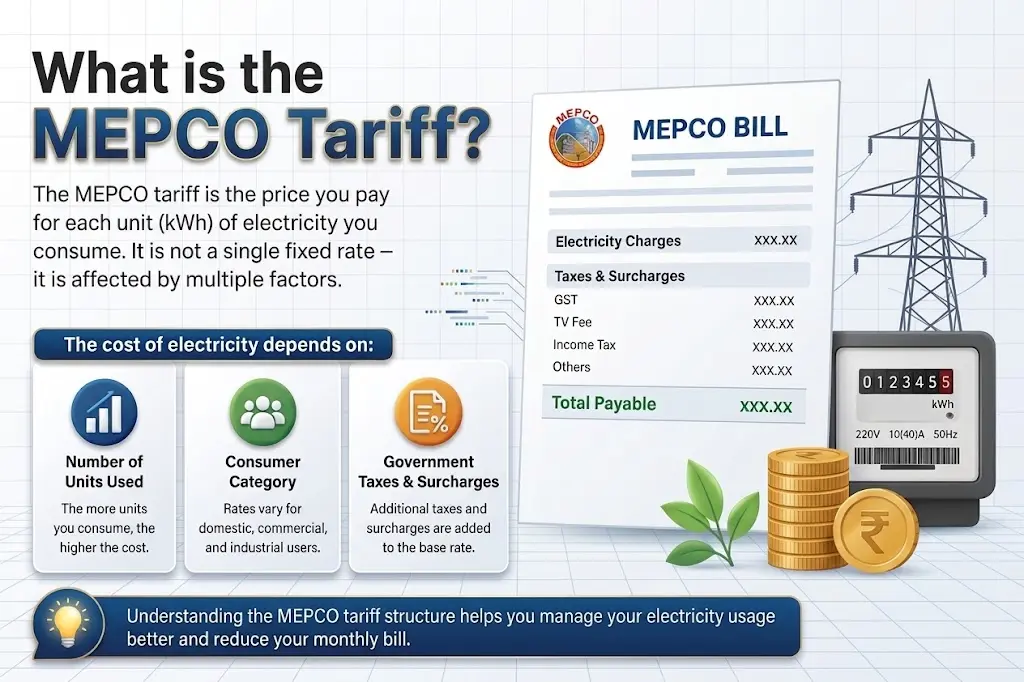
How MEPCO Tariff Rates Work
One of the easiest ways to understand your electricity bill is to separate the tariff into three basic areas:
1. Units Consumed
The first factor is the number of electricity units used during the billing period.
A household using 80 units will generally fall into a different tariff category or slab treatment than a household using 400 or 800 units.
2. Consumer Category
Your tariff also depends on the type of connection.
Common categories include:
- Residential or domestic
- Commercial
- Industrial
- Agricultural
- Other specialised categories
The rates and fixed charges are not the same for all of these categories.
3. Additional Charges
After the basic electricity charges are calculated, applicable taxes, duties, adjustments, and other charges can increase the final payable amount.
This is why two consumers with similar unit consumption can sometimes receive noticeably different bills.
MEPCO Slab System Explained
The slab system is an important part of residential electricity billing.
Instead of having one simple rate that applies to every household regardless of consumption, residential consumers are placed into consumption categories. The applicable tariff depends on the number of units consumed and whether the consumer is protected or non-protected.
The current tariff schedule includes residential ranges such as:
- Up to 50 units
- 51–100 units
- 101–200 units
- 201–300 units
- 301–400 units
- 401–500 units
- 501–600 units
- 601–700 units
- Above 700 units
The exact treatment and applicable rate depend on the consumer category.
This is important because it is not always correct to assume that every unit on a bill is charged at one identical rate.
MEPCO Tariff Rates 2026 for Domestic Consumers
The current NEPRA-published MEPCO residential tariff schedule lists different variable charges for different consumption categories.
For residential consumers with sanctioned load below 5 kW, the published schedule includes the following variable tariff figures before and after the listed PYA component:
| Residential Consumption | Variable Charge | PYA 2025 | Total Variable Charge |
|---|---|---|---|
| Up to 50 Units – Lifeline | Rs. 27.99/unit | Rs. 0.54 | Rs. 28.53/unit |
| 51–100 Units – Lifeline | Rs. 28.91/unit | Rs. 0.54 | Rs. 29.45/unit |
| 1–100 Units | Rs. 30.45/unit | Rs. 0.54 | Rs. 30.99/unit |
| 101–200 Units | Rs. 24.81/unit | Rs. 0.54 | Rs. 25.35/unit |
| 1–100 Units | Rs. 26.14/unit | Rs. 0.54 | Rs. 26.68/unit |
| 101–200 Units | Rs. 26.24/unit | Rs. 0.54 | Rs. 26.80/unit |
| 201–300 Units | Rs. 31.69/unit | Rs. 0.54 | Rs. 32.13/unit |
| 301–400 Units | Rs. 31.77/unit | Rs. 0.54 | Rs. 32.11/unit |
| 401–500 Units | Rs. 31.60/unit | Rs. 0.54 | Rs. 32.14/unit |
| 501–600 Units | Rs. 31.23/unit | Rs. 0.54 | Rs. 31.77/unit |
| 601–700 Units | Rs. 31.57/unit | Rs. 0.54 | Rs. 32.11/unit |
| Above 700 Units | Rs. 31.77/unit | Rs. 0.54 | Rs. 32.30/unit |
These figures come from the NEPRA tariff schedule and should be treated as the applicable published tariff components rather than a promise of the final amount on a consumer’s bill. Taxes, adjustments, fixed charges, and other components can change the final payable amount.
Why Are There Different Rates for Similar Unit Ranges?
You may notice that the official tariff table contains more than one entry for some consumption ranges, such as 1–100 and 101–200 units.
This is because the tariff structure distinguishes between different residential consumer treatments, including protected and non-protected consumers.
Therefore, simply looking at the number of units on your bill is not always enough to determine the exact tariff.
Protected vs Non-Protected MEPCO Consumers
The terms protected and non-protected are important when understanding residential electricity bills.
Protected Consumers
Protected consumers generally receive the benefit of the government-approved protected tariff structure when they meet the applicable conditions.
Their bills can therefore be different from those of non-protected consumers using a similar number of units.
The current tariff documentation also states that protected residential consumers can receive the benefit of one previous slab under the applicable rules.
Non-Protected Consumers
Non-protected consumers are charged according to the applicable non-protected tariff structure.
If household electricity consumption rises, the applicable tariff treatment can become more expensive. This is one reason why keeping track of monthly consumption is useful.
It is also important not to assume that simply using fewer than 200 units automatically makes a consumer protected. Consumer status depends on the applicable rules and billing history/category requirements.
What Is a Lifeline Consumer?
Lifeline consumers are residential consumers who fall within the lowest applicable consumption ranges under the tariff structure.
The current MEPCO tariff schedule separately lists:
- Up to 50 units – Lifeline
- 51–100 units – Lifeline
These categories have their own published rates.
Lifeline treatment should not be confused with the general protected category because the tariff rules and benefits can be different.
Fixed Charges in the MEPCO Bill
Many people look only at the number of units and the per-unit rate when estimating their bill. However, fixed charges can also be part of the calculation.
According to the current residential tariff schedule, minimum monthly customer charges apply in specified circumstances. For connections where applicable:
- Single-phase connection: Rs. 75 per consumer per month
- Three-phase connection: Rs. 150 per consumer per month
The tariff document also explains that fixed charges for non-ToU domestic consumers depend on sanctioned load, while ToU domestic fixed charges are based on 50% of sanctioned load or MDI, whichever is higher.
This is another reason why the final bill cannot always be estimated by multiplying units by a single tariff rate.
Time of Use (ToU) MEPCO Tariff
Some consumers have Time of Use meters. Under this arrangement, electricity prices can differ between peak and off-peak periods.
For residential consumers with sanctioned load of 5 kW or more, the published schedule lists:
- Peak: Rs. 33.15/kWh
- Off-peak: Rs. 24.67/kWh
The listed PYA component is Rs. 0.54/kWh, resulting in total variable charges of Rs. 33.68/kWh during peak hours and Rs. 25.21/kWh during off-peak hours in that schedule.
This makes the timing of electricity use more important for ToU consumers.
If you have a ToU meter, shifting some flexible electricity usage to off-peak periods may help control your electricity costs.
Commercial MEPCO Tariff
Commercial consumers follow a different tariff structure from residential consumers.
A shop, office, restaurant, workshop, or other commercial connection may have:
- Different variable electricity charges
- Fixed charges
- Different ToU rates where applicable
- Government taxes and duties
- Applicable adjustments
Therefore, residential tariff rates should not be used to estimate a commercial MEPCO bill.
The same principle applies to industrial and agricultural consumers. Each category has its own tariff structure and applicable conditions.
Industrial and Agricultural Tariffs
Industrial consumers generally have tariff arrangements that differ from ordinary domestic consumers.
Depending on the connection and sanctioned load, industrial consumers may have different:
- Energy rates
- Fixed charges
- Peak and off-peak rates
- Load-related charges
- Other applicable adjustments
Agricultural consumers also have their own tariff categories.
For this reason, anyone operating a business, factory, tube well, or agricultural connection should check the tariff category shown on the electricity bill before estimating the bill.
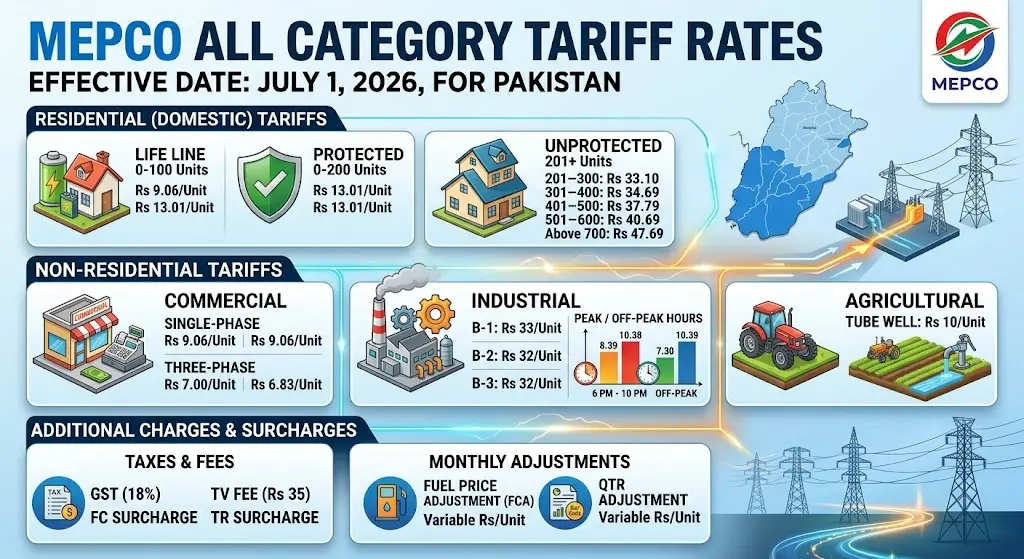
What Taxes Are Included in a MEPCO Bill?
Your electricity bill can contain more than the basic electricity consumption charge.
Depending on the consumer category and applicable government rules, the bill may include items such as:
General Sales Tax (GST)
GST may be applied to applicable electricity charges according to the prevailing tax rules.
The amount shown on the bill depends on the applicable taxable components.
Electricity Duty
Electricity duty is another government charge that can appear on electricity bills.
Its application and amount depend on the applicable rules and consumer category.
Television Fee
A TV fee can also appear as a separate charge on eligible electricity bills.
This is not a charge for the electricity you consumed. It is a separate government-related fee collected through electricity billing.
Fuel Charges Adjustment
Fuel-related adjustments can affect electricity bills when the cost of power generation changes.
These adjustments can be positive or negative depending on the approved calculation for the relevant period.
Quarterly Tariff Adjustment
Quarterly adjustments can also affect the amount payable by consumers.
These adjustments are part of the broader tariff mechanism and may change the final bill even when your electricity consumption remains similar.
NEPRA continues to publish tariff and adjustment decisions during the year, so consumers should check the latest applicable notification rather than relying on an old rate table.
What Is Fuel Price Adjustment (FPA)?
Fuel Price Adjustment, commonly referred to as FPA, is related to changes in the cost of fuel used for electricity generation.
Electricity generation costs can change because fuel prices and other generation-related costs do not remain constant.
When an approved adjustment applies to a billing period, it can increase or decrease the amount charged to consumers.
For example:
If the applicable adjustment is positive:
Your bill may increase.
If the applicable adjustment is negative:
The adjustment may reduce the applicable charges, subject to the rules for your consumer category.
This is why your electricity bill can change from one month to another even when your unit consumption is almost the same.
What Is a Quarterly Tariff Adjustment?
A quarterly tariff adjustment is another factor that can change electricity bills.
It is based on approved adjustments under the electricity tariff framework and may cover different cost components.
For consumers, the important point is simple: the amount you pay is not determined only by the base per-unit tariff.
NEPRA publishes decisions and notifications relating to periodic tariff adjustments, including quarterly adjustments for distribution companies.
For the most reliable information, check the latest official NEPRA tariff and notification information when a new adjustment is announced.
Why Is My MEPCO Bill Higher Than Expected?
A higher-than-expected bill does not necessarily mean that the meter has recorded an incorrect number of units.
Several factors can increase the final amount.
1. Higher Unit Consumption
The most obvious reason is increased electricity use.
Air conditioners, refrigerators, water pumps, irons, electric heaters, washing machines, and other high-power appliances can significantly increase monthly consumption.
2. A Different Tariff Slab
Moving into a different consumption range can affect the applicable tariff treatment.
3. Fixed Charges
Where applicable, fixed charges are added separately from energy consumption charges.
4. Taxes and Duties
Government taxes and duties increase the amount payable beyond basic energy charges.
5. Fuel or Quarterly Adjustments
An approved adjustment can increase or decrease your bill independently of your current month’s consumption.
6. Previous Balance
If an earlier amount remains unpaid, it can also appear in the current bill.
7. Arrears or Other Charges
Outstanding amounts or other applicable charges can also affect the total.
How to Read Your MEPCO Bill
Understanding a few important sections of your bill can make it much easier to find the reason behind a higher amount.
Look for:
Reference Number / Consumer ID:
This identifies your electricity connection for billing purposes.
Billing Month:
Shows the month for which the bill was issued.
Meter Reading:
The current and previous readings help determine your electricity consumption.
Units Consumed:
This shows how many electricity units were recorded during the billing period.
Tariff:
This indicates the tariff category applicable to your connection.
Energy Charges:
These represent the basic electricity consumption charges.
Taxes and Adjustments:
These show additional amounts applied to the bill.
Current Bill:
This is the amount generated for the current billing period before considering any previous outstanding amount where applicable.
Due Date:
This is the date by which payment should normally be made to avoid late-payment consequences.
How to Reduce Your MEPCO Electricity Bill
You do not always need to make major lifestyle changes to reduce electricity consumption. Small changes can help, especially when they are followed consistently.
Use Air Conditioners Carefully
Air conditioners can consume a large amount of electricity.
Set a reasonable temperature instead of keeping the AC at an extremely low setting. Clean the filters regularly and avoid running the AC in rooms with open doors or windows.
Use LED Bulbs
Replacing old incandescent bulbs with LED lighting can reduce lighting-related electricity consumption.
LED bulbs also generally last longer than traditional bulbs.
Switch Off Unused Appliances
Do not leave lights, fans, chargers, televisions, computers, or other devices running when nobody is using them.
It may seem like a small saving, but unnecessary electricity use adds up over time.
Use Energy-Efficient Appliances
When replacing an old appliance, check its energy efficiency.
A more efficient refrigerator, air conditioner, washing machine, or fan can reduce electricity consumption over the long term.
Watch Your Monthly Units
One of the simplest habits is to keep an eye on your electricity meter.
If your normal monthly usage is around 180 units, a sudden increase to 250 or 300 units deserves attention.
Finding the reason early can help prevent a much higher bill next month.
Use ToU Electricity Wisely
If you have a Time of Use meter, try to move flexible electricity usage toward applicable off-peak hours.
This can be particularly useful for appliances that do not need to operate at a specific time.
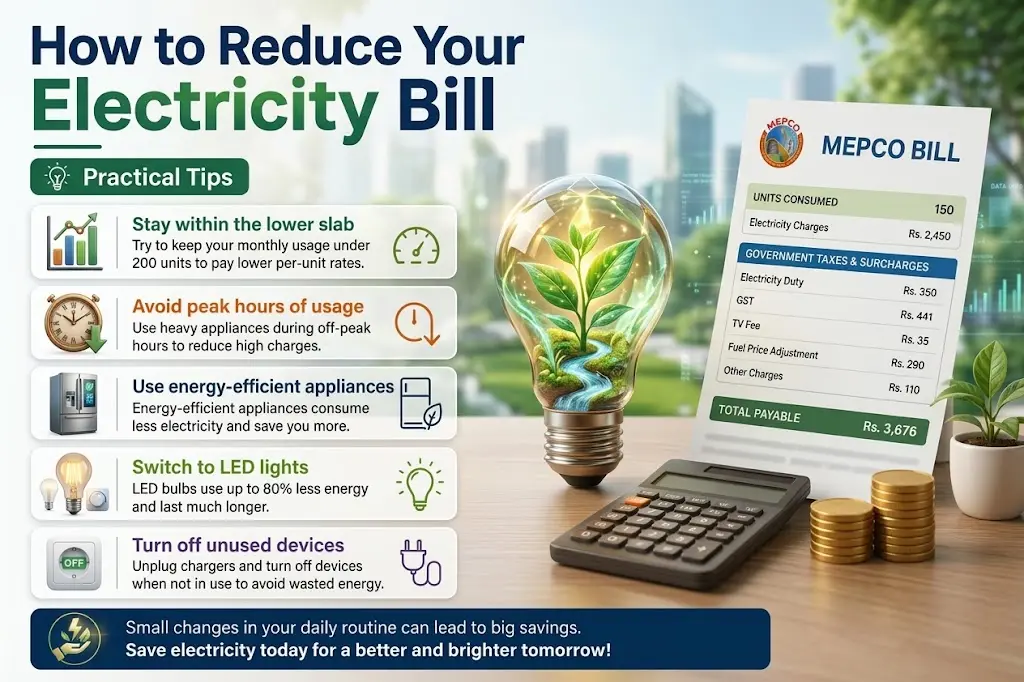
Is Using Less Than 200 Units Always Better?
Keeping consumption low can certainly help control electricity costs, but the tariff system is more complicated than simply saying that every consumer below 200 units receives the same rate.
The applicable category, protected status, previous consumption and other tariff conditions can matter.
Therefore, it is better to look at your actual tariff category and bill details rather than relying on a simple unit threshold.
Does Every MEPCO Consumer Pay the Same Per-Unit Rate?
No, the rate depends on the consumer category and applicable tariff structure.
A residential consumer, commercial consumer, industrial consumer, and agricultural consumer can all have different tariffs.
Even among residential consumers, protected, non-protected, lifeline, and ToU consumers can have different applicable charges.
Can MEPCO Tariff Rates Change During the Year?
Yes, electricity tariffs and adjustments can change because of government decisions, NEPRA determinations, fuel adjustments, quarterly adjustments, taxes, and other approved changes.
NEPRA’s 2026 records show several tariff-related decisions and notifications during the year, including periodic adjustments and MEPCO-specific tariff decisions.
Because of this, an article or tariff table published several months ago may not reflect every charge appearing on your latest bill.
MEPCO Tariff and Your Monthly Bill
It helps to think of your electricity bill as a combination of different components rather than one simple calculation.
A simplified view is:
Electricity Consumption + Applicable Fixed Charges + Taxes + Adjustments + Other Applicable Charges = Final Bill
The actual calculation can be more detailed because different tariff categories have different rules.
This is why using the number of units alone will not always produce an exact bill estimate.
Common MEPCO Tariff Misunderstandings
“Every unit has the same price.”
Not necessarily.
Residential electricity tariffs use different consumption categories, and the applicable rate depends on the consumer’s tariff category and status.
“My bill should equal units multiplied by the tariff.”
Not exactly.
The final bill can also include fixed charges, taxes, duties, adjustments, and other applicable charges.
“If I use fewer than 200 units, I automatically become a protected consumer.”
Not necessarily.
Protected status is determined according to the applicable tariff rules and consumer conditions. Simply looking at the current month’s units is not enough.
“FPA is a permanent extra tax.”
No.
Fuel-related adjustments are separate from ordinary electricity consumption charges and can vary according to the approved adjustment mechanism.
“ToU meters charge the same rate all day.”
No.
Time of Use tariffs distinguish between peak and off-peak periods.
How to Check Your MEPCO Bill Online
Checking your bill online is useful when you want to confirm your current charges, due date, units, or billing information without waiting for a paper copy.
You can visit MEPCCO-Bill.pk to access the site’s MEPCO bill-related resources.
Before estimating your bill, keep your reference number or consumer information available. Your bill details can help you understand:
- Units consumed
- Billing period
- Current charges
- Previous balance
- Due date
- Applicable tariff
- Taxes and adjustments
For official regulatory information about electricity tariffs, adjustments, and notifications, you can also refer to NEPRA.
Frequently Asked Questions – MEPCO Tariff
What is the MEPCO per-unit rate in 2026?
There is no single MEPCO per-unit rate for every consumer. The applicable rate depends on your tariff category, consumption slab, consumer status, connection type, and other applicable tariff conditions.
What is the MEPCO slab system?
The slab system divides residential electricity consumption into different unit ranges. Different rates and tariff treatments can apply to different ranges, depending on the consumer category.
What is a protected MEPCO consumer?
A protected consumer is a residential consumer who meets the applicable conditions under the protected tariff structure. Protected consumers can receive specific tariff benefits under the approved rules.
What is a non-protected MEPCO consumer?
A non-protected consumer is a residential consumer who does not fall under the protected category. The applicable tariff structure can therefore be different.A demand notice specifies the applicable charges that an applicant must pay during the connection process before the application can proceed to subsequent stages.
Why is my MEPCO bill higher than my unit charges?
Your final bill can be higher because it may include taxes, duties, fixed charges, fuel-related adjustments, quarterly adjustments, previous balances, and other applicable charges.
What is FPA on a MEPCO bill?
FPA refers to Fuel Price Adjustment. It reflects an approved adjustment related to changes in fuel costs and can increase or decrease applicable electricity charges.
Does MEPCO charge different rates during peak hours?
Consumers with Time of Use tariffs can have different peak and off-peak electricity rates. The exact rate depends on the applicable tariff schedule.
Can MEPCO tariff rates change?
Yes. Electricity tariffs and related adjustments can be revised or updated through the applicable regulatory and government process. It is therefore better to check the latest tariff notification when calculating a current bill.
Final Words
Understanding MEPCO tariff rates can make your electricity bill much easier to read.
The amount you pay is influenced by more than just the number of units shown on the meter. Your consumer category, protected or non-protected status, tariff slab, connection type, fixed charges, taxes, and approved adjustments can all affect the final amount.
For residential consumers, keeping monthly consumption under control is one of the easiest ways to manage electricity costs. Checking your units regularly, using energy-efficient appliances, reducing unnecessary usage, and making better use of off-peak hours where applicable can all help.
Most importantly, do not rely on an old tariff table when estimating your current bill. Electricity rates and adjustments can change, so always compare the information with the latest applicable tariff notification.
For MEPCO bill checking and related information, visit MEPCCO-Bill.pk. For official regulatory decisions and tariff notifications, refer to NEPRA.