
I’ve seen this particular billing problem cause more confusion than it deserves. A consumer pays a MEPCO bill, keeps the bank or wallet confirmation, and then the next time the bill is checked, there it is again: Unpaid
The first reaction is usually, “I already paid this.”
That reaction is understandable. But the word arrears on a bill does not, by itself, tell you that your payment disappeared. It tells you what the billing record is carrying as an unpaid amount at the time that bill was generated.
That difference matters.
MEPCO bills are connected with payment records maintained through the electricity billing and collection system. A payment made through a bank, mobile wallet, ATM, or another channel has to reach the relevant billing record and be posted correctly. Until that happens, the older amount can continue to appear in the account.
NEPRA’s Consumer Service Manual defines arrears as an unpaid amount of the bill, while the bill’s payable amount can include arrears from an earlier billing period.
So, if your payment was genuine but your new bill still shows arrears, don’t immediately pay the same amount a second time. Check what happened first.
1. The Payment and the Bill Do Not Always Update at the Same Moment
This is the part that gets missed most frequently.
You can receive a successful payment message from your bank or wallet before the payment has appeared in the billing record used to generate your next MEPCO bill. Those are two related systems, but the transaction still has to be processed and matched to the electricity account.
This becomes especially noticeable when a payment is made close to the billing date.
Imagine your previous bill was Rs. 8,500. You pay it through a banking app on the evening of the due date. The transaction is accepted and your bank shows the money as paid.
Then the next MEPCO bill is generated before the payment information has been fully posted to the billing record.
The new bill might still carry the Rs. 8,500 as arrears.
That doesn’t automatically mean you owe Rs. 17,000.
It means you need to establish whether the payment has been credited.
There is another detail worth understanding. NEPRA’s billing terminology separates the current amount from arrears and also identifies late payment surcharge as a separate charge associated with non-payment by the due date.
So the numbers on the bill should be read line by line rather than treating the final payable figure as proof that every component is a fresh charge.
What the different situations can look like
| What happened | What the next bill may show | What you should do |
|---|---|---|
| Payment posted before billing | No previous arrears | Normally nothing |
| Payment made shortly before bill generation | Previous amount may still appear | Check payment status and wait for posting if appropriate |
| Payment rejected or reversed | Previous amount remains | Confirm with the bank or wallet |
| Wrong reference number used | Your bill remains unpaid | Check the payment details immediately |
| Payment genuinely not received | Previous amount appears as arrears | Contact the payment channel and MEPCO |
| Payment credited but account still incorrect | Arrears may remain incorrectly | Keep receipt and request billing correction |
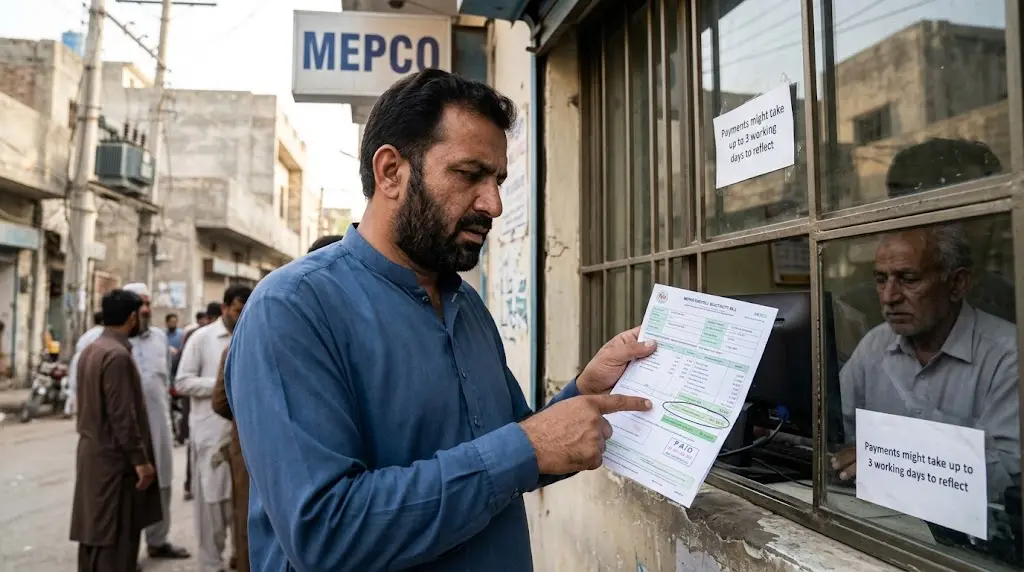
This is why the receipt matters more than a screenshot of a payment button saying “successful.” You want the actual transaction details, including the amount, date, payment channel and reference or transaction number.
2. Check the Reference Number Before Blaming the Billing System
A surprisingly simple mistake causes some of the hardest billing disputes.
The consumer enters the wrong reference number.
MEPCO accounts are tied to specific consumer billing identifiers. If you accidentally enter another customer’s reference number when paying, the payment may be processed successfully by the financial institution while your own electricity account remains unpaid.
The banking app doesn’t necessarily know that you intended to pay a different MEPCO account.
This is where people usually go wrong: they see a successful transaction and stop checking the details.
When I look at a disputed payment, the first things I would compare are:
- The 14-digit MEPCO reference number on the bill.
- The reference number entered during payment.
- The amount actually paid.
- The payment date and time.
- The transaction or receipt number.
- The payment channel used.
Do these six checks before making another payment.
And don’t ignore small differences. A single incorrect digit in a reference number is enough to send a payment somewhere other than the account you intended to clear.
The same principle applies when somebody else pays the bill for you. A family member might have several electricity bills saved in a banking app and select the wrong one. The payment confirmation will still look perfectly normal.
A quick payment check
Bill reference → Payment reference → Amount → Date → Transaction ID → Current bill status
If those details line up, you have much stronger evidence that the payment belongs to your account.
For consumers who regularly check bills online, the MEPCO bill checking service on mepco-bill.pk can also be useful for checking the latest billing record rather than relying only on an old paper bill.
3. Paying After the Due Date Creates Another Layer of Confusion
There is a difference between paying a bill late and paying a bill that was never paid.
That sounds obvious, but the two situations get mixed together all the time.
A bill paid after its due date can involve a late payment surcharge. NEPRA’s Consumer Service Manual specifically defines LPS as an amount imposed because the bill was not paid within the due date.
Now consider this sequence:
Previous bill: Rs. 6,000
Due date: August 20
Payment made: August 22
Next bill generated: before the payment was fully reflected
The next bill could still contain an amount related to the previous cycle, and there may also be an LPS component depending on the applicable billing treatment.
This is why simply looking at the word “arrears” isn’t enough.
You need to ask a more precise question: What exactly is included in the arrears amount?
If the arrears figure is exactly the previous bill amount, compare it with your receipt.
If it differs, look for LPS, adjustments, installments, deferred amounts or another billing component.
The timing of the payment matters too. NEPRA’s manual says the due date for bills is generally within 15 days from the issue date, while consumers are advised to follow the payment instructions printed on their bills.
For that reason, I wouldn’t use an online payment confirmation alone to decide that the new bill is wrong. I would compare the dates first.
A simple timeline
Bill issued → Due date approaches → Payment made → Payment processed → Payment posted → Next bill generated
The closer your payment is to the last two events, the more carefully you should check the account.
4. The Payment Went Through, But the Arrears Still Look Wrong
Sometimes the problem is not that the payment failed.
The problem is that the billing record hasn’t been corrected.
This is where keeping evidence becomes very useful.
Suppose you paid Rs. 12,400. Your bank shows the transaction as completed. You have the receipt. Your reference number matches. Yet the next MEPCO bill still carries Rs. 12,400 under arrears.
Don’t throw away the receipt and don’t immediately assume that you have to pay Rs. 12,400 again.
Start with the payment channel.
If you paid through a bank, confirm that the transaction was completed rather than merely initiated. If you used a mobile wallet, check whether the transaction was successful and not later reversed. If you paid through an agent or physical counter, keep the stamped receipt.
Then compare the payment with the MEPCO billing record.
This is also where a complaint becomes useful if the discrepancy doesn’t clear.
MEPCO-related complaints can involve billing problems, and NEPRA operates a complaint management system for consumer disputes. NEPRA describes its Consumer Service Manual as applicable to consumers served by distribution companies.
MEPCO’s billing issues are not always simple enough to solve by making another payment. A duplicate payment can create another problem that then has to be sorted out.
For a broader look at the support process, the site’s guide to MEPCO helpline and complaint contacts is worth keeping with your billing records.
What to keep when disputing an arrears amount
Keep these together:
- The bill showing the arrears.
- The previous bill that you paid.
- Payment receipt or transaction confirmation.
- Bank or wallet transaction ID.
- The MEPCO reference number.
- Date and time of payment.
- Any complaint reference number you receive.
It sounds like paperwork for a problem that should be simple. Unfortunately, once a billing dispute reaches a human being, these details are what make the case much easier to verify.
5. Not Every Amount Called Arrears Is the Same Kind of Problem
There is a tendency to see one number on the bill and assume it represents a single unpaid monthly bill.
That isn’t always a safe assumption.
NEPRA’s billing terminology distinguishes arrears from other billing items such as deferred amounts, installments and late payment surcharge.
That means you should inspect the surrounding entries on the bill.
A previous unpaid amount might be carried forward. An installment arrangement can create another amount that appears as part of what is payable. A late payment surcharge can increase the amount associated with an overdue bill.
There are also cases where an adjustment enters the account later.
This is particularly relevant for consumers who have unusual billing histories, such as disputed meter readings, detection-related charges, installments or previously deferred bills.
For example, NEPRA records include MEPCO consumer cases where disputed billing amounts and detection charges appeared as arrears and were later the subject of complaints and review.
That doesn’t mean every arrears entry is an error. It means the label needs to be read in context.
And this is where I would slightly reframe the whole issue: the question isn’t “Why did MEPCO charge me again?” The better question is “What transaction or billing amount is this arrears figure referring to?”
That small change in approach usually makes the investigation much clearer.
A practical way to read the bill
| Check | What you are trying to establish |
|---|---|
| Arrears amount | Which earlier amount is being carried forward? |
| Current bill | What are you being charged for this billing cycle? |
| LPS | Was a late-payment amount added? |
| Billing history | Does the earlier bill show as paid or unpaid? |
| Payment receipt | Was your payment actually completed? |
| Reference number | Did the payment go to the correct account? |
| Adjustments/installments | Is there another reason for the balance? |
You don’t need to understand every technical billing code to do this. You just need to match the numbers.
6. What I Would Do Before Paying the Arrears Again
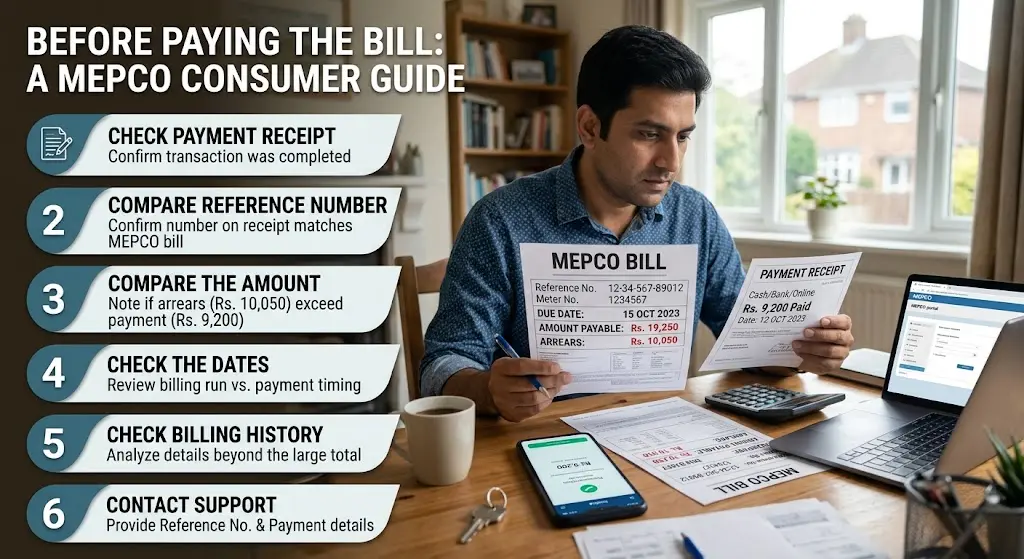
If I were sitting with a MEPCO bill showing arrears after a payment, I would handle it in this order.
First, check the payment receipt.
Confirm the transaction was completed, not merely submitted.
Second, compare the reference number.
Make sure the number on the payment record is the same as the number on your MEPCO bill.
Third, compare the amount.
If you paid Rs. 9,200 and the bill shows Rs. 9,200 in arrears, that’s a useful clue. If it shows Rs. 10,050, find out where the extra Rs. 850 came from.
Fourth, check the dates.
A payment made very close to the due date or close to the next billing run deserves closer attention.
Fifth, check the billing history.
Don’t rely only on the large total printed near the bottom.
Sixth, contact the relevant support channel if the discrepancy remains.
Give them the reference number and payment transaction details instead of simply saying, “My bill is wrong.”
That last part saves time.
A support representative needs something they can trace.
If your issue concerns another billing feature, such as self meter reading or newer digital metering, the MEPCO Smart AMI meter guide provides useful background on how newer meter technology is being introduced in selected areas.
The technology changes, but the basic consumer habit doesn’t: keep your billing record and payment evidence.
7. When You Should Treat the Arrears as a Real Outstanding Amount
Not every arrears entry is a temporary posting issue.
Sometimes the bill really wasn’t paid.
The bank transaction could have failed. A wallet payment could have been reversed. The wrong reference number could have been used. A physical payment might not have been completed correctly.
There are also situations where a previous amount genuinely remains outstanding.
NEPRA’s Consumer Service Manual defines arrears simply as an unpaid amount, and its billing provisions account for arrears when calculating the amount payable on a bill.
So don’t use the fact that you remember “making a payment” as the only evidence.
A successful payment should be supported by a completed transaction record.
This distinction becomes more serious when arrears continue from one bill to another. A consumer shouldn’t ignore a growing balance while assuming that the system will eventually correct itself.
If the amount remains after a reasonable opportunity for the payment to be posted, investigate it.
If there is a genuine dispute, keep the records and register a complaint rather than repeatedly paying the same amount without checking where the earlier payment went.
That is especially important if the bill carries a disconnection warning.
8. The Part Most People Miss: Your Receipt Is Evidence
I keep coming back to this because it matters.
A payment receipt isn’t just proof that money left your bank account. In a billing dispute, it helps establish exactly what payment was made, for which account, through which channel and when.
A screenshot saying “Payment Successful” is useful, but a complete transaction record is better.
Keep the original receipt whenever possible.
This also applies to older bills. If you have a habit of deleting payment notifications after a few weeks, change that habit. Electricity bills are recurring transactions, and an issue that looks insignificant today can become difficult to reconstruct several billing cycles later.
The MEPCO information published through mepco-bill.pk is intended to make these billing questions easier to understand, but the actual payment record still matters when an account needs to be corrected.
One side thought here: this is one reason I prefer checking the actual figures instead of relying on a verbal assurance that “the bill was paid.” Numbers leave a trail. A vague memory doesn’t.
And if the figures don’t match, stop and find the missing piece before paying again.
The short version
Paid + correctly matched + properly posted = previous bill should no longer remain as an unpaid balance.
Paid but not yet posted = temporary arrears may appear.
Paid to the wrong reference = your account can still show arrears.
Payment failed or was reversed = arrears are genuine.
Arrears contain another billing component = inspect the bill before assuming it is a duplicate charge.
That distinction is much more useful than simply asking whether MEPCO “received” the payment.
FAQs
Why does my MEPCO bill show arrears when I paid the previous bill?
The payment may not have been posted to the billing record when the new bill was generated. It can also happen if the wrong reference number was used or the payment was reversed. Check the receipt, reference number, amount and payment date before paying again.
How long should I wait after paying before checking my MEPCO bill?
There isn’t one universal posting time that applies to every payment channel and every situation. If the payment was made close to the billing date, allow time for the transaction to be processed, then check the account again. If the arrears remain, use your transaction record to investigate the discrepancy.
What if I paid the exact amount shown as arrears?
Don’t automatically pay it twice. First compare the payment receipt with the MEPCO reference number and check whether the payment has been credited to the account.
Can a late payment surcharge appear even after I have paid?
Yes, the timing of the payment matters. NEPRA defines the late payment surcharge as an amount associated with non-payment within the due date, so a payment made after the due date can have consequences beyond the original bill amount.
What should I do if MEPCO keeps showing the same paid amount as arrears?
Keep the original bill, payment receipt, transaction ID and reference number. If the payment remains unmatched, contact the relevant MEPCO support channel or register a billing complaint with the supporting evidence rather than repeatedly paying the same disputed amount.
A recurring arrears entry is worth investigating, especially when you have clear proof that the payment was completed. The goal is not simply to make the number disappear from one bill. It is to make sure the payment is correctly attached to the right electricity account.
For another practical billing issue, you can also read the guide on MEPCO bill format and its six main sections to see where the major billing figures appear.

Pingback: Is MEPCO Net Metering Still Worth It in 2026? – MEPCO Bill Check 2026
Pingback: Why Does Your MEPCO Smart Meter Reading Look Wrong? – MEPCO Bill Check 2026