
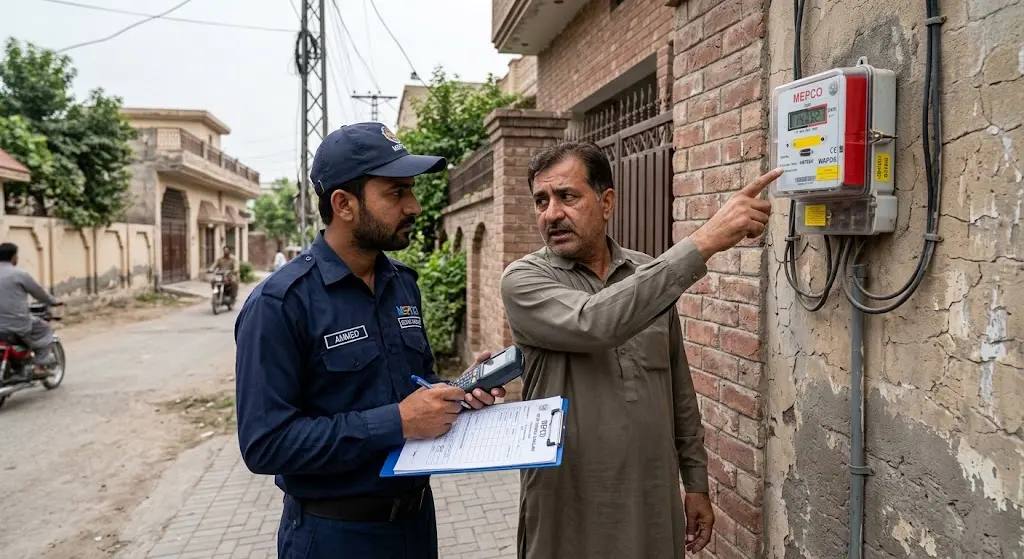
The easiest way to spot a bad MEPCO bill is sometimes standing right outside your house.
Look at the meter.
Then look at the reading printed on the bill.
I’ve found that this simple comparison tells you more than staring at the final payable amount. A bill might look unusually high because of several different charges, but when the actual meter reading is higher or lower than the reading recorded on the bill, you have a much more specific problem to investigate.
MEPCO’s own meter-reading procedure says readings are taken routinely each month, with the date, meter reading, units consumed and any discrepancy recorded. The procedure also says readings are preferably taken in the presence of the customer or an authorized representative.
So if the number on your bill doesn’t match what is physically showing on your meter, don’t simply assume the higher bill is correct.
Start with the numbers.
1. Check the Reading Before You Challenge the Bill
The first mistake people make is comparing the total bill amount instead of comparing the meter readings.
Suppose your previous bill showed a reading of 18,450 and the current bill shows a present reading of 18,780. That means the billed consumption is based on 330 units.
But if you stand at the meter and see 18,590, something needs checking.
The bill is using a reading that is 190 units above the physical meter reading.
That doesn’t automatically prove someone made an error. There could be a timing issue, a reading-date difference, a meter replacement, or another billing adjustment involved. But it gives you a concrete reason to investigate rather than simply arguing that the bill “looks too high.”
MEPCO’s published meter-reading procedure specifically records the reading date, meter reading and units consumed. That is why those details deserve your attention when checking a disputed bill.
The quick comparison I use
| What to compare | What you are checking |
|---|---|
| Previous reading | Starting point for the billing period |
| Present reading | Reading used for the current bill |
| Actual meter reading | Number currently displayed on your meter |
| Reading date | Whether the physical and billed readings relate to the same period |
| Units consumed | Difference between readings |
| Meter photo | Evidence of the physical reading |
Take a clear photograph of the meter display when you discover the problem.
Make sure the reading is visible. If possible, include enough of the meter in the photograph to make it clear which meter the photograph belongs to.
And keep the bill.
It sounds obvious, but people throw away the old bill, take a blurry photograph three weeks later, then try to reconstruct what happened. That makes a simple billing dispute much harder to explain.
2. Work Out Whether the Error Is Actually in the Reading
There are several situations that look like a wrong meter reading but aren’t necessarily the same problem.
The most straightforward case is a wrong present reading.
For example:
- Previous bill: 25,600
- Present reading on bill: 26,100
- Actual meter reading: 25,720
The bill appears to be based on 500 units, while the meter shows only 120 units above the previous reading.
That is a significant difference.
Another situation is a reading-date problem. MEPCO’s meter-reading system operates around billing cycles, and readings are scheduled according to batches. The official procedure says meters in a batch are normally read on the same dates each month.
This matters because the date printed on the bill and the date you personally check the meter aren’t necessarily the same thing.
A meter that reads 25,720 today could legitimately have shown 25,600 when the meter reader visited.
That’s why a photograph taken immediately after receiving the bill is useful, but it doesn’t by itself prove what the meter showed on the official reading date.
This is where people usually go wrong.
They see today’s meter reading, subtract the previous bill reading and assume the difference must be the exact number MEPCO should have billed. That’s not always enough. The billing date, official reading date and current physical reading all need to be considered together.
A simple example
Imagine your bill says:
Previous reading: 10,000
Present reading: 10,450
Units billed: 450
You check the meter after receiving the bill and it reads:
10,520
That does not mean the bill is wrong. The meter has already moved beyond the billed reading because electricity was consumed after the official reading.
But if the bill says 10,700 while your meter shows 10,520, you have a stronger reason to request verification.
That distinction saves a lot of unnecessary arguments.
3. Take Evidence Before Asking MEPCO to Correct It
Once you think the reading is wrong, don’t immediately start with a complaint saying, “My bill is fake.”
Be specific.
A useful complaint explains exactly what differs.
For example:
“The present reading printed on my bill is 10,700, while the meter currently shows 10,520. Please verify the meter reading and billing record.”
That’s much easier for an officer to understand than:
“My bill is too high. Please fix it.”
I would keep these items together:
- Current MEPCO bill
- Previous bill
- Clear photograph of the meter
- Meter number, if visible
- Date the photograph was taken
- Your reference number
- Any previous complaint number
- Payment records if the disputed amount has already been paid
MEPCO has previously described accurate billing as an objective supported by meter-reading technology such as Hand Held Units and AMR/Smart Meter systems.
That also means consumers should take advantage of the information already available to them rather than relying entirely on memory.
The MEPCO Bill Check service can be useful for retrieving a current bill so you can compare the printed reading and units with your physical meter.
The same comparison becomes especially useful if you don’t have your paper copy anymore.
One small side point
If you have solar or another setup that makes your electricity consumption unusually low, don’t assume every high bill is caused by the meter reader.
There are other components on an electricity bill, including adjustments and taxes. A wrong-looking total and a wrong meter reading are two different complaints.
Check the reading first.
Then investigate the rest.
4. Ask for Verification Through the Proper Channel
Once you’ve documented the discrepancy, contact MEPCO and request verification.
For a straightforward reading dispute, explain:
- Your reference number
- Billing month
- Reading shown on the bill
- Reading visible on the meter
- Difference between the two
- Date of your photograph
- Request for meter and billing verification
MEPCO’s customer-service information lists 0800-63726 as a customer service contact, while its official materials also describe complaint centers and online complaint facilities.
For a disputed bill, the local subdivision office can also matter because that is where the connection and field-level records are handled.
The important part is getting a complaint reference or other record of your request.
Don’t rely on a conversation at a counter that leaves you with nothing in writing.
If the issue isn’t resolved through the distribution company, the NEPRA Consumer Affairs process provides a further route for consumer complaints. NEPRA’s complaint system states that a consumer should first make a representation to the concerned officers of the distribution company, and it asks for details including the reference or consumer number and complaint information.
NEPRA also publishes decisions involving MEPCO consumer complaints, including recent cases concerning detection bills and other billing disputes.
That is worth knowing because a billing disagreement does not necessarily end at the first complaint desk.
What to say in your complaint
Keep it factual.
Mention the numbers.
Don’t exaggerate the situation or accuse an individual employee of deliberately changing your reading unless you have evidence for that claim.
A simple statement such as:
“The present reading on my bill does not correspond with the meter reading observed at my premises. I request verification of the reading and correction of the bill if an error is confirmed.”
is much stronger.
5. What Happens If the Meter Itself Is Faulty?
A wrong bill and a faulty meter are related, but they aren’t identical problems.
If the physical meter is malfunctioning, damaged, stuck, displaying unusual readings or showing another technical problem, tell MEPCO that you suspect a meter fault.
Don’t open the meter.
Don’t remove a seal.
Don’t ask an electrician to interfere with the meter wiring.
And definitely don’t try to “fix” the meter yourself.
MEPCO’s published material says meter readers are also expected to check irregularities or discrepancies in the metering system and report them for corrective action.
If a meter requires official testing or replacement, that process should be handled through the electricity distribution company.
This is another place where consumers sometimes make the situation worse. Someone sees a meter behaving strangely, calls a local electrician, and the meter or its wiring is disturbed before MEPCO inspects it.
Now the original billing problem is mixed with a metering issue.
Leave the equipment alone and report the fault.
6. Don’t Confuse a Wrong Reading With a Detection Bill
This distinction matters.
A normal billing dispute concerns the accuracy of the electricity consumption recorded for your billing period.
A detection bill is a different matter.
MEPCO describes detection bills as being associated with inspection findings involving issues such as unrecorded consumption, meter tampering, unauthorized connections or other irregularities. The assessment can involve the inspection report and estimated consumption.
So if your bill has suddenly increased because the present reading is wrong, don’t automatically call it a detection bill.
Likewise, if you have received an actual detection bill, don’t treat it as though it were simply a normal monthly reading correction.
The complaint and verification process may be different.
For readers dealing specifically with a detection bill, the MEPCO detection bill guide explains the distinction and the documents that are useful when requesting a review.
That separation is important because the wrong complaint category can waste time.
7. If Your Bill Has Already Been Paid, Keep the Evidence
Paying a disputed bill doesn’t erase the underlying issue.
If you paid because the due date was close, retain the payment receipt or digital confirmation along with the disputed bill and your photographs.
Make a simple folder on your phone.
Something like:
MEPCO September 2026 dispute
Inside it, keep:
- Bill PDF or photograph
- Meter photograph
- Previous bill
- Payment receipt
- Complaint screenshot
- Complaint reference
- Any response from MEPCO
This is boring administrative work, but it becomes extremely useful if the issue continues into another billing cycle.
The MEPCO informational resources I maintain on mepco-bill.pk are designed around the same basic idea: consumers should be able to check the bill, compare the numbers and understand what they are actually being charged for before taking the next step.
If your problem turns out to be something other than the reading itself, the MEPCO Bill Payment Methods guide also explains the available payment channels and the importance of keeping payment records.
8. A Better Habit for the Next Billing Cycle
You don’t need to photograph your meter every hour.
Once a month is enough for most households.
Take a clear picture around the expected reading period. Keep the date in your phone’s photo information, or simply add the date to the filename.
For example:
MEPCO-meter-04-Sep-2026
Next month, do it again.
After a few months, you’ll have your own small consumption record. You’ll know roughly how quickly the meter moves, and you’ll notice an unusual bill much earlier.
MEPCO’s published procedures already recognize the importance of recording meter readings and discrepancies.
There is also a newer approach worth knowing about. The Apna Meter Apni Reading MEPCO guide explains the self-reading process associated with PITC’s Power Smart system, including submission around the reading date printed on the bill.
That doesn’t mean you should assume every consumer’s bill will use a self-submitted reading, but it gives consumers another way to understand how meter-reading information can enter the billing process.
And honestly, keeping your own record is still useful even when the system is working properly.
9. The Mistakes That Make a Billing Dispute Harder
I’ve seen the same basic mistakes repeated in electricity billing complaints.
The first is waiting too long.
A person receives the bill, notices something strange, leaves it on the table, then checks the meter several weeks later. By that time, the physical reading has changed substantially.
The second is taking a photograph with no readable number.
A dark picture of a meter behind glass isn’t much help.
The third is throwing away previous bills.
Without the previous reading, it’s harder to establish how many units were added during the disputed period.
The fourth is focusing only on the payable amount.
A high amount isn’t proof of a high meter reading. Taxes, adjustments, previous arrears and other charges can change the final figure.
And then there is the accusation problem.
Calling someone dishonest before the actual discrepancy has been checked doesn’t strengthen a complaint. Numbers do.
If the bill says 21,840 and the meter says 21,420, write those numbers down. That’s useful. “They are overcharging me again” is much harder to investigate.
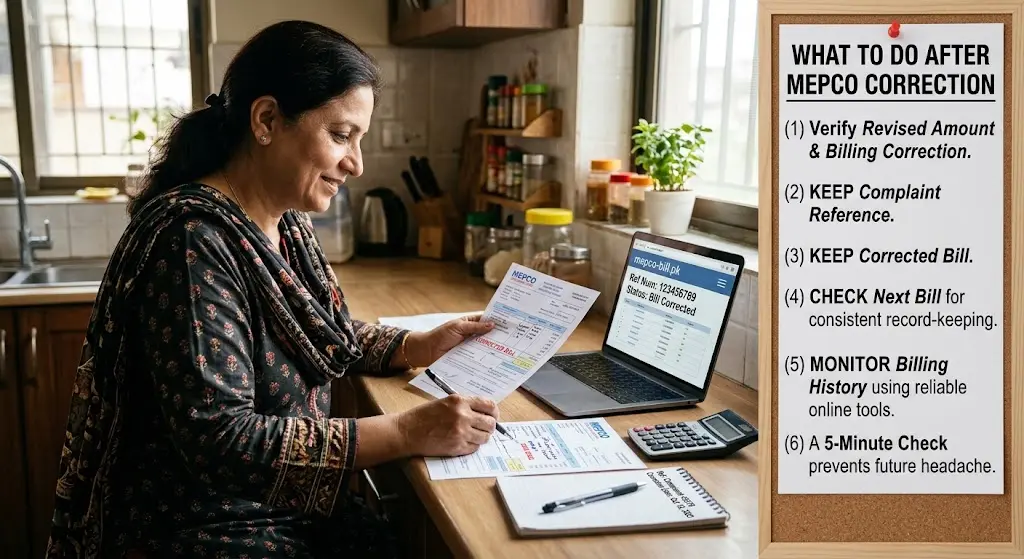
10. What to Do When MEPCO Confirms the Reading Is Wrong
If verification establishes that the billed reading was incorrect, ask what correction will be made to the billing record and how the revised amount will be reflected.
Keep the complaint reference.
Keep the corrected bill.
Then check the next bill as well.
I would not stop checking after seeing one corrected statement. A billing record is a chain, and an error that isn’t properly reflected in the next cycle can create another headache.
For consumers who regularly monitor their accounts, checking the latest statement through a reliable MEPCO bill-checking service and comparing the reading history is a sensible routine. The current MEPCO bill checker at mepco-bill.pk provides access to bill information using the reference number or consumer ID.
The goal isn’t to become an expert in electricity billing.
It’s simply to know your own numbers.
A five-minute check can reveal a discrepancy before it turns into a much larger argument.
FAQs
What should I do if my MEPCO bill reading is higher than my meter?
Take a clear photograph of the meter showing the current reading and compare it with the present reading printed on your bill. Keep the current and previous bills, then request MEPCO to verify the reading and billing record.
Can a meter reading be wrong even if the bill amount looks normal?
Yes. A reading error doesn’t always produce an obviously unusual bill, especially if the difference is small. Comparing the previous reading, present reading and physical meter reading is more useful than judging the bill by its total amount alone.
Should I take a picture of my MEPCO meter?
Yes, particularly around the expected reading date or as soon as you notice a discrepancy. A clear, dated photograph gives you a record of what the meter displayed when you checked it.
What if MEPCO does not correct the wrong reading?
Keep your complaint reference and supporting documents and follow up through the appropriate MEPCO complaint channel. If the matter is not resolved after approaching the concerned distribution company officers, NEPRA’s Consumer Affairs complaint process provides a further avenue for eligible consumer disputes.
Is a wrong meter reading the same as a detection bill?
No. A routine billing-reading dispute concerns the consumption recorded for the billing period. A detection bill relates to an inspection and assessment involving an alleged irregularity or unrecorded consumption, so it should be handled as a separate matter.
A wrong MEPCO meter reading is much easier to deal with when you catch it early. Check the physical number, compare it with the bill, save the evidence and put the complaint in writing. After that, let the official verification process determine what actually went wrong.
For another useful reference on MEPCO billing, you can also review the MEPCO Bill Format guide to understand where the reading and other billing information appears on the statement.

Pingback: How MEPCO Smart Meters Track Electricity Every 15 Minutes – MEPCO Bill Check 2026
Pingback: MEPCCO-Bill.pk Explains the Real Cost of Going Solar – MEPCO Bill Check 2026
Pingback: What Happens to Your MEPCO Bill After Solar Export? – MEPCO Bill Check 2026
Pingback: Why Does Your MEPCO Smart Meter Reading Look Wrong? – MEPCO Bill Check 2026
Pingback: 3 Mistakes MEPCO Solar Applicants Often Make – MEPCO Bill Check 2026
Pingback: Why Is My MEPCO Bill Marked Estimated? – MEPCO Bill Check 2026