The first time a large amount appears on a MEPCO bill, the instinct is usually the same: check the units, check the meter, check the due date, and then wonder where that extra figure came from.
The confusion gets worse when the bill contains a detection charge. A regular electricity bill and a detection bill are not simply two versions of the same thing. They serve different purposes, and the way the amount is calculated is different too.
I spend a lot of time simplifying MEPCO billing information for consumers, and this is one area where a little terminology makes a big difference. A person who understands what the bill is actually showing is in a much better position to spot an incorrect assessment and ask the right questions.
MEPCO itself describes detection billing as relating to matters such as illegal abstraction or consumption of electricity, direct hooking, and meter slowness.
So, what changes when a normal monthly bill becomes a detection bill?
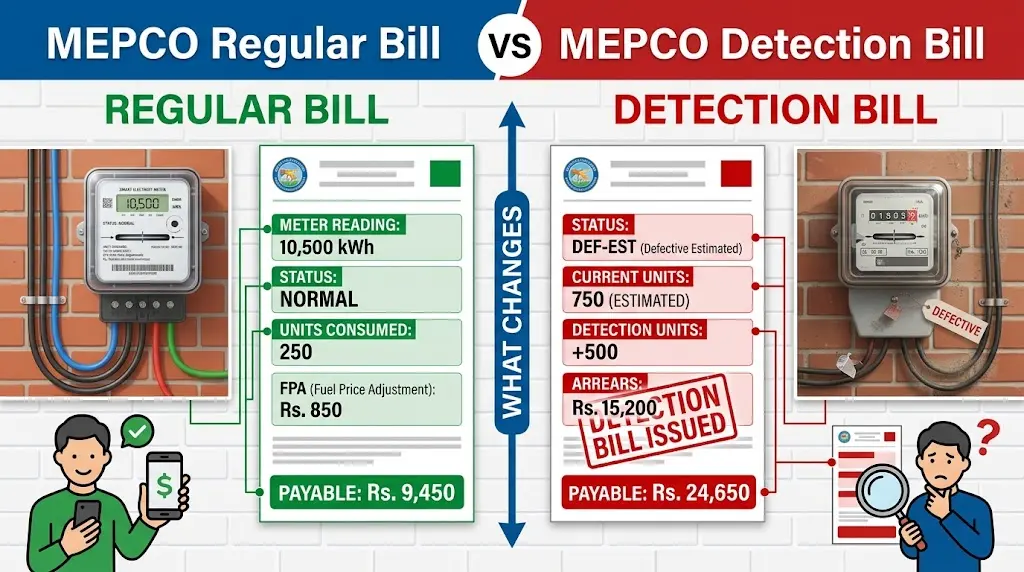
1. A regular bill records current consumption. A detection bill deals with an assessment
A regular electricity bill is primarily based on the electricity consumption recorded during the applicable billing period. Your meter reading produces the units, and those units are then processed under the applicable tariff, taxes, adjustments, and other charges.
A detection bill works differently.
It is an assessment intended to recover electricity that the distribution company believes was consumed but was not properly recorded or billed. The Ministry of Energy describes a detection bill as an assessment charged because of less billing arising from technical or administrative grounds.
MEPCO’s own published detection policy also describes a formal process involving approval, service of the detection bill, and the reasons and details being supplied to the consumer.
That distinction matters because you shouldn’t look at a detection bill as though it were simply this month’s electricity bill with a few extra rupees added.
Here is the practical difference:
| Point | Regular Electricity Bill | Detection Bill |
|---|---|---|
| Main purpose | Charge for billed electricity consumption | Recover assessed unbilled consumption or loss |
| Main basis | Metered consumption and applicable tariff | Prescribed assessment method |
| Period | Normal billing cycle | A defined previous period under applicable rules |
| Why it appears | Ordinary monthly billing | Detection of a billing/metering issue or unauthorized use |
| Calculation | Meter reading, tariff, taxes and adjustments | Consumption history, other permitted evidence, or load-based assessment depending on the case |
| Dispute | Billing or meter-reading complaint | Specific challenge to the detection assessment and supporting evidence |
This is why the first question should not be, “Why is my electricity rate so high?”
The better question is, “What exactly has MEPCO assessed, for what period, and on what evidence?”
That takes you to the real issue.
2. The calculation is where the biggest difference appears
A normal bill starts with actual recorded consumption. A detection assessment can involve a reconstruction of consumption for a period when the company believes electricity was being used without being fully recorded.
The Consumer Service Manual is particularly important here. NEPRA’s current legal resources list the revised Consumer Service Manual issued on November 26, 2025, after earlier amendments and clarifications.
Under the detection-bill provisions discussed in NEPRA decisions, the assessment is made according to a prescribed order rather than simply allowing the distribution company to choose any figure it wants.
For registered consumers, NEPRA decisions have referred to this order:
- Previous consumption or billing history.
- Future undisputed consumption where reliable previous consumption is unavailable.
- Load-based calculation where the relevant consumption history is not available.
The load-based formula referenced in the CSM is:
Detection units = Load × Load Factor × 730 × Months
Here, load refers to the connected or sanctioned load, whichever is higher, while the applicable load factor and assessment period are also relevant.
There is an important detail here that gets missed surprisingly easily.
A detection bill is not supposed to ignore units that were already charged through ordinary billing for the same period. The applicable rules provide for adjustment of consumption already billed.
So if you receive an assessment covering several months, don’t look only at the final rupee amount. Look at:
- the detection period
- total assessed units
- the method used to calculate those units
- your actual billing history
- the load used in the calculation
- units already billed during the disputed period
- any inspection or checking evidence
That paper trail tells you much more than the headline amount.
Where people usually go wrong
A common mistake is to compare a detection bill with the previous month’s normal bill and conclude that the company has simply “increased the tariff.”
That isn’t necessarily what happened.
The number of assessed units itself could be the major reason for the jump. A detection assessment can cover consumption attributed to an earlier period, so comparing it only with one ordinary monthly bill gives you the wrong picture.
This is also why keeping old bills matters. The [MEPCO Bill History page]MEPCO Bill History can help you review earlier months, units, billed amounts, and recorded payments. The site’s bill-history guidance specifically recommends comparing several months rather than treating one unusual figure in isolation.
3. A detection bill does not automatically prove that every amount charged is correct
This is probably the most important point for consumers.
Seeing the word “DETECTION” on a bill does not mean you should assume the calculation is automatically beyond question.
NEPRA’s published MEPCO decisions show that detection bills have been withdrawn or revised where the required basis or evidence was not adequately established.
One October 2024 MEPCO case is particularly useful because NEPRA examined the consumer’s consumption history and the evidence submitted by MEPCO. The decision noted the absence of concrete photo or video evidence supporting the alleged theft and directed MEPCO to withdraw the detection bill.
That does not mean every detection bill is wrong. It means the assessment has to stand on the applicable procedure and evidence.
In another MEPCO case listed by NEPRA in 2025, the regulator considered a detection assessment based on 49,150 units over six months and examined the applicable calculation method and the consumer’s billing history.
This gives us a useful way to read a disputed bill.
| What to check | Why it matters |
|---|---|
| Inspection/checking report | Establishes what was allegedly found |
| Detection period | Shows how far back the assessment goes |
| Consumption history | May be relevant to calculating assessed units |
| Connected/sanctioned load | Important where load-based calculation is used |
| Photos/videos or other evidence | Particularly relevant in alleged theft cases |
| Units already billed | Helps identify possible double charging |
| Approval and service details | Part of the prescribed detection process |
MEPCO’s published detection policy says that after approval by the competent authority, the Revenue Officer serves the detection or assessment bill with its details and reasons. It also describes the detection assessment as being issued separately before being reflected as arrears in subsequent billing.
That is very different from an ordinary bill simply being generated at the end of the monthly reading cycle.
4. What actually changes on your bill?
Suppose your normal monthly bill shows:
Current consumption: 280 units
Energy charges: calculated according to your applicable tariff
Taxes and adjustments: added according to the relevant billing rules
Total: your ordinary monthly payable amount
Now imagine MEPCO identifies a suspected metering or electricity-use issue covering an earlier period.
The detection assessment might then contain an additional number of units attributed to that earlier period.
The practical effect can be substantial because you are no longer looking at only the current month’s recorded consumption.
You might see:
Current monthly consumption: 280 units
Detection assessment: additional assessed units
Arrears/previous balance: possibly reflecting the detection amount after it is carried into subsequent billing
Taxes, surcharges or other applicable components: depending on the billing treatment
Total payable: considerably higher than a normal month
This is why a consumer should separate the bill into two questions:
What do I owe for this month’s electricity?
and
What amount is being recovered because of the detection assessment?
Those are related, but they are not the same calculation.
If you are trying to understand your ordinary monthly bill first, the MEPCO Bill Calculator can be useful for estimating ordinary consumption-based charges. The site’s own warning is worth remembering, though: an estimate is not the same thing as the actual official statement.
For a detection dispute, the calculator is not a substitute for the assessment sheet.
The assessment itself needs to be examined.
5. What should you do after receiving a detection bill?
Don’t start by arguing about the total amount.
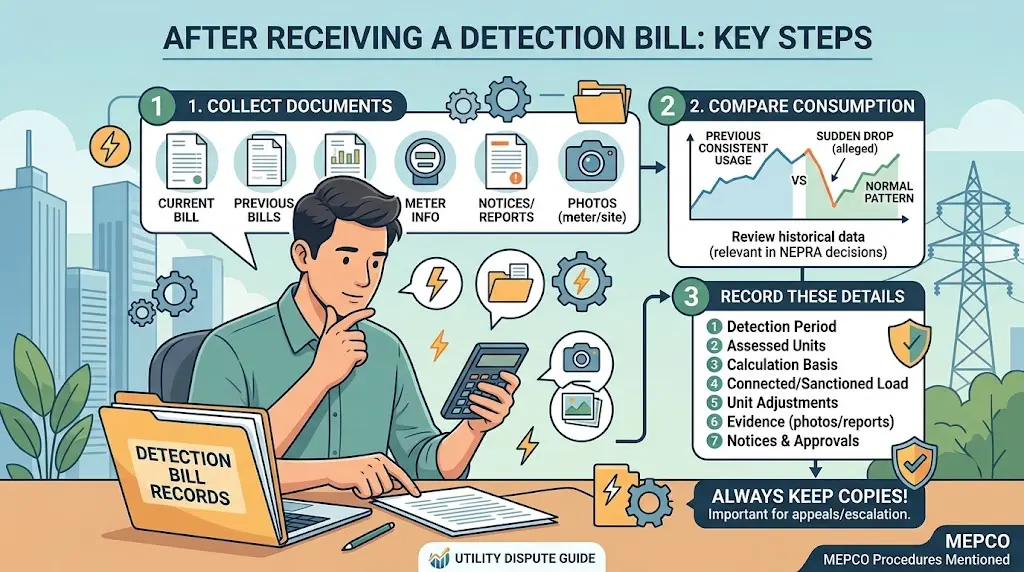
Start by collecting the documents.
Keep the current bill, previous bills, your meter information, and any notice or checking report you were given. If the issue concerns an alleged physical condition at the meter or connection, photographs of the meter and surrounding installation are also useful records.
Then compare your consumption history.
A sudden drop in recorded consumption can be relevant, but so can a normal or healthy consumption pattern. NEPRA decisions have specifically considered historical consumption when reviewing whether a detection assessment was supported.
Write down the following:
1. Detection period:
Which months are included?
2. Assessed units:
How many units have been added?
3. Calculation basis:
Was the assessment based on previous consumption, future consumption, load, or another prescribed method?
4. Load:
What connected or sanctioned load was used?
5. Existing billing:
Were units already charged during the same period adjusted?
6. Evidence:
What inspection findings, photographs, videos, reports, or other material support the assessment?
7. Notice and approval:
What documentation accompanied the detection bill?
And keep copies of everything you submit.
This sounds basic, but it becomes important if the matter moves beyond the local office.
MEPCO’s own procedures page lists a Detection Policy among its published customer procedures and provides the company’s customer-service contact information.
6. A detection bill and a meter-reading error are not the same complaint
Another source of confusion is treating every unusually high bill as a detection bill.
A wrong meter reading is a different problem.
Suppose your meter display shows 18,450 units but the bill records 19,450. That’s primarily a meter-reading or billing-data issue.
You don’t need to start by discussing electricity theft or a load-based detection assessment. You need to establish what the actual meter reading was and ask for correction.
The same applies when the tariff category is wrong or a particular billing adjustment appears unexpectedly.
The website’s current guidance recommends keeping a clear photograph of the physical meter display when submitting a meter-reading complaint, then using the official complaint-management process where appropriate.
A detection dispute is more specific.
It concerns an assessment that the company says is justified because of a detected discrepancy, unauthorized use, meter issue, or another qualifying circumstance.
That distinction saves time. If you take the wrong complaint to the wrong desk, you can spend days explaining something that isn’t actually the problem.
7. The safest way to read the difference
I use a simple test when explaining MEPCO billing issues:
Regular bill = What the meter recorded for the current billing cycle.
Detection bill = What the distribution company says should be recovered for consumption or loss that was not properly captured or billed, based on the applicable detection procedure.
That doesn’t mean a regular bill is never corrected or that a detection bill is always wrong.
It simply tells you what evidence you should be looking for.
For a regular bill, concentrate on the meter reading, units, tariff category, taxes, adjustments, and payment status.
For a detection bill, add another layer: the inspection, assessment period, calculation method, load, consumption history, evidence, and procedural documentation.
That is the part many consumers miss.
And if the amount looks impossible, don’t rely only on the total displayed on the bill. Work backward from the units and the period. A large amount becomes much easier to understand once you know exactly how many units were assessed and why.
A quick reference to keep
REGULAR BILL
Meter reading
      ↓
Current-period units
      ↓
Applicable tariff
      ↓
Taxes / adjustments / other charges
      ↓
Monthly payable amount


DETECTION BILL
Inspection / identified discrepancy
      ↓
Assessment period
      ↓
Permitted calculation method
      ↓
Detection units
      ↓
Applicable billing treatment
      ↓
Detection amount / arrears
This is also why I recommend consumers keep their previous MEPCO bills instead of deleting them after payment. A six-month or twelve-month record can tell you much more than one bill sitting in front of you.
For people who regularly check bills through mepco-bill.pk, the online bill record is useful for retrieving the statement, but the underlying distinction remains the same: the official billing record and the reason for a detection assessment need to be examined separately. The site’s published information states that its lookup service retrieves billing data from the official PITC system rather than issuing the bill itself.
Frequently Asked Questions
Is a detection bill the same as a normal MEPCO bill?
No. A normal bill primarily charges for electricity recorded during the ordinary billing cycle. A detection bill is an assessment intended to recover consumption or loss that MEPCO says was not properly billed or was associated with an identified discrepancy.
Why did my bill suddenly become much higher after a detection charge?
The increase can come from assessed units covering an earlier period, rather than from the current month’s electricity consumption alone. Check the detection period, number of assessed units, and calculation method before assuming that the tariff itself has changed.
Can MEPCO calculate a detection bill from previous consumption?
Previous billing or consumption history is one of the methods referred to in the Consumer Service Manual, and NEPRA decisions have discussed it as the first priority in the prescribed order for registered consumers. Other methods apply where reliable historical consumption is unavailable.
What documents should I ask for if I disagree with a detection bill?
Ask for the checking or inspection report, calculation details, assessment period, relevant load information, and supporting evidence applicable to the allegation. MEPCO’s detection policy also describes service of the assessment with its details and reasons after the required approval.
Should I compare my detection bill with last month’s bill?
Not by itself. A much better comparison is several months of consumption, including the months covered by the detection assessment. NEPRA decisions involving MEPCO show why consumption history can matter when the validity of an assessment is reviewed.
The word “detection” on an electricity bill deserves a closer look, but it doesn’t need to create confusion. Separate the ordinary monthly consumption from the assessed amount, identify the period involved, and then work through the calculation and supporting record.
That is usually where the real answer is.
For the latest official regulatory framework, NEPRA’s NEPRA Consumer Service Manual resources are the best place to check the applicable rules.