Mepcco-Bill Tracks 5 Big MEPCO Changes in 2026
A MEPCO consumer could look at five different updates from 2026 and think they have nothing to do with each other.
A new bill layout. Smart AMI meters. More payment channels. Updated complaint contacts. Changes to the rules around solar and prosumers.
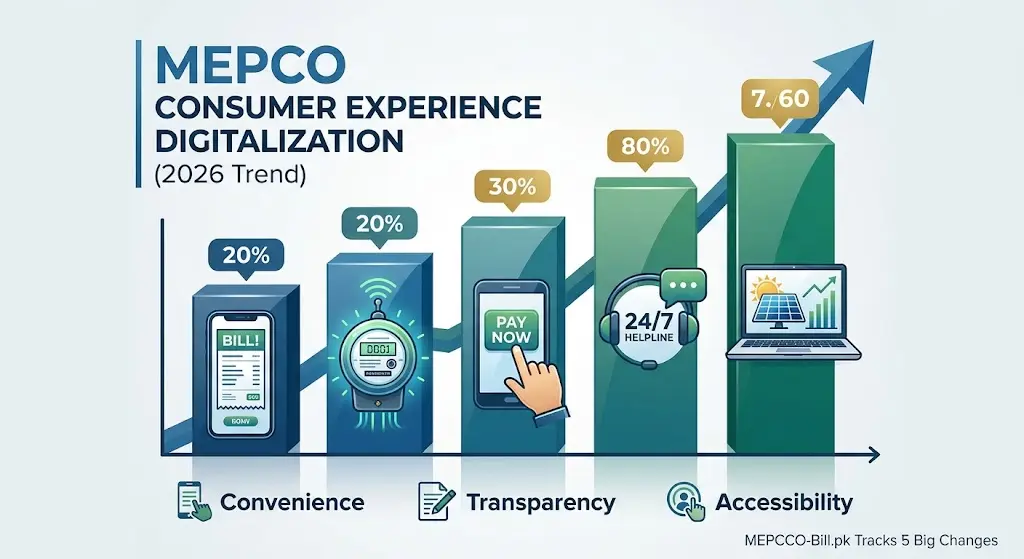
But put them side by side and a pattern starts to appear. MEPCO’s consumer-facing systems are becoming more digital, while some of the rules behind billing and distributed solar are changing at the same time.
That distinction matters because not every change affects the amount printed on your electricity bill. Some affect how you read it. Others affect how you pay it, how your meter communicates with the utility, or how you deal with MEPCO when something goes wrong.
I’ve pulled the five developments together below because this is where the confusion usually starts. One update gets mixed with another, an older rule gets repeated, and suddenly a routine bill question becomes much harder than it needs to be.
1. The MEPCO Bill Has a Cleaner Layout
The most visible change for an ordinary consumer is probably the redesigned bill.
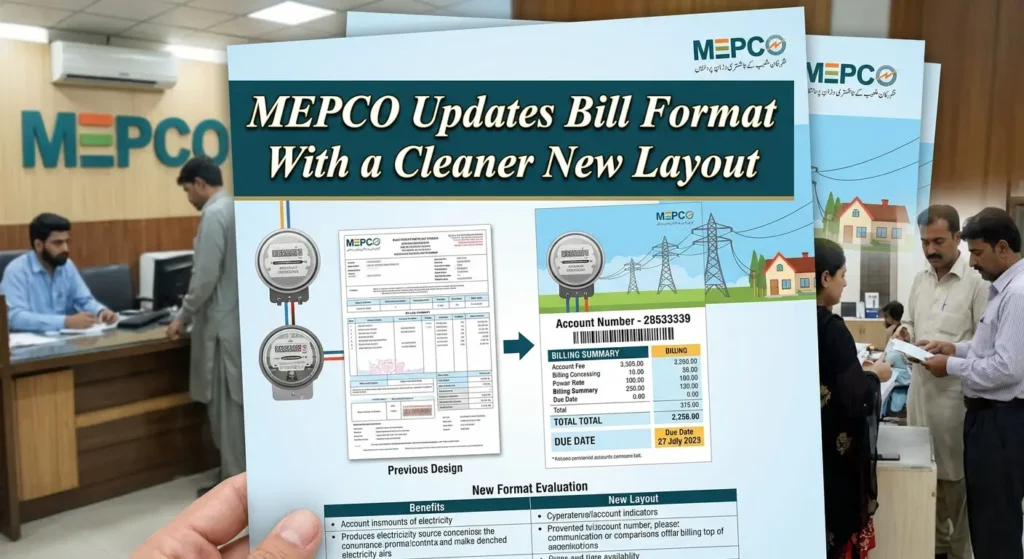
The updated format gives more separation to the information people actually look for first, including the payable amount, due date, meter information, consumer details, and payment information. The revised layout also gives clearer space to the QR code and related payment details.
This sounds cosmetic until you try checking a bill on a phone or comparing it with the previous month.
I usually think of an electricity bill as a page with two jobs. It records what happened during the billing period, and it tells you what needs to be paid. The new arrangement makes those two jobs easier to follow.
The basic identifiers remain useful. The 14-digit Reference Number and 10-digit Consumer ID are still important when checking billing information online.
Here is the practical difference:
| Older presentation | Updated presentation |
|---|---|
| Information can appear crowded | Information is more clearly separated |
| Payable amount can take longer to find | Payable amount is easier to identify |
| Due date may require more searching | Due date has clearer placement |
| Payment information is less prominent | QR and payment information receive clearer space |
| Different billing components can blend together | Sections are easier to distinguish |
There is one misunderstanding I expect to see quite a bit.
A different-looking bill does not automatically mean a different calculation.
If your bill is higher, compare the meter readings and units first. Then check the billing period, electricity charges, taxes, surcharges and adjustments. The new layout itself is not an explanation for a higher amount.
That is also why keeping an old bill is useful. You don’t need a pile of paper, a saved PDF or screenshot from the previous month is enough for a quick comparison.
For readers who regularly use MEPCCO-Bill.pk to check billing information, the change is fairly straightforward: the information is still familiar, but it is arranged in a way that makes the first check quicker.
2. MEPCO Is Moving More Connections Toward Smart AMI Metering
The second change is more technical, but consumers will notice it when a conventional meter is replaced.
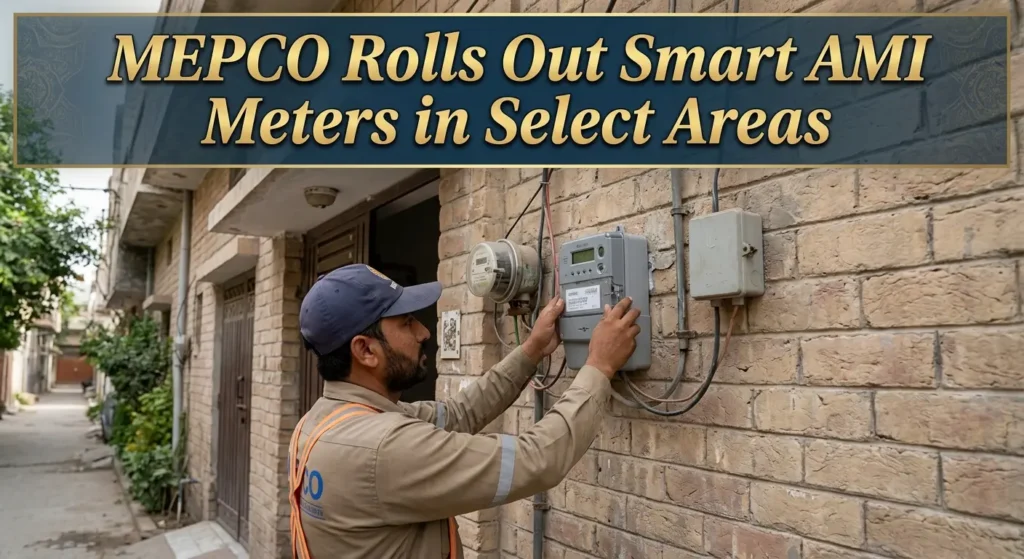
MEPCO has been rolling out AMI, or Advanced Metering Infrastructure, meters in selected areas and connections. AMI is not simply a digital meter with a newer display. It is a metering and communication system that allows information to be collected electronically and communicated to the utility.
That changes the relationship between the physical meter and the billing system.
With a traditional setup, manual processes play a larger role in collecting meter information. An AMI system is designed to provide more automated data collection and remote monitoring.
A simple comparison helps:
| Conventional metering | AMI metering |
|---|---|
| Greater reliance on traditional reading processes | Greater use of automated data collection |
| Less remote meter information | Greater remote monitoring capability |
| Meter information is collected through established manual/digital processes | Meter communicates with utility systems |
| Limited remote status information | More information can be available remotely |
| Older metering infrastructure | Communication-enabled infrastructure |
The exact functions depend on the meter model and the communication infrastructure MEPCO has deployed. That last part is worth keeping in mind.
And here’s where people usually go wrong: a smart meter does not mean cheaper electricity.
The meter is a measurement and communication device. It does not, by itself, reduce the applicable tariff, taxes, fixed charges or other billing components.
If your old meter is replaced with an AMI meter, the useful question is not whether the meter looks more modern. It is whether the readings, billing information and meter status are being recorded correctly.
MEPCO’s smart-meter rollout is also being introduced in stages. A consumer should not assume that every connection in every part of the service territory will receive an AMI meter at the same time.
For anyone who wants to understand the practical side of these meters, the detailed guide on how MEPCO smart meters track electricity every 15 minutes is a useful related reference.
3. Bill Payment Is Becoming More Digital and More Flexible
There was a time when paying an electricity bill was almost synonymous with taking the paper bill to a counter.
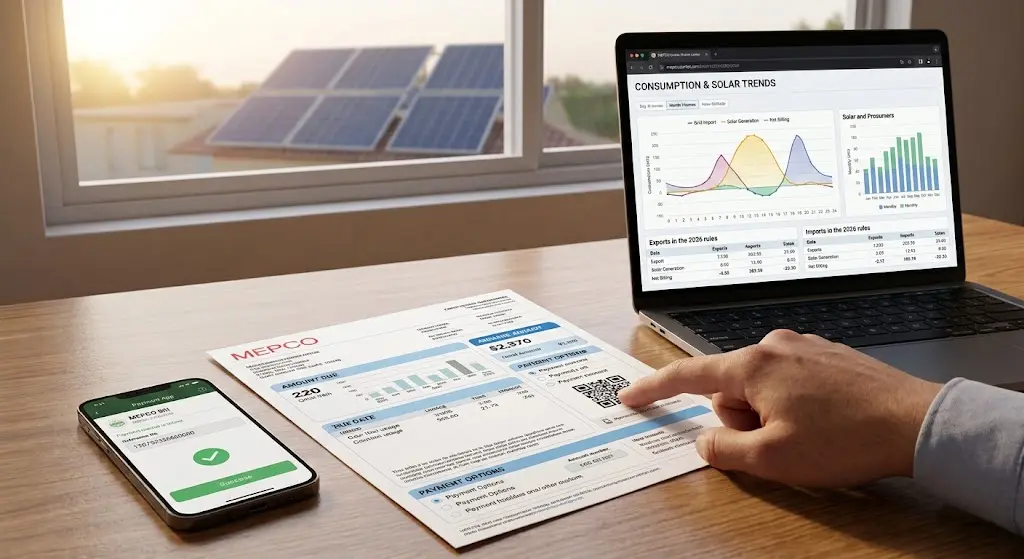
That option still exists, and there is nothing wrong with using it. But MEPCO consumers now have several digital routes available, including mobile wallets, banking applications, internet banking and ATMs, alongside traditional bank and collection-point payments.
The practical options look something like this:
| Your situation | Payment route | What you generally need |
|---|---|---|
| You use a mobile wallet | Wallet payment | MEPCO Reference Number |
| You already bank online | Mobile/internet banking | Reference Number and bank app/account |
| You use a debit card but not banking apps | ATM | Card and bill information |
| You prefer cash | Bank or authorized counter | Bill or Reference Number |
| You need a digital receipt | Wallet or banking app | Reference Number and payment account |
| You have a special demand or charge | Relevant MEPCO facility | Check the applicable payment instructions |
Mobile wallets such as JazzCash and Easypaisa are among the familiar options, while MEPCO payment guidance also refers to other digital-wallet and banking services. The exact menus inside an app can change, so memorizing a particular sequence of buttons isn’t especially useful.
The principle is simpler.
Select electricity or utility payments, choose MEPCO, enter the Reference Number, and then check the consumer information and amount that appear before confirming.
That last check is easy to skip.
Don’t skip it.
A payment system fetching the consumer name and amount gives you a chance to catch a mistyped Reference Number before money leaves your account.
MEPCO’s business planning also points toward more integrated payment functions, including ordinary bill payments, part payments, demand-notice payments and miscellaneous payments, along with payment-status updates and digital notifications.
That is a bigger development than simply adding another payment method.
It suggests that payment is gradually becoming part of a connected digital billing process.
One small side thought here: I still like keeping payment receipts. Digital transactions are convenient, but a transaction reference becomes very useful if money has been deducted and the bill status has not updated yet.
If you run into that particular problem, the guide on why a MEPCO bill can show arrears after payment is worth keeping nearby.
4. Complaint and Helpline Information Is Being Made Easier to Track
The fourth change is less visible than a redesigned bill or smart meter, but it matters when something actually goes wrong.
MEPCO’s customer-service information identifies 118 for complaints and 0800-63726 as a customer-service contact. The company’s telephone information also lists these contacts for consumer assistance.
Why does that deserve a place among the major changes?
Because complaint handling is where outdated information becomes especially frustrating.
A consumer with a billing problem does not need five old phone numbers copied across different websites. They need the current channel for the problem in front of them.
That might be a billing correction, a meter issue, an outage, or another service complaint.
The basic habit I recommend is keeping your bill information beside you when contacting MEPCO. Your Reference Number and connection details are much more useful than simply saying that you live in a particular city.
This becomes even more relevant because MEPCO’s territory is large. The company operates across 13 districts of South Punjab, including Multan, Muzaffargarh, Layyah, Dera Ghazi Khan, Rajanpur, Lodhran, Bahawalpur, Rahim Yar Khan, Khanewal, Sahiwal, Pakpattan, Vehari and Bahawalnagar.
A complaint about a particular feeder is not necessarily a district-wide issue.
The district tells you the broad service territory. Your specific connection information tells MEPCO much more about the account and network involved.
That is one reason I prefer using the information printed on the bill rather than trying to explain an electricity problem from memory.
5. Solar Consumers Are Dealing With a Different 2026 Rulebook
The fifth development is the one that has probably produced the most online confusion.
MEPCO consumers with solar installations have had to keep up with the 2026 NEPRA Prosumer Regulations and subsequent amendments.
The original Prosumer Regulations, 2026 were notified on February 9, 2026. Under the framework described by the current MEPCO guidance, electricity imported from the distribution licensee is billed under the applicable tariff, while electricity supplied by the prosumer to the licensee is treated under the applicable net-billing mechanism.
Then came an amendment notified on August 6, 2026, under S.R.O. 1330(I)/2026.
For distributed-generation facilities up to 25 kW, the amendment removed the requirement for concurrence from NEPRA itself, with the relevant distribution licensee handling the approval route instead. For an MEPCO consumer within that category, MEPCO therefore has a more direct role in the approval process.
A quick reference:
| Solar situation | 2026 position described in the current guidance |
|---|---|
| System up to 25 kW | NEPRA concurrence is no longer required |
| Approval for systems up to 25 kW | Relevant distribution licensee handles the approval |
| Electricity imported from the grid | Billed according to the applicable tariff |
| Electricity exported to the licensee | Credited under the applicable prosumer net-billing mechanism |
| Original Prosumer Regulations | Notified February 9, 2026 |
| Amendment referenced here | S.R.O. 1330(I)/2026, August 6, 2026 |
There is a very common mistake here.
People hear that the approval route for smaller systems changed and then assume the whole billing framework returned to the older net-metering arrangement.
Those are separate issues.
The approval process and the financial treatment of imported and exported electricity should not be treated as the same thing.
For anyone considering solar, I would also keep the MEPCO net metering rules updated under NEPRA 2026 guide bookmarked because this is an area where older information can remain online long after a regulatory change.
What These Five Changes Have in Common
Looking at all five together, the pattern is fairly practical.
The bill itself is becoming easier to read.
Meters are becoming more capable of communicating information digitally.
Payment is moving across more digital channels.
Complaint information is being organized around clearer consumer-service contacts.
And solar consumers are dealing with a regulatory framework that has changed during 2026.
None of those developments means that every MEPCO consumer needs to change what they do every month.
For a normal household, the routine is still quite simple:
- Check the Reference Number and consumer details.
- Compare the current meter reading and units with the previous bill.
- Check the payable amount and due date.
- Use whichever legitimate payment channel suits you.
- Keep the transaction receipt.
- If something looks wrong, use the current complaint route rather than relying on an old phone number.
- If you have solar, check the current regulatory position instead of applying an older net-metering rule automatically.
That is probably the most useful way to look at the changes tracked by MEPCCO-Bill.pk.
Not every development changes the bill amount. Some simply change the machinery around the bill.
And those smaller changes matter because they affect what happens before the bill arrives, how you check it, how you pay it, and what you do when the numbers don’t look right.
FAQs
Has MEPCO changed the actual electricity tariff because of the new bill format?
No. The redesigned bill is primarily a presentation change. A higher payable amount should be checked against consumption, meter readings, billing dates, applicable charges, taxes and adjustments rather than blamed on the new layout.
Will every MEPCO consumer receive an AMI smart meter in 2026?
No such assumption should be made. The current information describes AMI deployment as a staged rollout involving selected areas and connections. The exact timing depends on MEPCO’s deployment.
Can I still pay my MEPCO bill at a bank or collection point?
Yes. Digital payment has expanded, but traditional payment channels remain available. Consumers can use options such as banks, authorized collection points, ATMs, banking apps and mobile wallets depending on the service available to them.
What MEPCO complaint number should I keep?
MEPCO’s customer-service information lists 118 for complaints and 0800-63726 as a customer-service contact. For a specific issue, keep your Reference Number and relevant bill information available when contacting support.
What changed for solar systems up to 25 kW?
Under the August 6, 2026 amendment to the Prosumer Regulations, distributed-generation facilities up to 25 kW no longer require concurrence from NEPRA itself, with approval handled by the relevant distribution licensee. That approval change should not be confused with the separate rules governing billing and exported electricity.
The useful thing about following these updates together is that you start seeing the MEPCO bill as part of a larger system rather than just a monthly piece of paper.
And that makes the ordinary details easier to understand.
For checking your latest MEPCO billing information, you can use mepcco-bill.pk.