
The solar conversation around MEPCO changed several times in 2026, which is why two people with perfectly good information can still give you different answers about net metering.
I have seen this confusion particularly around the words “net metering” and “net billing.” Older information still appears in searches, while the National Electric Power Regulatory Authority (NEPRA) has introduced the Prosumer Regulations, 2026 and then amended them during the year. The latest amendment listed by NEPRA was notified on August 6, 2026.
For an MEPCO consumer considering solar, the distinction matters. The rules governing how electricity is purchased from a prosumer, how imported electricity is billed, and who handles approval are not simply the same as the old net-metering arrangement.
There is another detail worth keeping straight: the August amendment is mainly about the approval route for smaller distributed-generation systems. It does not mean that every part of the solar billing framework has gone back to the old system.
1. The 2026 Rule Change That MEPCO Consumers Need to Know
The original NEPRA Prosumer Regulations, 2026 were notified on February 9, 2026 under S.R.O. 251(I)/2026. They introduced a regulatory framework built around the term “prosumer,” covering consumers who generate electricity through distributed generation facilities and interact with the distribution system.
Under Regulation 14 of those regulations, billing operates on a net-billing arrangement. Electricity supplied by the distribution licensee to the prosumer is billed according to the applicable tariff, while electricity supplied by the prosumer to the licensee is billed at the national average energy purchase price.
That is the part that causes the most confusion.
Under the current framework, you should not automatically assume that one exported solar unit receives the same financial value as one imported electricity unit. The two sides of the meter are treated differently for billing purposes.
Then came another important development.
NEPRA’s public record shows a notification dated August 6, 2026, S.R.O. 1330(I)/2026, amending the Prosumer Regulations, 2026.
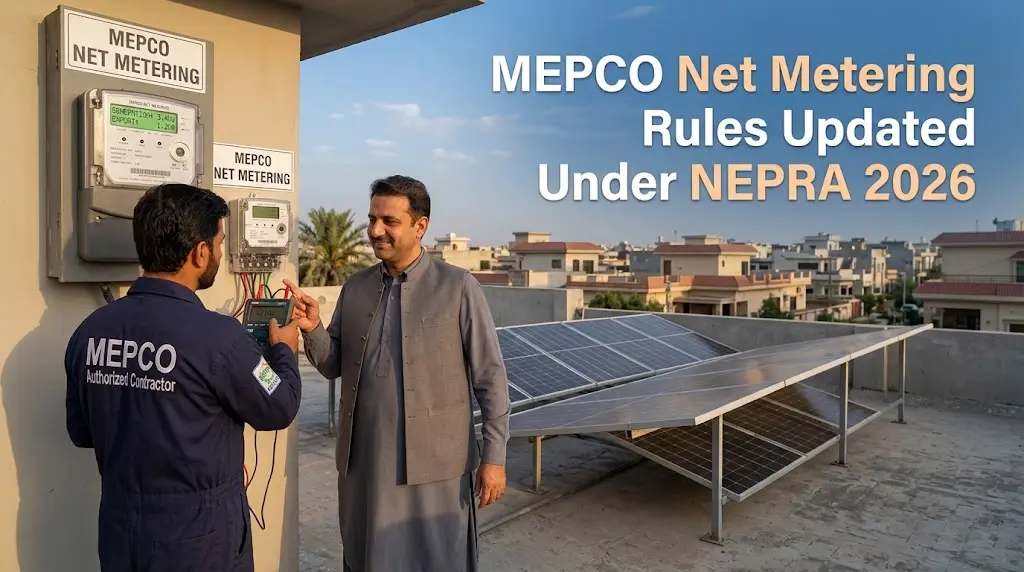
The practical change is significant for smaller solar systems. Distributed-generation facilities of up to 25 kW no longer require concurrence from NEPRA itself. The relevant distribution licensee handles the approval instead. Contemporary reporting on the notification confirms that the change is intended to simplify the process for smaller solar consumers.
For an MEPCO customer, that means MEPCO becomes especially important in the approval process for systems falling within this limit.
And that is where some older online guides become misleading.
A quick comparison
| Situation | 2026 position |
|---|---|
| Solar/distributed-generation system up to 25 kW | NEPRA concurrence is no longer required |
| Approval for up to 25 kW | Handled by the relevant distribution licensee |
| Electricity imported from the grid | Billed at the applicable tariff |
| Electricity exported to the licensee | Credited according to the applicable prosumer net-billing mechanism |
| Original 2026 regulations | Notified February 9, 2026 |
| Latest amendment discussed here | S.R.O. 1330(I)/2026, August 6, 2026 |
The important point is that “approval became easier” and “the billing rules disappeared” are two completely different statements. Only the first one follows from the August amendment.
2. Net Metering and Net Billing Are Not the Same Thing
This is probably the biggest place where MEPCO solar customers go wrong.
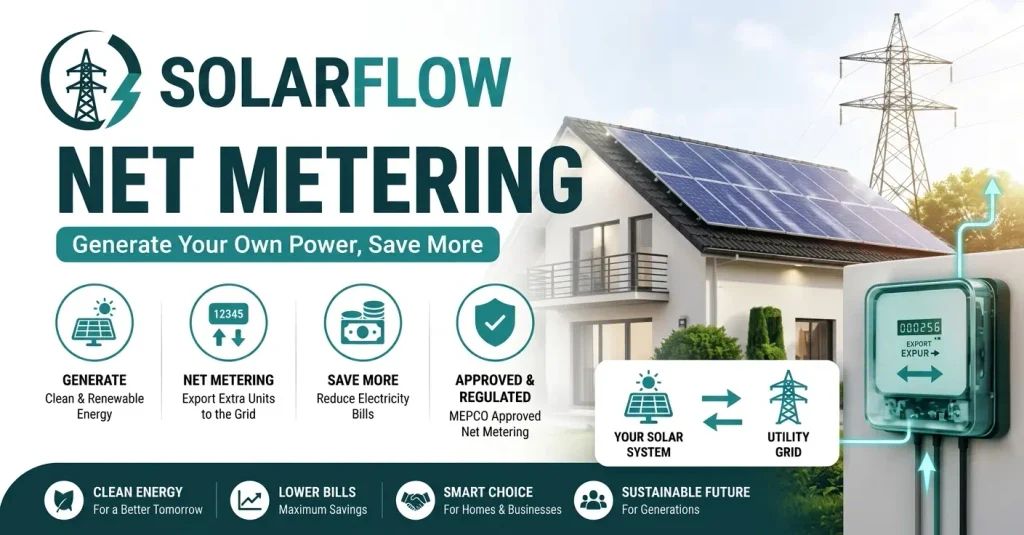
A homeowner may have heard from a friend that a green meter simply subtracts exported units from imported units. That description belongs to the way many people understood the older net-metering model, but the 2026 Prosumer Regulations expressly describe a net-billing arrangement.
Think about a normal month.
Your house uses electricity from the MEPCO grid at different times. Your solar panels also generate electricity, and some of that generation may be consumed inside your house. When generation exceeds what your premises are using at a particular time, electricity can flow toward the distribution grid, subject to the applicable connection and regulatory requirements.
The billing treatment separates those flows.
The electricity you receive from the licensee is charged according to the applicable tariff.
The electricity your distributed-generation facility supplies to the licensee is credited at the national average energy purchase price under Regulation 14 of the 2026 regulations.
That distinction changes how a solar owner should think about system economics.
A simple calculation such as:
“Monthly solar production minus monthly household consumption equals free electricity”
is not a reliable description of the billing arrangement.
The timing of generation and consumption matters too. A household that uses a large portion of its solar production during daylight hours has a different practical position from one that produces heavily during the day but consumes most of its electricity after sunset.
This is why I would be careful with old articles that quote a single “net-metering rate” as if it applies forever. Regulatory rates, billing mechanisms and approval requirements need to be checked against the current NEPRA framework.
For readers comparing their solar setup with their actual electricity charges, the MEPCO Tariff Rates 2026 guide is also useful because the imported electricity side of the bill still depends on the applicable tariff structure.
3. What the August 2026 Amendment Means for an MEPCO Solar Applicant
The most useful part of the August update is fairly straightforward.
If your distributed-generation facility is 25 kW or below, the approval process no longer requires separate concurrence from NEPRA. The relevant distribution licensee is responsible for approval under the amended framework.
For an MEPCO consumer, that means the application process is less dependent on obtaining a separate regulatory concurrence from Islamabad.
But don’t read this as permission to connect a solar system to the MEPCO network without following the required process.
The amendment changes who approves the qualifying system. It does not remove the technical and interconnection requirements that apply to connecting distributed generation to the distribution network.
This distinction is easy to miss.
A person might see a headline saying that NEPRA approval is no longer required and conclude that a 20 kW solar system can simply be connected to the grid after installation. That is not what the amendment says.
The safer way to understand it is:
- Your system falls within the applicable distributed-generation framework.
- If its capacity is 25 kW or below, the special NEPRA concurrence requirement is removed.
- The relevant distribution licensee handles the approval.
- Technical and connection requirements still matter.
- Billing follows the applicable Prosumer Regulations and tariff arrangements.
That last point is particularly important for MEPCO consumers.
MEPCO is the distribution company serving a large part of South Punjab, so consumers within its service area need to distinguish between information about Pakistan’s general solar regulations and the actual procedure used by their distribution licensee.
You can also see how the site approaches other MEPCO consumer systems in the MEPCO Smart AMI Meter 2026 guide. Smart meters and solar connections are separate subjects, but accurate meter data becomes increasingly relevant as electricity flows in both directions.
4. Existing Solar Consumers Are a Separate Case
Here’s where people usually go wrong: they apply a new 2026 rule to an older agreement without checking the transitional provisions.
The February regulations repealed the earlier regulatory framework, but they also contained provisions dealing with approvals, licences, concurrences and agreements that existed before the new regulations came into force. The original Regulation 21 addressed the treatment of arrangements created under the repealed regulations.
NEPRA subsequently published an amendment concerning this transitional treatment. The February amendment draft specifically proposed that distributed generators with valid agreements executed under the repealed regulations would continue to be billed according to the earlier rate and mechanism until their agreements expired.
This is an area where a homeowner should not rely on a social-media summary.
Your actual agreement date and status matter.
For someone who already has a valid solar agreement, the relevant question isn’t simply:
“What’s the 2026 net-metering rate?”
The better question is:
“What regulatory arrangement applies to my existing agreement, and when does that agreement expire?”
That is a much more useful way to approach an electricity bill.
If you need to compare older electricity records before discussing a billing issue, the MEPCO Old Bill History guide explains how previous bills can be accessed using the reference number or customer ID.
Keep those older bills. They are useful records when you are trying to understand how your electricity charges changed after a meter replacement, solar connection, tariff change or billing adjustment.
5. What Your MEPCO Bill May Look Like After Solar
A solar consumer shouldn’t judge the arrangement simply by looking at the number of units printed on one line.
There are several pieces of information worth checking.
Start with the meter readings and billing period. Then look at the imported electricity and any electricity credited or accounted for under the distributed-generation arrangement.
Your applicable tariff also matters. Taxes, surcharges and other approved billing components do not necessarily disappear just because a property has solar panels.
The practical picture is closer to this:
| Part of the calculation | What to examine |
|---|---|
| Grid electricity consumed | Units supplied by MEPCO |
| Applicable tariff | Rate/category used for imported electricity |
| Solar generation | Electricity produced by the distributed-generation system |
| Electricity exported | Electricity supplied to the distribution system |
| Export credit | Value calculated under the applicable prosumer arrangement |
| Other bill components | Taxes, surcharges and applicable adjustments |
| Final payable amount | Amount shown after the billing calculation |
This is why two homes with similarly sized solar systems can have noticeably different bills.
One family might consume most of its electricity during the afternoon. Another might return home in the evening and rely heavily on the grid after the sun has gone down.
The solar panel capacity alone doesn’t tell the whole story.
And there is a slightly boring detail that matters more than people expect: keep your meter and billing records. When something looks wrong, having six or twelve months of bills is much more useful than trying to remember what the bill looked like last summer.
6. The 25 kW Threshold Deserves Extra Attention
The August amendment creates a clear threshold that prospective solar customers should understand.
The exemption from NEPRA concurrence applies to distributed-generation facilities of 25 kW or below. Reports on the official notification describe the relevant technology in the context of solar and other qualifying distributed-generation sources such as wind and biogas.
That doesn’t mean a 26 kW installation and a 25 kW installation should be treated as practically identical.
Once you move above the stated threshold, the simplified exemption no longer applies in the same way.
So if someone is designing a system close to the limit, don’t make the decision based only on panel count or inverter capacity advertised by an installer. Look at the actual capacity definition and the applicable regulatory requirements.
This is also a good point to slow down when an installer says, “It’s under 25 kW, so everything is automatic.”
It isn’t.
The August amendment simplifies the regulatory approval route. It does not turn grid interconnection into a purely private installation decision.
For an MEPCO consumer, the distribution company’s requirements still form part of the process.
7. What I Would Check Before Applying for Solar Under the Updated Rules
I would keep the paperwork simple and verify the important parts before paying an installer.
First, establish your existing electricity details. Keep your MEPCO reference number, customer information and recent bills together.
Second, determine the proposed distributed-generation capacity. The 25 kW threshold is now directly relevant to the approval route.
Third, check the current MEPCO and NEPRA requirements rather than relying on an installer’s older checklist. The rules changed during 2026, so a document prepared under the previous framework isn’t automatically current.
Fourth, understand your expected electricity use. Solar production and household consumption are not always synchronized.
Fifth, keep the final agreement and approval documents. Don’t treat them like paperwork that can be thrown away after installation.
A simple folder containing your application, approval, agreement, meter details and monthly bills can save a lot of frustration later.
This is one reason I keep returning to records throughout the MEPCO information published on mepccobill.pk. Electricity questions are much easier to resolve when the consumer has the actual bill and connection information in front of them rather than a screenshot from a social-media post.
And yes, save digital copies too.
A phone photo is better than nothing, but a clearly named PDF folder is better when you’re trying to compare several months of billing.
8. The Biggest Mistakes I See in 2026 Solar Information
There are three mistakes worth calling out.
The first is using an old net-metering rate as though it automatically applies to every new solar applicant. The 2026 Prosumer Regulations changed the framework to net billing, with imported electricity billed at the applicable tariff and exported electricity treated under the national average energy purchase price mechanism.
The second is confusing the removal of NEPRA concurrence for systems up to 25 kW with removal of the entire approval process. The August amendment shifts the approval responsibility to the relevant distribution licensee for qualifying systems.
The third is assuming that an existing solar agreement and a new application are governed identically.
They aren’t necessarily.
The transitional treatment of existing agreements is precisely why the date and terms of your existing arrangement matter.
And this is where I would rather be slightly repetitive than give somebody a neat but wrong answer.
Check the document. Check the date. Check the applicable regulation.
Solar installations cost real money, and a misunderstanding about the billing mechanism can affect the financial calculation for years.
9. What MEPCO Consumers Should Expect Going Forward
The regulatory picture in 2026 has already changed more than once.
NEPRA notified the Prosumer Regulations in February, amendments followed, and another amendment was notified in August. NEPRA’s own current listings show the August 6 notification alongside the earlier 2026 regulatory developments.
That means anyone researching MEPCO net metering should pay attention to publication dates.
An article written before February 9, 2026 is unlikely to describe the full current framework.
Even an article written in February or March could miss later changes.
That’s not necessarily because the older article was badly written. The rules themselves moved.
For consumers, the practical lesson is simple: treat the latest official NEPRA notification as more authoritative than an old calculator, installer brochure or social-media graphic.
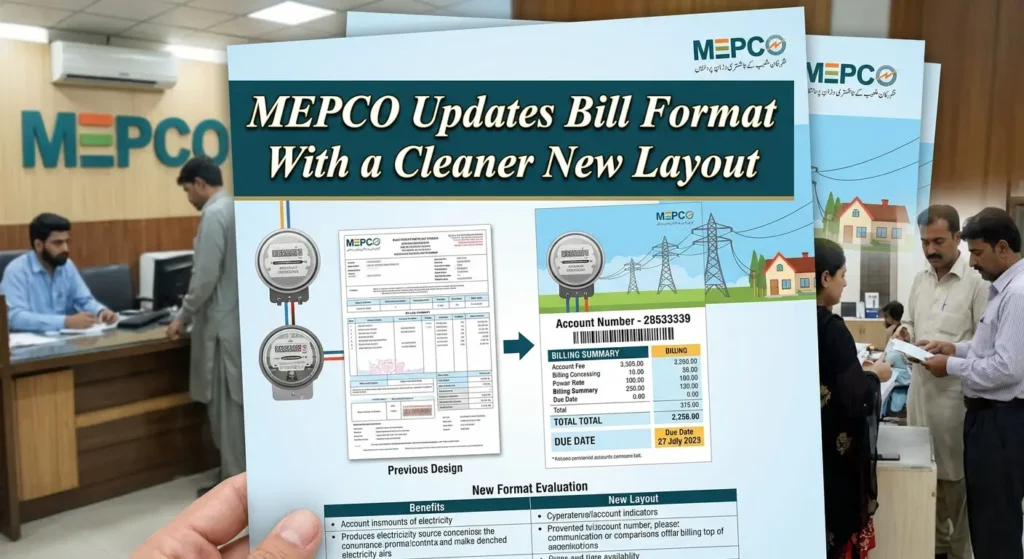
The same approach applies when checking your actual electricity charges. The new MEPCO bill format guide explains where key details such as the reference number, meter readings, tariff category, charges and payable amount appear on the newer bill layout.
Those details become useful when you are comparing your pre-solar and post-solar billing records.
A Final Practical Note for MEPCO Solar Owners
The 2026 changes don’t make solar impossible, but they do make the old “net metering means exported units simply cancel imported units” explanation too simplistic.
For new applicants, the August 2026 amendment is particularly useful because distributed-generation facilities up to 25 kW no longer need NEPRA concurrence, with the relevant distribution licensee handling approval.
For billing, the distinction between electricity you buy from MEPCO and electricity your system supplies to the distribution network is still central to the 2026 prosumer framework.
And for people who already have an older agreement, don’t throw the agreement away and don’t assume the newest rule automatically replaces its billing treatment. The transitional provisions are there for a reason.
I would keep the paperwork, keep the bills, and check the regulation that actually applies to your connection. That is a little less exciting than a headline promising a revolutionary solar saving, but it is much more useful when the electricity bill arrives.
FAQs
Does MEPCO still have net metering in 2026?
The 2026 NEPRA framework uses a net-billing arrangement for prosumers rather than simply applying the older net-metering model. Imported electricity is billed at the applicable tariff, while electricity supplied by the prosumer to the licensee is treated under the national average energy purchase price mechanism.
Do I need NEPRA approval for a solar system of 25 kW or less?
The August 6, 2026 amendment removed the requirement for NEPRA concurrence for qualifying distributed-generation facilities of 25 kW or below. The relevant distribution licensee handles the approval instead.
Does the 25 kW rule mean I can install solar without any approval?
No. The amendment changes the approval route, not the need to comply with applicable distribution-system and interconnection requirements. For an MEPCO consumer, the relevant MEPCO process still matters.
What happens to an older net-metering agreement?
Existing agreements require separate attention because the 2026 regulatory framework includes transitional treatment for arrangements made under the earlier regulations. A valid older agreement may continue under the earlier billing mechanism for its applicable term, depending on the governing provisions and agreement status.
Is exported solar electricity worth the same as electricity I buy from MEPCO?
Under Regulation 14 of the 2026 Prosumer Regulations, they are treated differently. Electricity supplied by the licensee is billed according to the applicable tariff, while electricity supplied by the prosumer to the licensee is billed according to the national average energy purchase price.
For the latest regulatory reference, consult the NEPRA Prosumer Regulations and notifications, particularly the amendments issued during 2026.
Pingback: What Happens to Your MEPCO Bill After Solar Export? – MEPCO Bill Check 2026
Pingback: MEPCO Adds New Bill Payment Options – MEPCO Bill Check 2026