Why Is My MEPCO Bill Marked Estimated?
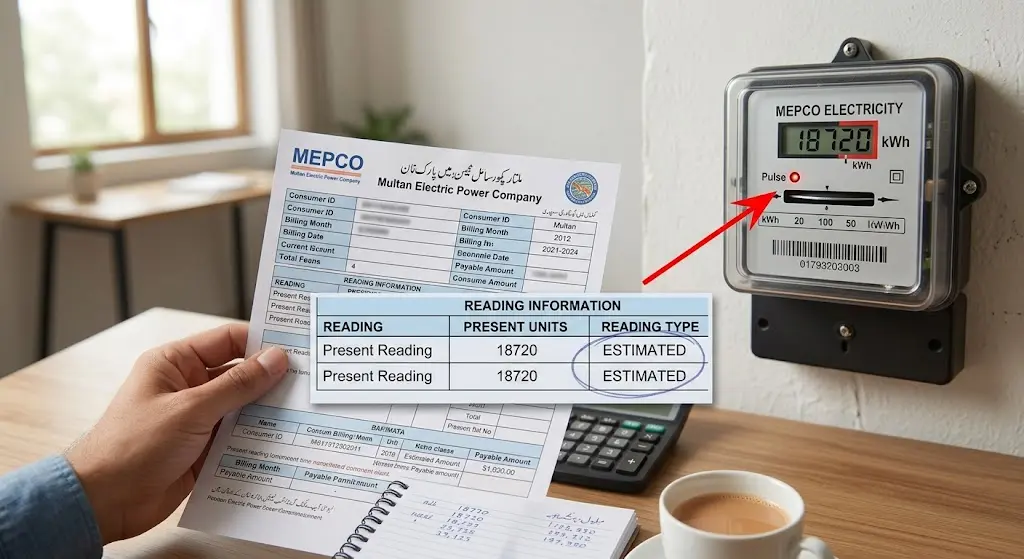
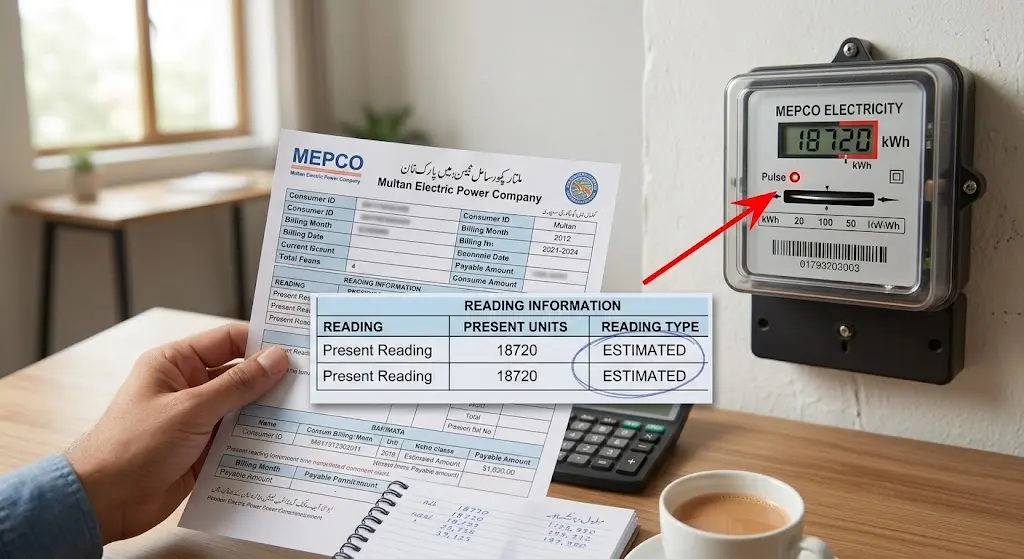
There’s a particular moment when an electricity bill becomes confusing: you look at the units, then notice the word “Estimated” beside the reading information.
The first reaction is usually that MEPCO has simply guessed your consumption.
That is not quite what an estimated MEPCO bill means.
I’ve spent a lot of time looking at the details consumers actually need when checking MEPCO bills, and this is one of those small labels that causes far more confusion than it should. An estimated reading usually tells you something about how the consumption figure was obtained. It does not, by itself, prove that the bill is wrong.
The useful question is not just, “Why are my units estimated?”
It is, “Why was an actual reading not used for this billing period?”
That distinction gives you a much better starting point.
1. What “Estimated” Actually Means on a MEPCO Bill
A normal electricity bill is based on a meter reading taken during the billing cycle.
The basic calculation is simple:
Present meter reading − Previous meter reading = Units consumed
So, if the previous reading was 18,400 and the present reading was 18,720, the consumption is 320 units.
An estimated bill is different. The units shown on the bill are based on an assessment rather than a straightforward actual meter reading for that period.
MEPCO’s published billing information specifically refers to estimated consumption in situations involving a defective meter. Its consumer guidance also explains that when a meter is declared defective, billing can be assessed using consumption from the corresponding month of the previous year, with a check-meter process intended to help establish actual consumption.
That is an important detail.
An estimate isn’t necessarily somebody sitting down and picking a random number.
There is a billing basis behind it.
The current MEPCO bill format also separates information such as previous reading, present reading, reading date, units and reading type, so those are the first areas I would check rather than jumping straight to the payable amount. Existing MEPCO billing guidance describes the same distinction between actual consumption and estimated consumption.
A quick way to read the difference
| What appears on the bill | What it generally tells you |
|---|---|
| Actual reading | Consumption is based on a recorded meter reading |
| Estimated reading | Consumption has been assessed rather than established through a normal actual reading |
| Defective meter indication | The meter condition is relevant to the billing assessment |
| Reading date | Helps establish which billing period the reading relates to |
This is why the word “estimated” should make you investigate, not immediately assume overbilling.
There is a difference between an estimated bill and an incorrect bill.
Sometimes an estimate is being used because the normal reading process could not provide a reliable figure. If the assessment itself appears wrong, that is when you have something specific to challenge.
2. A Defective Meter Is One of the Main Reasons
This is the part many consumers don’t know.
MEPCO’s consumer information explains that when a meter is declared defective, the assessment can be based on the consumer’s consumption during the same month of the previous year. The guidance also refers to installing a check meter so actual consumption can be established.
So imagine your bills looked like this:
| Billing period | Units | Reading status |
|---|---|---|
| September 2025 | 305 | Actual |
| October 2025 | 280 | Actual |
| August 2026 | 190 | Actual |
| September 2026 | 305 | Estimated |
A consumer looking only at August and September might think, “I used 190 units last month, so why am I suddenly being charged for 305?”
But that comparison misses something important.
If the current bill is being assessed because of a defective meter, the relevant basis may not simply be the immediately previous month’s consumption. The corresponding month from the previous year can matter under the stated procedure.
This is where people usually go wrong.
They see an estimated figure and compare it only with last month’s units.
Instead, check the reading type, meter status and the consumption history around the same month of the previous year.
That doesn’t automatically make the estimated figure correct. It simply tells you what you need to investigate.
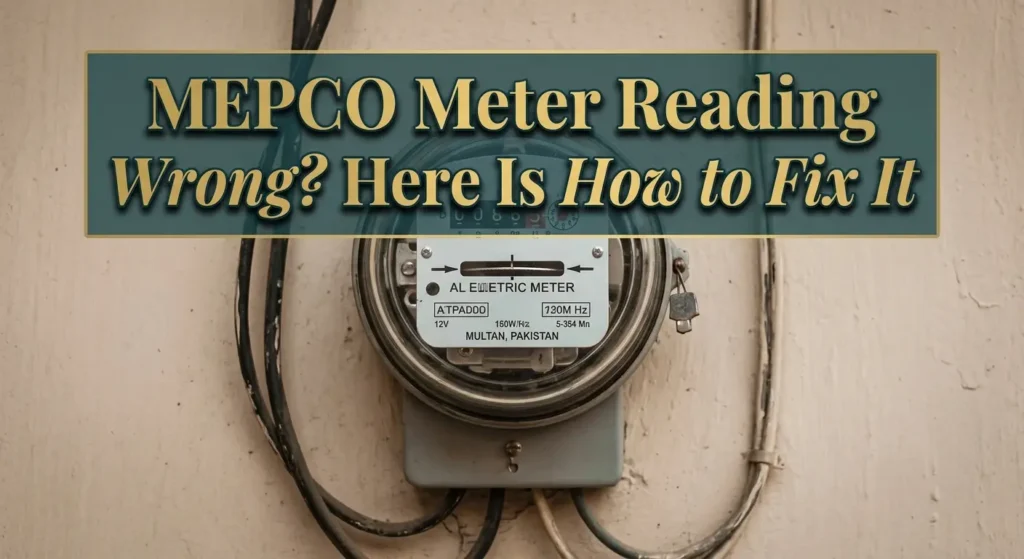
And there is another small detail worth keeping in mind. A meter problem does not always look dramatic from outside. The issue may be with the meter’s ability to provide a reliable reading, rather than something obvious like a completely blank display.
So don’t wait for the meter to look completely dead before taking an estimated bill seriously.
3. Why Your Estimated Units Can Look Unusually High
An estimated bill can be surprising because the number may not resemble your recent monthly consumption.
Suppose your household used:
- 175 units in July
- 190 units in August
- 315 estimated units in September
That jump deserves a look.
But the jump alone doesn’t establish an error.
First check the month being used as the assessment basis. Then check the reading information printed on the bill.
MEPCO’s existing consumer guidance explains estimated billing in the context of defective meters and also discusses accumulated readings. When readings accumulate, the billing process can involve separate bills that account for the period over which readings accumulated.
That matters because electricity billing isn’t always as simple as comparing one month’s final number with the next month’s final number.
A better record looks like this:
Month        Units       Reading Type
--------------------------------------
Sep 2025     305         Actual
Oct 2025     280         Actual
Nov 2025     265         Actual
...
Aug 2026     190         Actual
Sep 2026     305         Estimated
Once you write the numbers down, the situation usually becomes easier to understand.
You can see whether the estimated figure resembles the corresponding month from the previous year. You can also see whether the current figure is completely out of line with your history.
That is much more useful than staring at the total bill amount.
If you regularly check your electricity information through mepcco-bill.pk, I recommend keeping a simple record of the readings or at least saving your recent bills. It takes very little time, and it gives you something concrete to compare when a strange bill arrives.
4. Check These Five Things Before Calling the Bill Wrong
Before submitting a complaint, look at the bill carefully.
I would check these five things first:
1. Previous meter reading
Find the previous reading printed on the bill. This tells you the starting point used for the billing calculation.
2. Present meter reading
If an actual present reading is shown, compare it with the number currently displayed on the physical meter.
3. Reading date
Don’t ignore the date.
A physical meter reading taken today is not necessarily the same reading that existed when the official meter reading was taken. Electricity continues to be consumed after the official reading.
4. Reading type or meter status
This is particularly important when the bill says estimated. Look for indications showing whether the reading was actual, estimated or connected with a meter condition.
5. Previous-year consumption
If the bill appears to be an estimated defective-meter assessment, compare it with the corresponding month from the previous year rather than only the previous month.
MEPCO’s own consumer information and existing billing guidance make these distinctions relevant when understanding estimated consumption.
Here’s where people usually make the wrong comparison
Imagine your bill shows a present reading of 20,000.
You check your meter three days later and see 20,060.
That does not automatically mean MEPCO used a wrong reading. Your household consumed electricity during those three days.
On the other hand, if the bill shows 20,500 and the physical meter is still showing 20,060 shortly after the bill’s reading date, you have a more specific discrepancy worth reporting.
The date matters.
The reading matters.
The history matters.
And the estimated status matters.
5. What If the Meter Was Not Read?
An estimated bill can also raise a different question: was the meter actually read?
MEPCO’s consumer information states that meters are normally read on a monthly basis according to the reading date shown on the bill. It also advises consumers to contact the relevant subdivision when a meter has not been read.
That gives you a practical point to investigate.
If you were expecting a normal reading but the bill is marked estimated, don’t immediately assume the meter is defective. Find out what happened to the reading.
There is a difference between:
- a meter that was declared defective,
- a meter that was not read,
- an assessment based on an applicable billing procedure, and
- a bill that contains an actual reading but appears to have another calculation problem.
Those situations can require different explanations.
This is also why I don’t recommend complaining only about the final amount.
A complaint saying, “My bill is too high,” gives the billing office very little to work with.
A complaint saying, “My bill is marked estimated, the present reading is shown as X, the meter currently shows Y, and the corresponding month last year was Z units,” is much more useful.
The second version identifies the actual issue.
6. What Should You Do If the Estimated Figure Looks Wrong?
Start by documenting what you can see.
Keep:
- Your current MEPCO bill.
- At least two or three previous bills.
- A clear photograph of the physical meter.
- The date the photograph was taken.
- Your Reference Number.
- Your Consumer ID, if available.
- Any previous complaint or service reference.
The photograph is particularly useful if the printed meter information and physical meter appear inconsistent.
Take the picture clearly enough that the meter reading can be seen. Don’t wait several weeks and then try to remember what the display showed when the bill arrived.
I learned to put these records together before contacting anyone because it changes the conversation. Instead of arguing about whether the bill “looks high,” you have numbers that can be checked.
You can also review the MEPCO meter-reading guide if the main concern is that the reading printed on the bill does not appear to match the physical meter. That guide deals specifically with comparing the billed reading, reading date and physical meter reading.
And if you need to understand how the information is arranged on the newer statement, the site’s guide to the updated MEPCO bill format is useful as a reference.
7. How to Complain About an Estimated MEPCO Bill
Once you’ve identified a specific problem, keep the complaint factual.
You don’t need a long explanation.
Something like this is enough:
“My MEPCO bill for this billing period is marked estimated. I request verification of the meter status and the basis used to calculate the estimated units. The previous year’s corresponding consumption was ___ units, while the current bill shows ___ estimated units.”
If the physical meter also appears inconsistent, include that information.
For example:
“The present reading printed on the bill is ___, while the meter currently shows ___. I have attached a photograph of the meter and request verification of the billing record.”
MEPCO’s consumer-service information provides complaint and customer-service channels, while the Consumer Service Manual provides procedures and timeframes for different types of billing complaints. Existing guidance on disputing wrong MEPCO bills also recommends keeping the complaint reference and supporting documents.
That reference number matters more than people think.
Keep it.
If you need to follow up later, you want to be able to point to the original complaint instead of starting the entire explanation again.
8. Don’t Confuse an Estimated Bill With a Detection Bill
These two things should not be treated as the same problem.
An ordinary estimated bill concerns how consumption was assessed when a normal reading was not available or reliable.
A detection bill involves a separate assessment related to an alleged irregularity or unrecorded consumption.
That distinction is worth making because the complaint process and documents can be different.
If your bill is simply marked estimated, start with the meter-reading information and assessment basis.
If you’ve received a detection bill, look at the inspection and assessment details instead.
The site’s existing guide to disputing a wrong MEPCO bill also points out that a consumer should identify the actual problem instead of describing every unusually high bill as “overbilling.”
That is a small wording difference, but it makes a practical difference when you’re trying to get a problem checked.
9. Four Common Mistakes With Estimated Bills
Mistake 1: Comparing only the final rupee amount
A higher bill doesn’t necessarily mean higher consumption. Taxes, adjustments and other charges can change the final payable amount.
Mistake 2: Comparing an estimated month only with the previous month
If the estimate relates to a defective meter assessment, the corresponding month from the previous year can be relevant.
Mistake 3: Checking the physical meter long after the billing date
The meter keeps running. A reading taken weeks later cannot simply be treated as the reading that MEPCO should have recorded earlier.
Mistake 4: Complaining without keeping evidence
A bill, dated meter photograph and consumption history give you something concrete to discuss.
And one more thing: don’t interfere with the meter yourself.
Don’t remove seals, open the equipment or ask someone to modify the wiring to make the reading “correct.” If the meter appears faulty, report the problem through MEPCO’s official process.
The aim is to establish what happened, not create another problem around the meter.
10. A Simple Routine That Makes Estimated Bills Easier to Spot
You don’t need to monitor the meter every day.
Once around the expected reading period is enough for most households.
Take a clear photograph of the meter and keep your recent bills. If you do this for several months, you build a small personal record of consumption.
For example:
Expected reading period
        ↓
Photograph meter
        ↓
Save current bill
        ↓
Compare previous reading
        ↓
Check reading type
        ↓
Compare consumption history
        ↓
Investigate any clear discrepancy
This routine also helps you notice patterns.
If the same connection keeps receiving estimated readings, that is different from seeing an estimated reading once. Repeated estimated billing deserves a closer look at the meter status and the reason actual readings are not being used.
The point isn’t to become an electricity-billing specialist.
It’s simply to know what numbers are appearing on your own bill.
That is something I think every consumer should be able to do without needing a technical background.
FAQs About Estimated MEPCO Bills
Why does my MEPCO bill say estimated instead of actual?
An estimated reading means the consumption figure was assessed rather than established through a normal actual meter reading for that billing period. MEPCO’s published guidance specifically discusses estimated consumption in connection with defective meters and related billing procedures.
Does an estimated MEPCO bill mean my meter is defective?
Not necessarily from the word “estimated” alone. A defective meter is one documented reason for estimated consumption, but you should check the meter status, reading information and the applicable billing basis before deciding what caused it.
Why are my estimated units higher than last month’s units?
The assessment may not simply be based on the immediately preceding month’s consumption. For a defective-meter assessment, MEPCO’s consumer guidance refers to consumption for the same month of the previous year. Check that month as well as your recent bills.
Can I challenge an estimated MEPCO bill?
Yes, if you believe the meter status, reading or assessment is incorrect, document the issue and request verification through the appropriate MEPCO complaint channel. Keep your bill, meter photograph, consumption history and complaint reference.
What should I do if my meter reading and MEPCO bill don’t match?
First check the official reading date because your physical meter will continue recording consumption after that date. If there is still a clear discrepancy, photograph the meter, keep the bill and request verification of the meter reading and billing record.
An estimated MEPCO bill isn’t something I would ignore, but I also wouldn’t assume the word “estimated” proves the bill is wrong.
Start with the reading information. Check the meter status. Look at the corresponding month from the previous year when the applicable procedure calls for it. Keep a dated record of the physical meter and save your bills.
Once you know how the figure was produced, you can tell whether you’re simply looking at an assessment or whether there is an actual billing discrepancy that needs to be corrected.
For MEPCO consumers, keeping your own small record is one of the simplest ways to make that distinction.