MEPCO Net Metering Rate Drops to Rs 11 in 2026
For MEPCO consumers, it matters because the old idea of sending one extra solar unit to the grid and getting one grid unit back in return has changed. Under the 2026 Prosumer Regulations, electricity supplied by a prosumer to the distribution company is credited using the national average energy purchase price, while electricity taken from the grid is billed at the applicable consumer tariff.
That is the practical difference between the old net-metering arrangement and the new net-billing approach.
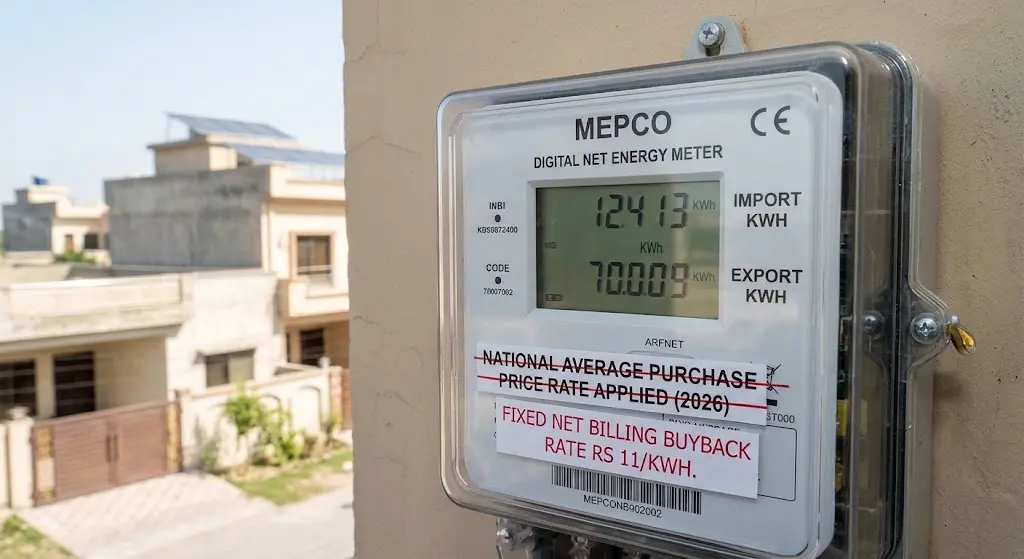
There is also a detail worth clearing up before getting into the numbers: Rs11 is not simply a special MEPCO retail tariff. It is the approximate figure being reported for the national average purchase price used for exported solar electricity. The exact treatment depends on the applicable NEPRA framework and any later notifications or amendments.
For anyone in the MEPCO service area who already has solar, is applying for a new connection, or is considering an installation, that distinction matters.
1. Why the Rs11 Figure Matters for MEPCO Solar Users
Under the previous net-metering arrangement, the attraction was straightforward.
You generated electricity during daylight hours, used some of it in your home, and exported the excess to the grid. Electricity imported from the grid could then be offset against electricity exported to the grid according to the applicable net-metering rules.
The 2026 framework changed the billing mechanism.
NEPRA’s Prosumer Regulations, 2026 introduced a net-billing arrangement in which electricity supplied by the licensee to the prosumer is billed according to the applicable tariff, while electricity supplied by the prosumer to the licensee is billed at the national average energy purchase price.
So the value of an exported unit is no longer automatically the same as the price you pay for an imported unit.
That is where the roughly Rs11 figure becomes significant.
A MEPCO consumer could, depending on the billing situation, pay the applicable tariff for electricity taken from the grid while receiving a much lower credit for electricity exported from the solar system.
This is why the economics of solar have changed even though the panels themselves have not.
The useful part is still the electricity you generate and consume directly. The less useful part, financially, is generating large amounts of electricity only to send it back to the grid at the lower purchase price.
That difference is easy to miss when someone simply says, “Solar is still connected to the grid.”
The connection may be the same physical connection, but the accounting behind it is different.
2. Rs11 Is Not a Separate MEPCO Electricity Tariff
This is where people usually go wrong.
You may see the phrase “MEPCO buyback rate Rs11” and assume MEPCO has independently announced a flat Rs11 tariff for every solar consumer.
That is not the right way to understand the 2026 framework.
The regulations state that electricity supplied by the prosumer to the licensee is billed according to the national average energy purchase price.
So, for a MEPCO customer, the important question is not simply:
“What rate does MEPCO pay me?”
It is:
“What purchase price is applicable to exported electricity under the current NEPRA prosumer framework?”
That wording matters because regulatory rates and arrangements can change through notifications and amendments.
NEPRA’s own news record shows that the Prosumer Regulations, 2026 were notified on February 9, 2026, and that amendments were subsequently notified during 2026, including an amendment dated August 6.
So I would not treat an online Rs11 figure as a permanent lifetime rate.
For a person calculating the return from a solar installation, the safest approach is to check the applicable NEPRA rules and current notifications rather than building a 10-year calculation around one headline number.
For readers of mepcco-bill.pk, this is also why I prefer separating the actual regulation from the simplified number used in news reports.
3. Old Net Metering vs New Net Billing
The easiest way to understand the change is to put the two arrangements beside each other.
| Feature | Earlier net metering | 2026 prosumer framework |
|---|---|---|
| Basic arrangement | Net metering | Net billing |
| Electricity imported from grid | Offset against exported electricity under the applicable framework | Billed at the applicable consumer tariff |
| Electricity exported to grid | Previously settled through the net-metering mechanism | Credited at the national average energy purchase price |
| One-for-one unit adjustment | Core feature of the old arrangement | Replaced by monetary credit |
| Value of self-consumed solar | Reduces grid consumption | Still reduces grid consumption |
| Value of surplus solar | Historically more closely linked to retail electricity value | Lower because export credit is based on the purchase-price mechanism |
| Main concern for new users | Export/import rules | Difference between import cost and export credit |
The official regulation is quite clear on the basic billing structure. At the end of the billing cycle, the licensee calculates the electricity supplied to the prosumer and the electricity supplied by the prosumer to the licensee under the net-billing arrangement.
There is another useful point.
If the billed amount associated with electricity supplied by the prosumer exceeds the billed amount associated with electricity supplied by the licensee, the regulations provide for the resulting net amount to be credited against the next billing cycle or paid by the licensee quarterly.
That means the system has not simply stopped recognizing exported solar electricity.
The method of valuing it has changed.
4. What This Means for a MEPCO Household
Imagine a house with solar panels producing electricity during the day.
At noon, the family might be running fans, refrigerators, a water pump, computers and other appliances. Some of the solar electricity is consumed immediately.
That part is still valuable.
Every unit of solar generation used directly by the house is a unit that does not have to be purchased from MEPCO at the applicable grid tariff.
The situation changes when generation is much higher than daytime household consumption.
Suppose the solar system produces a large surplus while nobody is using much electricity. That surplus goes toward the grid under the approved arrangement. Under the 2026 framework, the exported electricity receives the applicable national average energy purchase price rather than simply cancelling an imported unit at the retail tariff.
This creates a simple financial lesson:
Self-consumption and export are no longer equally valuable.
That is probably the most useful thing for a prospective solar customer to understand.
A system designed around daytime self-consumption has a different financial profile from a system designed to produce a large surplus for export.
This also makes household usage patterns more important.
A family that uses most of its electricity during daylight hours has a different situation from a household where the biggest loads happen after sunset.
And that is a point people sometimes skip because they focus too heavily on the number of panels.
5. Existing MEPCO Solar Customers Need to Check Their Agreement
Not every person with a MEPCO solar connection should assume the new arrangement applies in exactly the same way.
The 2026 regulations contain transitional provisions for distributed generators with valid agreements under the repealed regulations. The regulations state that such agreements remain subject to specified treatment during their existing term, with the applicable framework changing when the agreement expires or is renewed.
That makes your existing paperwork important.
If you already have a valid agreement, do not rely solely on a social-media post saying that every solar customer has immediately moved to the Rs11 arrangement.
Check:
- The date of your agreement
- The applicable net-metering or prosumer arrangement
- The expiry date
- Your current billing treatment
- Any amendments or notifications that affect your agreement
This is particularly important because NEPRA’s regulatory framework changed during 2026 and amendments were subsequently issued.
A useful related explanation is our guide on MEPCO net metering rules updated under NEPRA 2026, especially if you are trying to understand where an existing connection fits into the new framework.
6. New Solar Applicants Face a Different Calculation
For someone considering a new solar installation in the MEPCO area, the calculation should now start with consumption rather than the old assumption that every exported unit is as valuable as an imported unit.
Look at the household’s actual electricity pattern.
How much electricity is being consumed during the day?
How much is consumed after sunset?
How much of the solar generation is likely to be used directly?
How much could become surplus?
These questions are more useful than simply asking how many kilowatts of panels can fit on the roof.
A simple example makes the point.
Suppose a solar system generates 20 units during a particular period.
If the household directly uses 15 of those units, only 5 units need to be considered as surplus for export.
Now compare that with a household that uses only 8 of those 20 units during solar-generation hours. The remaining 12 units have a different financial value because they are exported rather than directly replacing grid electricity.
The exact bill calculation depends on the consumer’s tariff, billing period, imports, exports and applicable regulatory treatment. But the principle remains simple.
The first unit of solar electricity you use yourself is generally more valuable to the household than a unit generated only for export when export compensation is substantially below the retail tariff.
That is the calculation homeowners should understand before choosing system size.
7. The Part of the Change That Gets Overlooked
There is a tendency to talk about the Rs25.9 figure from the old system and the roughly Rs11 figure under the new framework as if the entire value of solar has been cut by the same percentage.
That is too simple.
A solar system does two different things for a household.
First, it supplies electricity directly.
Second, it exports excess electricity.
The regulatory change mainly affects how exported electricity is valued.
Direct solar consumption still means the household does not need to purchase that same electricity from the grid.
This distinction is especially relevant for MEPCO customers whose daytime loads are predictable.
A home with heavy daytime consumption could use a significant share of its generation before electricity ever reaches the grid.
A home that is empty throughout the day may export much more of its generation.
So two houses with identical solar systems can have very different financial results.
This is one reason I would be careful with blanket claims that solar is either “finished” or automatically a perfect investment. The numbers depend on the system, consumption profile, tariff, financing cost, maintenance, generation and the applicable export rules.
8. What a MEPCO Consumer Should Check on the Bill
The easiest way to understand how the new arrangement affects you personally is to look at your actual billing data.
Keep an eye on the following:
| What to check | Why it matters |
|---|---|
| Imported kWh | Shows how much electricity you took from the grid |
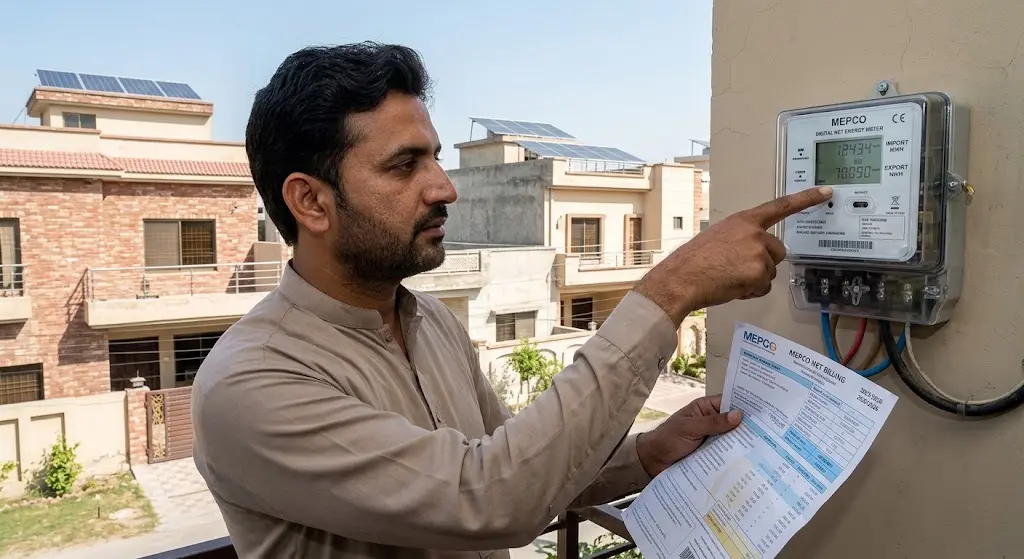
| Exported kWh | Shows how much solar electricity went to the grid |
| Applicable import tariff | Determines the value of electricity purchased from MEPCO |
| Export credit | Shows how exported electricity is being valued |
| Billing period | Helps compare one cycle with another |
| Existing agreement date | Important for determining applicable transitional treatment |
| Credit carried forward | Shows whether excess export value remains available under the applicable arrangement |
Do not judge the new system from one unusually low or high bill.
Compare several billing cycles.
Summer consumption can be very different from winter consumption, particularly when air conditioners are involved. Solar generation also changes through the year.
And there is a small practical detail worth mentioning: keep copies of your agreement and previous bills. When regulations change, having the old documents in front of you is much easier than trying to reconstruct your situation months later.
If your MEPCO bill contains an unexpected solar adjustment, credit or charge, compare it with the meter readings and previous billing cycle before assuming the Rs11 figure itself is the cause.
9. Common Mistakes People Make About the Rs11 Buyback Rate
The first mistake is treating Rs11 as a fixed MEPCO retail tariff.
It isn’t.
The 2026 regulations refer to the national average energy purchase price for electricity supplied by the prosumer to the licensee.
The second mistake is assuming every existing solar customer immediately moved onto identical terms.
Existing agreements have transitional provisions, so the agreement date and status matter.
The third mistake is calculating solar savings using the export rate alone.
That misses self-consumption.
If you generate electricity and use it directly, you reduce the amount of electricity you need to purchase from the grid.
The fourth mistake is sizing a new system around maximum possible generation without considering daytime demand.
More panels are not automatically better if a large percentage of the extra generation becomes low-value export.
The fifth mistake is using an old net-metering calculator for a new 2026 application.
The billing mechanism changed, so calculations based on one-for-one unit adjustment can produce a misleading result for a new prosumer.
For related background, readers can also compare the explanation of MEPCO net metering vs off-grid solar before deciding which setup matches their household.
10. What the Rs11 Change Means for Solar Payback
Solar payback is now more sensitive to how electricity is consumed.
Under the older arrangement, surplus exports could provide substantial value because exported units participated in the net-metering mechanism.
Under the newer arrangement, a lower export credit means the payback calculation has to distinguish between:
Solar electricity used directly
and
Solar electricity exported to the grid.
That difference should be included in any serious calculation.
A homeowner should also account for the cost of the solar system, inverter replacement, maintenance, financing if applicable, expected generation, degradation, and the applicable electricity tariff.
I would not use a simple formula such as:
Total solar cost ÷ Rs11 export income
because that ignores the main saving from replacing grid electricity with self-generated power.
At the same time, using the full retail electricity tariff for every solar unit would also be misleading if a significant portion of the system’s output is exported.
The honest calculation sits between those two extremes.
This is also why our MEPCO solar net billing information should be read alongside your actual consumption and billing records rather than treated as a substitute for them.
11. What Happens to Excess Solar Electricity?
Under the net-billing arrangement, the distribution company purchases electricity supplied by the prosumer and provides credit based on the applicable national average energy purchase price.
If the resulting billed amount from exported electricity exceeds the billed amount associated with electricity supplied by the licensee, the regulations provide for the net amount to be credited against the next billing cycle or paid quarterly.
That is different from the old mental model of simply counting imported and exported units and cancelling them against each other.
The accounting is now based on monetary value.
For a MEPCO consumer, that means your bill can no longer be understood properly by looking at only one meter reading.
You need to know both sides of the transaction.
How many units came from the grid?
How many went to the grid?
What price was applied to each side?
Once you look at it that way, the new system becomes much easier to understand.
12. A Practical Way to Think About Solar in 2026
I would break the decision into three parts.
Part one: daytime consumption.
Work out how much electricity your home uses while the solar system is producing.
Part two: solar generation.
Estimate realistic generation rather than assuming the panels will produce their maximum rated capacity every day.
Part three: export.
Estimate how much electricity will remain after your own household consumption and understand that exported electricity is credited under a different pricing mechanism.
That gives you a much more useful picture than simply comparing the old Rs25.9 figure with the new Rs11 figure.
The policy has changed, but the basic household question has not:
How much electricity can your solar system replace before you have to buy electricity from the grid?
For many homeowners, that is still the number worth paying attention to.
Frequently Asked Questions
Is the MEPCO solar buyback rate exactly Rs11 per unit in 2026?
Rs11 is commonly used as an approximate figure for the current export value, but the regulations define compensation by reference to the national average energy purchase price. It should not be treated as a permanent MEPCO-specific fixed rate.
Does the Rs11 rate apply to every existing MEPCO net-metering customer?
Not necessarily. The 2026 regulations contain transitional provisions for customers with valid agreements under the previous framework, so the date and status of the existing agreement matter.
Can I still export excess solar electricity to the MEPCO grid?
The 2026 framework provides for electricity supplied by a prosumer to the licensee to be purchased and credited under the net-billing arrangement. The important change is how that exported electricity is valued.
Why does self-consumed solar matter more under the new system?
Because electricity used directly by the household replaces electricity that would otherwise have been purchased from the grid at the applicable consumer tariff. Exported electricity receives the applicable national average energy purchase price instead.
Should I install a smaller solar system because of the lower buyback rate?
There is no single system size that fits every MEPCO household. Your daytime consumption, evening consumption, roof capacity, system cost, expected generation and expected amount of export all affect the calculation. A system designed around actual household use is more informative than choosing a size solely from the export rate.
The Rs11 figure gets attention because it is easy to compare with the older numbers. But the more useful change to understand is the move from unit-for-unit netting toward a system where imported and exported electricity have different values.
For MEPCO consumers, the practical question in 2026 is not simply how much solar electricity the roof can produce. It is how much of that electricity the household can actually use, and how much surplus will be sold back under the current regulatory framework.
For more MEPCO billing and consumer information, visit mepcco-bill.pk.