
A noticeable change on a MEPCO bill is not always caused by using more electricity.
Sometimes the units are almost the same as the previous month, yet the payable amount moves. That is where the 2026 tariff structure becomes relevant. The electricity rate applied to a MEPCO consumer depends on the applicable consumer category, consumption slab, sanctioned load, and other charges appearing on the bill.
For 2026, NEPRA’s tariff record shows a revised framework for MEPCO under the national consumer-end tariff. The Federal Government notified the MEPCO schedule through S.R.O. 47(I)/2026, with effect from January 1, 2026.
That doesn’t mean every MEPCO customer suddenly pays one identical per-unit price.
This is where people usually get confused.
1. The 2026 MEPCO rate is not simply one price per unit
When someone asks, “What is the MEPCO unit rate in 2026?”, the short answer is that there isn’t one rate that applies to every household.
The tariff schedule separates consumers into categories and consumption slabs. Residential consumers, commercial connections, industrial consumers, and other categories have different tariff arrangements. Residential customers themselves are divided according to consumption and protected or non-protected status.
The NEPRA tariff documentation also distinguishes between variable charges and fixed charges. The 2026 policy changes specifically introduced or revised fixed charges for domestic consumers other than lifeline consumers.
For ordinary residential consumers, the applicable rate therefore needs to be read together with the slab shown on the bill.
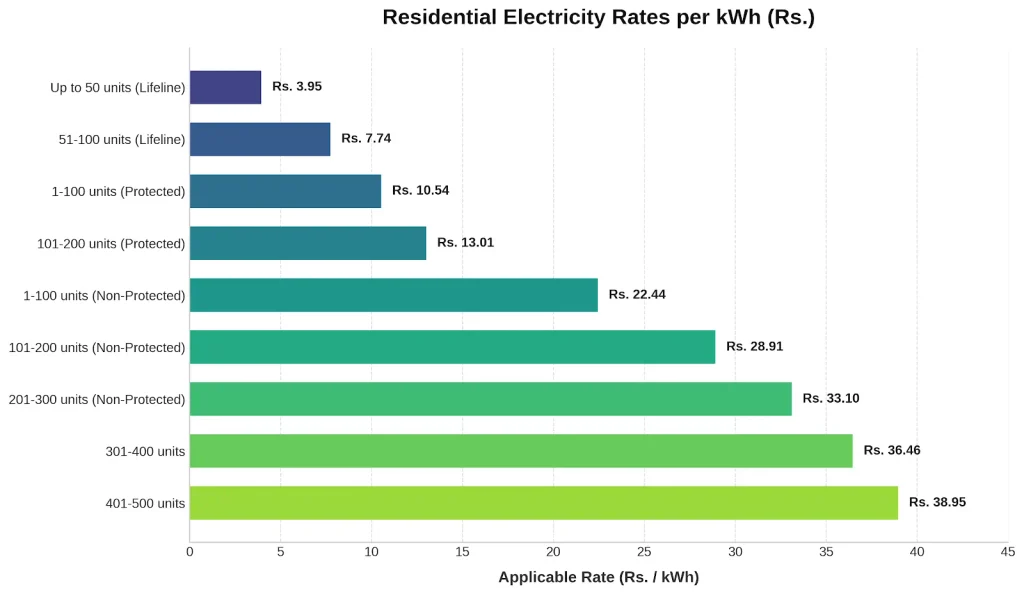
A useful reference from the 2026 notified tariff schedule is:
| Residential category | Uniform applicable rate |
|---|---|
| Up to 50 units, Lifeline | Rs. 3.95/kWh |
| 51-100 units, Lifeline | Rs. 7.74/kWh |
| 1-100 units, Protected | Rs. 10.54/kWh |
| 101-200 units, Protected | Rs. 13.01/kWh |
| 1-100 units, Non-Protected | Rs. 22.44/kWh |
| 101-200 units, Non-Protected | Rs. 28.91/kWh |
| 201-300 units, Non-Protected | Rs. 33.10/kWh |
| 301-400 units | Rs. 36.46/kWh |
| 401-500 units | Rs. 38.95/kWh |
| 501-600 units | Rs. 40.22/kWh |
| 601-700 units | Rs. 41.85/kWh |
| Above 700 units | Rs. 47.20/kWh |
These figures come from the 2026 tariff schedule and should not be interpreted as the final amount a customer pays on the bill. Taxes, duties, adjustments and other applicable charges are separate components.
There is another detail worth keeping in mind. The tariff documentation identifies a distinction between protected and non-protected residential consumers. So two homes with similar current consumption aren’t necessarily billed in exactly the same way if their consumer status differs.
That distinction matters more than simply looking at the number of units.
2. Why your bill can rise even when the units have not changed much
The per-unit tariff is only one part of a MEPCO bill.
A household might look at the “Units Consumed” figure, compare it with last month’s bill and expect the payable amount to move proportionally. Electricity bills don’t work quite that neatly.
The bill can contain energy charges along with fixed charges, government taxes, duties, surcharges and adjustments applicable to the billing period.
The 2026 Federal Government tariff rationalization documents specifically discuss the introduction or revision of fixed charges for domestic consumers other than lifeline consumers. The policy reasoning was linked to recovering a greater share of the power sector’s fixed costs rather than relying entirely on volumetric consumption.
So, if your MEPCO bill looks higher than expected, don’t immediately assume that the meter reading is wrong.
Check the bill line by line.
This is also why keeping an older bill is useful. You can compare the current meter reading, previous reading, units, tariff category, fixed charges and adjustments instead of comparing only the final payable amount.
At mepccobill.pk, I would use the same approach when checking a bill online: first identify the basic billing information, then look at the charges that explain the final amount.
And if the issue is an unexpected special charge rather than the normal tariff, it is worth understanding the difference between an ordinary bill and a MEPCO detection bill.
3. What the 2026 tariff means for different residential users
The effect of the tariff depends heavily on where a consumer falls in the residential structure.
A low-consumption lifeline customer is treated differently from a household using several hundred units. A protected consumer is also treated differently from a non-protected consumer.
For example, the 2026 schedule lists a uniform applicable rate of Rs. 3.95 per kWh for consumption up to 50 lifeline units and Rs. 7.74 per kWh for the 51-100-unit lifeline category. The protected 1-100 and 101-200 unit categories have uniform applicable rates of Rs. 10.54 and Rs. 13.01 respectively.
Once consumption moves into higher categories, the applicable rate increases.
This is why crossing a consumption threshold deserves attention.
A household that normally stays near a particular slab should not treat every additional unit as though it has exactly the same billing effect. The applicable tariff structure matters.
There is also a separate Time of Use arrangement for residential consumers whose sanctioned load is 5 kW or above. The tariff schedule lists separate peak and off-peak rates for this category.
That makes the sanctioned load another detail worth checking before trying to calculate a bill from a simple “units × rate” formula.
A practical way to read your bill:
- Check the current and previous meter readings.
- Confirm the number of units billed.
- Look at the consumer tariff/category.
- Check whether the connection is protected, non-protected or lifeline where applicable.
- Look for fixed charges.
- Review taxes and other government charges.
- Check whether an adjustment has been included.
- Compare the final amount with the previous bill.
It sounds basic, but this catches a surprising number of misunderstandings.
4. The part people usually miss: NEPRA rate versus the amount on your bill
There are several numbers in the tariff documents, and they don’t all mean the same thing.
NEPRA’s tariff material distinguishes between the regulator-determined tariff and the uniform applicable tariff. The official January 2026 notification also refers to the final tariff determined by NEPRA and the Government’s tariff-rationalization arrangements.
So if you find a table online showing an MEPCO rate and then notice that your bill doesn’t equal that rate multiplied by your units, that isn’t automatically evidence of an incorrect bill.
The calculation has more pieces.
For example, the January 2026 schedule contains MEPCO-specific variable charges as well as a separate uniform national applicable tariff. For residential categories, the MEPCO variable figures in the schedule differ from the final uniform applicable figures.
This distinction is easy to overlook because many websites simply publish a list headed “MEPCO per unit rate.”
A cleaner way to think about it is:
Tariff rate → energy charge → fixed/other applicable charges → taxes and adjustments → final bill amount
The arrows aren’t a literal billing formula for every consumer category, but they illustrate why the headline per-unit figure should not be treated as the complete bill calculation.
And this is where I would be careful with online bill calculators. They are useful for estimates, but the actual MEPCO bill remains the better reference for the amount payable.
5. What changed in the 2026 tariff structure
The 2026 changes weren’t limited to changing a number beside “Rs./kWh.”
The Federal Government’s February 2026 motion explained that the tariff structure was being recalibrated because a significant portion of power-sector costs are fixed while the existing system relied heavily on volumetric recovery. The proposed approach included changes to fixed charges while keeping the targeted tariff differential subsidy within the stated limits.
NEPRA’s January 2026 record also shows that MEPCO’s tariff was considered under a Multi Year Tariff framework for FY 2025-26 through FY 2029-30.
There is another reason not to treat the January tariff notification as the only number that matters for the whole year.
NEPRA continued issuing tariff adjustment decisions during 2026. Its MEPCO tariff page lists, among other things, periodic adjustments and fuel charge decisions during the year.
So a bill issued later in 2026 can reflect applicable adjustments beyond the basic tariff schedule.
That is probably the most useful point for an ordinary consumer.
The rate printed in a general 2026 tariff table is not necessarily the only charge affecting your current bill.
6. How to check whether your current MEPCO bill makes sense
When I check an electricity bill, I wouldn’t start with the final amount.
I’d start with the readings.
Suppose the previous reading was 18,420 and the current reading is 18,510. The billed consumption is 90 units, assuming there are no meter-reading complications. From there, check the tariff category and the applicable slab.
Then look below the energy calculation.
This is where fixed charges, taxes, government charges and adjustments enter the picture. If there is an unusual amount, identify its label instead of simply adding up the visible unit rate.
If your bill has a revised or unusual amount, comparing it with a previous bill is particularly useful.
You can also keep a simple record:
| What to record | Why it matters |
|---|---|
| Previous meter reading | Establishes the starting point |
| Current meter reading | Establishes current consumption |
| Units billed | Shows the actual consumption used |
| Tariff category | Determines which rate structure applies |
| Protected/non-protected status | Affects applicable residential treatment |
| Fixed charges | Separate from energy consumption |
| Taxes/duties | Increase the final payable amount |
| FCA/QTA or other adjustment | Explains changes unrelated to basic units |
| Due date | Determines payment timing and possible consequences |
A small side thought here: taking a photo of your meter on the reading date is also a simple record to keep. It’s not a substitute for an official meter reading, but if a reading later looks unusual, having your own dated record gives you something concrete to compare.
And if you’re checking your bill online, make sure you enter the correct reference number. A single incorrect digit can lead to the wrong consumer record.
For payment options, the site’s guide covers online banking, mobile wallets, ATMs, bank branches and other payment channels in more detail. MEPCO bill payment methods is useful if you already have the bill and simply need to pay it.
7. Don’t confuse the tariff change with a meter problem
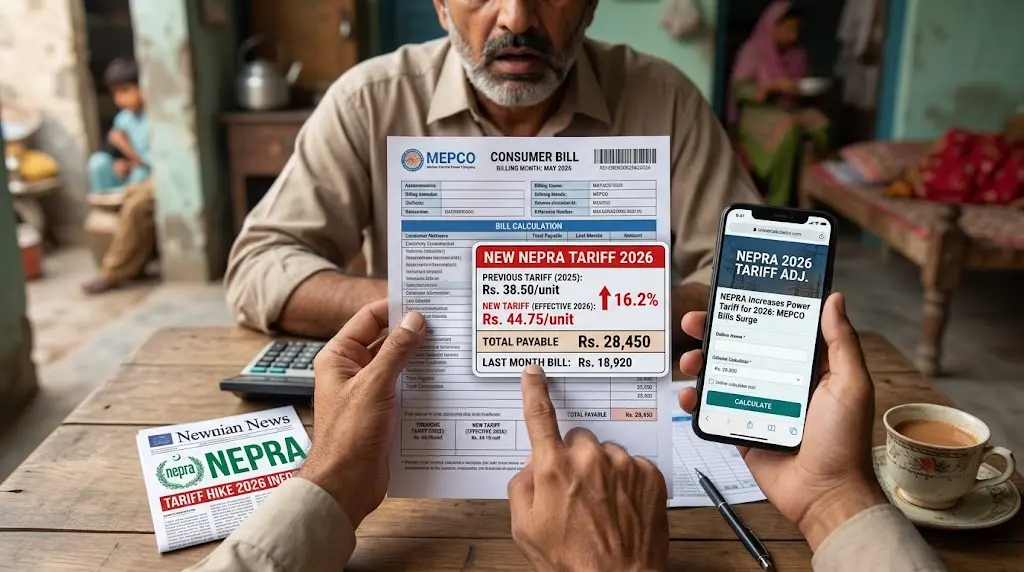
A higher bill doesn’t automatically mean your meter has become faulty.
Likewise, a lower bill doesn’t prove that the tariff has fallen.
There are several things that affect the amount:
- Units consumed
- Consumer category
- Protected or non-protected status
- Sanctioned load
- Fixed charges
- Applicable tariff
- Fuel or periodic adjustments
- Taxes and government charges
- Previous arrears or credits
If your meter reading itself appears inconsistent, that’s a different issue from a tariff change.
For example, if your household used roughly the same amount of electricity for several months but the bill suddenly shows an unusually large jump in units, first investigate the reading and billing period. Don’t simply blame the new 2026 tariff.
On the other hand, if the units are reasonable but the amount changed because a new charge or adjustment appears, then the tariff and billing components deserve closer attention.
That distinction saves a lot of unnecessary confusion.
MEPCO consumers who need customer support can also use the complaint and contact information covered in the site’s MEPCO helpline guide rather than relying on an unofficial number found in a random social-media post.
8. What MEPCO consumers should watch during the rest of 2026
The safest approach is to look at the actual bill for the billing period rather than relying on a tariff table copied months earlier.
NEPRA’s official MEPCO tariff page shows that tariff-related decisions continued throughout 2026, including periodic and fuel-charge adjustments.
That means consumers should pay attention to the billing period and the individual adjustment entries.
For households trying to control electricity costs, monthly unit consumption still matters. But the useful target isn’t simply “keep the bill low.” It is understanding which consumption slab you’re approaching and how your connection is categorized.
This becomes especially relevant in months when air conditioners, water pumps and other high-load appliances run more frequently.
A household that normally sits comfortably below a slab can move into a different billing position during a hot month. The bill then reflects both higher consumption and the tariff structure associated with that consumption.
That’s why comparing three or four consecutive bills is usually more informative than comparing only two.
FAQs About the 2026 MEPCO Tariff
Is there one MEPCO per-unit rate for 2026?
No. Residential consumers are divided into different categories and consumption slabs, while commercial, industrial and other connections have their own tariff structures. The applicable amount also needs to be considered alongside fixed charges, taxes and adjustments.
What is the 2026 rate for MEPCO lifeline consumers?
The 2026 uniform applicable schedule lists Rs. 3.95 per kWh for up to 50 lifeline units and Rs. 7.74 per kWh for 51-100 lifeline units.
Why is my bill higher when my units are almost the same?
The final bill isn’t based only on units multiplied by a per-unit rate. Fixed charges, taxes, duties and applicable tariff adjustments can also affect the payable amount. The 2026 tariff framework specifically introduced or revised fixed charges for domestic consumers other than lifeline consumers.
Does the January 2026 tariff remain the only figure used throughout the year?
Not necessarily. NEPRA’s MEPCO tariff records show additional fuel-charge and periodic-adjustment decisions during 2026, so the applicable bill can include adjustments beyond the basic tariff schedule.
Where should I check if my MEPCO bill looks incorrect?
Start by checking the reference number, meter readings, billing period, units, tariff category and individual charges. If the problem remains, use an official MEPCO customer-support channel and keep the bill available when making the complaint.
The useful habit here is simple: don’t judge a MEPCO bill from the final number alone. Look at the readings, the tariff category and the individual charges underneath it. Once those pieces are clear, a surprising bill usually becomes much easier to understand.
For readers using mepccobill.pk, the same principle applies when checking a duplicate bill online: use the current bill as the source of the actual payable amount, and use tariff information to understand how that amount was reached.
For additional MEPCO information, the site’s articles on MEPCO distribution areas and other consumer services provide related background.
Note: Tariff rates and adjustments are subject to official notifications and decisions. For a payment decision, use the amount and due date printed on the current MEPCO bill and verify any disputed charge through the relevant official channel.

Pingback: MEPCO Net Metering Rules Updated Under NEPRA 2026 – MEPCO Bill Check 2026