I remember how quickly the phrase “net metering” moved from something only solar installers talked about to something ordinary MEPCO consumers were asking about.
At first, the question was usually simple: can my solar panels reduce my MEPCO bill?
Then the questions became more specific. How many panels can I install? What happens to extra units? Why does the meter run backward? And, more recently, why are people saying that net metering has changed?
That last question needs some history, because MEPCO did not create its own separate solar settlement system. The rules have been shaped by NEPRA, amended several times, and applied through distribution companies such as MEPCO.
The biggest change came in 2026, when Pakistan moved from the older net-metering framework to the Prosumer Regulations and a net-billing arrangement for new installations. Existing agreements received transitional protection, which is one reason two solar consumers can still be operating under different billing arrangements.
Here is how we got there.
1. The 2015 rules started the system
The foundation was laid in September 2015.
NEPRA notified the National Electric Power Regulatory Authority (Alternative & Renewable Energy) Distributed Generation and Net Metering Regulations, 2015 through S.R.O. 892(I)/2015. The regulations established a formal framework for consumers who wanted to generate electricity through alternative and renewable energy sources and connect that generation to a distribution company’s network.
That distinction matters.
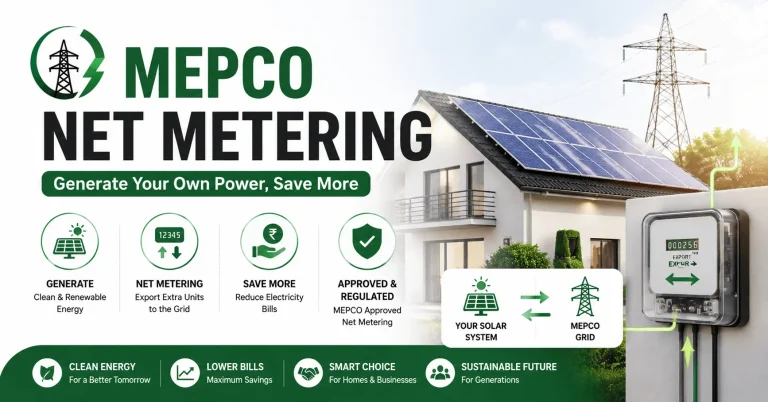
A household with solar panels was no longer simply producing electricity for itself. Once the system was connected to the distribution network under the regulatory framework, electricity could flow in both directions.
During the day, a solar system could produce more electricity than the home was using. The surplus could go into the grid. At another time, perhaps at night, the same consumer could draw electricity from the grid.
The original idea behind net metering was relatively easy to understand:
| Situation | What happens |
|---|---|
| Solar production is lower than household use | Electricity is imported from the grid |
| Solar production matches household use | Little or no grid import is required |
| Solar production exceeds household use | Surplus electricity is exported |
| Billing period ends | Imported and exported electricity is reconciled under the applicable rules |
For a MEPCO consumer, the distribution company was therefore part of a much larger regulatory arrangement. NEPRA established the framework, while the DISCO handled the practical connection and metering side.
This is also why old explanations of “MEPCO net metering rules” sometimes make the process sound more independent than it really was. MEPCO was implementing a national regulatory framework rather than writing an entirely separate set of solar rules.
2. The rules were changed before most people noticed
The 2015 framework did not remain untouched.
NEPRA amended it several times. Its legal archive lists amendments in 2017, 2018, 2020 and 2022, among others.
One of the most significant changes came in September 2018.
NEPRA’s 2018 amendment changed the treatment of system size and the way peak and off-peak electricity was reconciled. NEPRA’s own annual report explains that the previous flat 1 MW ceiling was replaced with a maximum tied to 1.5 times the consumer’s sanctioned load. It also explains that the earlier simple monthly unit netting arrangement was changed so that peak units were netted against peak units and off-peak units against off-peak units.
That sounds like technical paperwork, but it affected the economics of a solar installation.
Imagine a consumer producing electricity during daylight hours and consuming more electricity in the evening. The value of exported and imported electricity was not simply a matter of looking at one total number anymore. Time of use entered the calculation.
And this is where people usually go wrong.
They look at a solar system’s monthly generation and compare it with monthly household consumption as if both numbers automatically cancel each other. The actual settlement rules are more detailed than that.
The regulatory history shows something else too: net metering was never a frozen policy. NEPRA kept adjusting the framework as solar adoption, electricity costs, tariffs and distribution concerns changed.
3. MEPCO consumers became a significant part of the growth
By the early 2020s, net metering was no longer a niche experiment.
NEPRA’s 2021-22 annual report records 7,032 net-metering licences issued during that financial year, representing 243.43 MW of cumulative installed capacity. MEPCO accounted for 1,018 licences and 46.98 MW during that period.
That number is useful because it gives some perspective on MEPCO’s position.
Thousands of consumers were already participating in the system, and MEPCO was dealing with the practical side of connecting distributed generation to its network.
There were also regulatory changes around smaller systems.
In November 2021, NEPRA notified that distributed-generation facilities using solar or wind power up to 25 kW, connected through net-metering facilities, would not require a generation licence from NEPRA.
That did not mean a consumer could simply install panels and connect wires to the grid without approval. Connection, safety, technical and distribution requirements still mattered.
It meant the regulatory treatment of smaller installations was becoming less burdensome.
That trend is worth remembering because something similar happened again in 2026, although under a completely new regulatory framework.
There was also another important development involving the price paid for surplus electricity.
In 2022, NEPRA’s MEPCO tariff determination specifically discussed the growing cost of power purchases and said the Authority would initiate proceedings to amend the 2015 regulations regarding the tariff payable by DISCOs for excess energy supplied by net-metering consumers.
In February 2023, NEPRA addressed the terminology and calculation by considering replacement of the National Average Power Purchase Price, NAPPP, with the National Average Energy Purchase Price, NAEPP. The proceeding noted that the relevant purchase-price figure had risen substantially.
So the story was already moving toward a more complicated question:
What should a distribution company pay for electricity supplied by a consumer?
That question eventually became central to the 2026 change.
4. The 2026 rules changed the meaning of “net metering”
February 9, 2026 is the date to remember.
On that date, NEPRA notified the Prosumer Regulations, 2026, through S.R.O. 251(I)/2026. NEPRA’s legal archive now lists those regulations as the current framework, replacing the earlier distributed-generation and net-metering regulations.
The terminology changed from the older net-metering model to a net-billing arrangement.
The difference is not just a new label.
Under the 2026 framework, electricity supplied by the distribution licensee to the prosumer is billed at the applicable consumer tariff. Electricity supplied by the prosumer to the licensee is credited at the National Average Energy Purchase Price. Regulation 14 sets out this two-sided treatment.
That creates a very different calculation.
Under the older approach, people became accustomed to thinking in terms of one exported unit cancelling one imported unit, subject to the applicable regulatory details.
Under net billing, the two directions have separate values.
| Feature | Earlier net-metering framework | 2026 prosumer framework |
|---|---|---|
| Basic model | Net metering | Net billing |
| Grid electricity consumed | Settled under applicable tariff | Billed under applicable tariff |
| Surplus electricity exported | Credited under the earlier framework | Purchased at the applicable energy purchase price |
| Regulatory document | 2015 regulations and amendments | Prosumer Regulations 2026 |
| Existing agreements | Governed by their applicable arrangements | Transitional protection applies to qualifying old agreements |
| New applications | Older framework | 2026 framework |
This is why an old MEPCO solar customer and someone applying under the new system should not assume their bills will be calculated in exactly the same way.
The difference is regulatory, not simply a change in the appearance of the meter.
5. Existing MEPCO solar customers were not simply switched overnight
This is probably the most misunderstood part of the history.
When a new regulatory framework replaces an old one, people naturally assume every existing customer moves to the new system immediately.
That is not what the transitional provisions were designed to do.
NEPRA’s February 2026 amendment specifically dealt with agreements and approvals issued under the repealed regulations. It provided that qualifying distributed generators with valid agreements under the earlier regulations would continue to be billed according to the earlier rate and mechanism until the expiry of their existing agreements.
That protection is significant for MEPCO consumers who already had valid arrangements before the change.
So, in practical terms, there are two histories running side by side.
One belongs to consumers who entered the old net-metering system and still have a valid agreement.
The other belongs to consumers entering the new prosumer framework after the 2026 change.
And yes, that makes conversations about “the MEPCO net-metering rate” confusing. There isn’t one historical rate or one universal billing treatment that applies to every solar consumer regardless of when the agreement was made.
For readers trying to understand their own paperwork, I would start with the agreement and connection documents rather than a social-media post or a solar installer’s old quotation.
If you are also trying to understand what has changed on the ordinary electricity statement itself, the MEPCO bill format guide is useful because the bill layout and its individual fields tell you what is actually being charged.
6. The rules kept evolving through 2026
There is another detail that gets missed when people describe February 2026 as the “final” version.
It wasn’t.
NEPRA continued amending the Prosumer Regulations during 2026. Its official record shows amendments in April and August, including S.R.O. 1330(I)/2026 notified on August 6, 2026.
One of those later changes concerns smaller distributed-generation systems.
The August amendment removed the requirement for NEPRA concurrence for distributed-generation facilities of 25 kW or below, with the relevant distribution licensee handling approval under the amended framework. The change is reflected in current regulatory explanations of the August amendment.
That is an important practical distinction.
A person researching solar rules in early February 2026 could find information that was technically correct at that moment but incomplete for a consumer applying later in the year.
This is why I prefer checking the actual notification date when writing about electricity regulations. “The 2026 rules” is too broad now. There were the February regulations, subsequent amendments, and later administrative changes.
The same issue comes up with MEPCO billing generally. A bill format, complaint process, meter technology or tariff explanation can change while an older blog post continues circulating.
That is one reason I keep returning to primary regulatory documents when updating information for readers on mepcco-bill.pk.
7. What the history tells a MEPCO consumer today
The history is more useful when it answers a practical question: what should you actually check?
First, establish when your solar agreement was approved and executed.
If you have an older valid agreement, do not assume a new article about net billing automatically describes your settlement mechanism. The transitional rules specifically preserved qualifying existing arrangements until their agreement term expires.
Second, look at the direction of electricity flow.
A bidirectional or otherwise compliant metering arrangement records electricity moving between the premises and the distribution network. The 2026 framework requires metering capable of accounting for the two flows.
Third, separate solar generation from solar export.
Your panels might generate 20 kWh during a particular period, but that does not mean 20 kWh was exported. Some of that electricity could have been consumed immediately by your refrigerator, fans, water pump, inverter AC or other appliances.
That distinction becomes more important under a system where imported and exported electricity have different financial treatment.
And there is a slightly boring but useful side thought here: keep your old bills. People tend to save the latest statement and throw away everything else. A year later, when a meter is changed or a billing dispute appears, the older bills suddenly become very useful.
I would keep the bills, agreement, approval documents and payment records together.
If you are seeing a billing discrepancy unrelated to solar, the site’s guide on MEPCO detection bills explains how inspection-based charges differ from ordinary monthly billing.
For smart-meter users, the MEPCO Smart AMI Meter guide also helps explain why automated readings are different from the old manual-reading process.
The point is not to memorize every regulation number. It is to know which regulatory period your own connection belongs to.
8. A short timeline worth keeping
Here is the version I would save if you want the history without reading through years of notifications:
2015: NEPRA establishes the distributed-generation and net-metering framework through S.R.O. 892(I)/2015.
2017: NEPRA issues amendments to the 2015 framework, including changes concerning eligible applicants and distribution-company procedures.
2018: Major amendments change the system-capacity treatment and introduce separate peak and off-peak netting.
2020: NEPRA revises the fee schedule for distributed-generation licence applications.
2021: Solar and wind distributed-generation facilities up to 25 kW receive an important licensing exemption from NEPRA.
2022: NEPRA considers changes to the purchase price applicable to excess electricity supplied through net metering.
2023: NEPRA addresses the change from NAPPP terminology to NAEPP in the net-metering framework.
February 9, 2026: Prosumer Regulations 2026 are notified, establishing the new net-billing framework.
April 2026: Further amendments and related regulatory instruments appear in NEPRA’s records.
August 6, 2026: NEPRA notifies another amendment, including the revised treatment of concurrence for systems up to 25 kW.
That sequence explains why old and new explanations of MEPCO solar billing sometimes appear to contradict one another. They are frequently describing different regulatory periods.
9. Common questions MEPCO solar users still ask
Is MEPCO’s net metering still the same as it was in 2015?
No. The 2015 framework was amended several times and was ultimately replaced for the new regime by the Prosumer Regulations 2026. Existing qualifying agreements received transitional treatment.
Does every existing MEPCO solar customer move to net billing?
Not automatically. Consumers with valid agreements executed under the repealed regulations are covered by transitional provisions that preserve the earlier billing mechanism until the relevant agreement expires, subject to the applicable conditions.
Why is net billing different from old net metering?
The basic difference is valuation. Under the 2026 framework, electricity supplied by the distribution company is billed at the applicable consumer tariff, while electricity supplied by the prosumer to the licensee receives credit at the National Average Energy Purchase Price.
Did the rules change again after February 2026?
Yes. NEPRA issued further amendments during 2026. The official record shows amendments in April and August, including S.R.O. 1330(I)/2026 on August 6.
What should I check before assuming which rules apply to my solar connection?
Check the date and terms of your approval and agreement first. Then compare the metering arrangement and billing entries with the rules applicable to that agreement period. If the paperwork is unclear, get clarification from MEPCO or the relevant regulatory/customer-service channel rather than relying on an old solar quotation.
The history matters because the name stayed familiar while the rules underneath it changed.
That is probably the simplest way to understand MEPCO net metering. It was never one permanent formula. It was a regulatory system that evolved as distributed solar became a much larger part of Pakistan’s electricity conversation.
And now, in 2026, the important question is no longer simply whether a consumer has “net metering.” It is which framework their connection and agreement actually fall under.
For readers who regularly track their electricity statements, I would keep that distinction in mind every time a new rule is announced. A headline can tell you that the rules changed, but your own agreement tells you which part of that change actually reaches your bill.