
The part of a detection bill that usually catches my attention first is not the amount. It is the period.
A consumer sees a large number of units, looks at the charges, and naturally assumes the whole calculation must be correct because it came from MEPCO. That is where things sometimes get complicated. The rules do not simply say that a distribution company can pick an estimated number and recover it for as many months as it wants.
The current Consumer Service Manual, revised by NEPRA on November 26, 2025, contains specific provisions for detection bills, evidence of theft, calculation methods, notices, review, and complaint handling. MEPCO is one of the distribution companies to which this updated manual was circulated.
I have looked at MEPCO detection-bill cases on the NEPRA record before, and one pattern is worth keeping in mind: the calculation is only one part of the dispute. The consumption history, inspection evidence, period being charged, and method used to calculate the units all matter.
1. The Six-Month Rule Is the First Number to Check
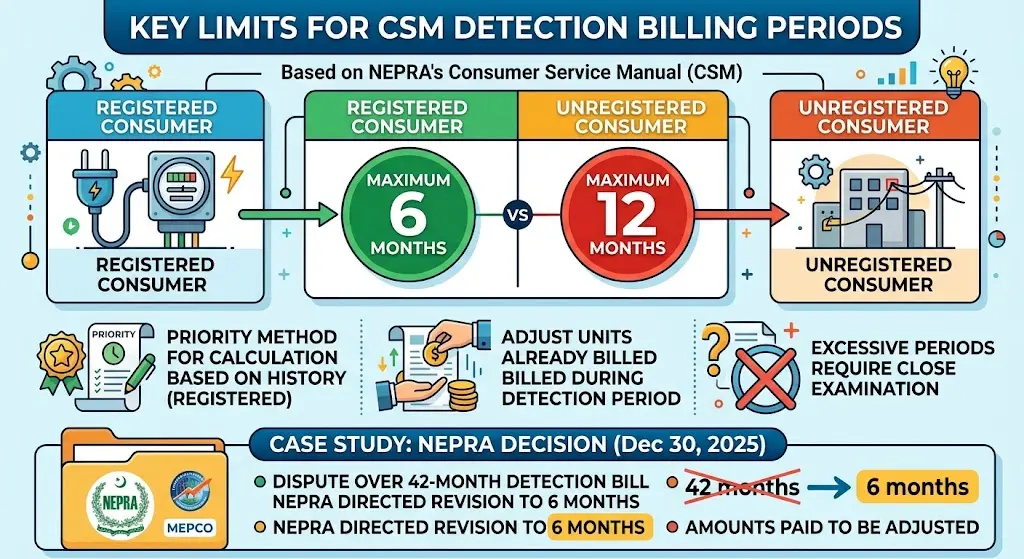
For a registered consumer, the updated CSM sets a maximum detection-billing period of six months in the relevant theft provisions. For an unregistered consumer, the maximum period is twelve months.
That distinction is easy to miss.
The manual states that DISCOs may recover losses through a detection bill, but the maximum charging period is restricted to twelve months for unregistered consumers and up to six months for registered consumers.
So, for a registered MEPCO connection, a detection bill covering several years deserves very close examination.
This isn’t just a theoretical point. A December 30, 2025 NEPRA decision involving MEPCO directed the company to revise a detection bill that had been calculated over 42 months. NEPRA referred to Clause 9.1.3(b) and directed that the bill be revised to the permitted six-month period, with amounts already paid adjusted.
That decision is useful because it shows how the rule works in an actual MEPCO dispute.
Here is the quick reference I use when checking the period:
| Consumer situation | Maximum period under the CSM |
|---|---|
| Registered consumer | Up to 6 months |
| Unregistered consumer | Up to 12 months |
| Registered consumer, calculation based on history | Priority method applies |
| Units already billed during detection period | Must be adjusted |
The six-month ceiling does not mean every registered consumer automatically receives a six-month detection bill. The circumstances and applicable provision still matter. But it does mean that a much longer assessment should not simply be accepted without checking the legal basis.
2. MEPCO Cannot Treat Every Detection Bill the Same Way
There is another part of the rule that matters just as much as the six-month period: how the detection units are calculated.
For registered consumers, Clause 9.1.3 gives an order of priority.
First comes previous consumption or billing history.
If credible previous consumption is unavailable, future undisputed consumption can be considered.
Only after that does the load-based calculation come into play.
The load formula is:
Detection units = Load × Load Factor × 730 × Months
The manual defines load for the registered-consumer calculation as the connected load or sanctioned load in kW, whichever is higher. It also specifies the use of the applicable load factor in Annexure V and 730 as the average number of hours in a month.
This is one of those technical details that makes a big difference to the final number.
For example, suppose an inspection records a connected load that is higher than the sanctioned load. That does not automatically mean the calculation should ignore the consumer’s actual billing history. The CSM places previous billing history first, followed by future undisputed consumption where previous credible consumption is unavailable, and then the load formula.
And the units already charged through routine monthly billing during the detection period have to be adjusted.
That last part is particularly important when someone is checking a surprisingly high detection bill.
Where people usually go wrong
They look only at the final rupee amount.
I would start somewhere else.
Look at the detection period. Then look at the number of detection units. Then ask how those units were calculated. After that, compare the calculation with the billing history.
A bill that looks frightening at first can become much easier to understand once these four pieces are separated.
3. Evidence Matters, Not Just an Inspection Remark
A detection bill connected with alleged electricity theft is not supposed to exist in a vacuum.
Clause 9.1.4 of the CSM states that photographs and/or videos are to be recorded as evidence of theft for presentation before the competent forum.
The manual also identifies various indications that can lead to further investigation in cases involving illegal abstraction by registered consumers. These include broken or tampered meter seals, missing terminal covers, holes in the meter body, reverse running, damaged components, a broken neutral, changes to polarity, shunts, chemical interference, and other means that interfere with accurate recording of demand or energy consumption.
That does not mean every damaged meter proves theft.
The wording matters. These are indications that lead to further investigation. The procedure then requires the metering installation to be secured, with a check meter installed where applicable, and photographs or video may be recorded as evidence. Once illegal abstraction is confirmed, the consumer is served a notice describing the allegations and given seven days to submit a reply.
This is one reason I would keep any inspection paperwork instead of relying only on the printed bill.
A consumer should ideally have copies of:
- The detection bill
- The inspection report or relevant inspection information
- Previous electricity bills
- Payment records
- Meter-related documents
- Any notice received from MEPCO
- Photographs or other evidence supplied during the dispute, where available
It sounds like paperwork for a paperwork problem. In practice, those records can make a billing dispute much easier to explain.
4. The Notice and Seven-Day Reply Period Are Easy to Miss
The procedure becomes more specific once illegal abstraction by a registered consumer is established.
Under the CSM, after confirmation of the issue, the consumer is served a notice by the SDO/AM(O) explaining the allegations and allowing seven days to furnish a reply. The reply is then examined by the relevant higher officer. If the response is unsatisfactory, no response is received, or the allegations are admitted, the detection bill can be served with the required approval.
The detection bill is also served along with a disconnection notice requiring payment within seven days under the procedure described in the manual.
That creates an important practical distinction.
Receiving a detection bill is not the same thing as receiving an ordinary monthly electricity bill.
The consumer should read the notice, not just the amount.
If you disagree with the allegation, don’t wait until the amount becomes an even bigger problem. Put the objection on record and preserve the documents supporting it.
The current rules also provide a formal review route. A consumer who disputes the detection bill can approach the DISCO’s review committee, and the CSM provides for a personal hearing before that committee.
For readers using MEPCO services, this is where a clear record becomes valuable.
5. Detection Bills Are Supposed to Show What You Are Being Charged For
A detection bill should not be treated as a mysterious extra figure added somewhere to the account.
The CSM requires theft detection bills to be issued separately and to show details including the reason, number of units, amount, detection period, and taxes. DISCOs are also required to maintain records of detection bills issued and payments made by consumers.
That gives you several things to check.
| Check this | Why it matters |
|---|---|
| Reason for detection bill | Shows what irregularity is being alleged |
| Number of units | Lets you examine the calculation |
| Detection period | Important because maximum periods apply |
| Amount | Helps separate energy charges from other components |
| Taxes | Confirms the bill’s complete financial calculation |
| Previous billed units | These may need adjustment |
| Inspection information | Helps establish what was actually found |
This is also where the newer MEPCO bill layout can be useful. The Ministry of Energy said the redesigned electricity bill was introduced to make consumption, payment information and other billing details easier to understand, with MEPCO among the DISCOs that started printing the new format in June 2026.
I’ve found that the clearer the ordinary billing record is, the easier it becomes to compare it against a disputed assessment.
If you want to understand how the redesigned bill is organized, the related guide on MEPCO’s updated bill format is useful background.
6. A Detection Bill Can Be Challenged When the Calculation Does Not Match the Evidence
This is probably the most important practical point.
A detection bill is not automatically beyond review simply because it was issued by the distribution company.
NEPRA’s own MEPCO decisions show cases where detection bills have been withdrawn or revised after the authority examined the billing history and evidence.
In one October 2024 MEPCO case, NEPRA found that the company had failed to provide concrete photographic or video evidence supporting the alleged direct theft and that the consumer’s consumption history did not show the type of reduction being relied upon. The detection bill was ordered to be withdrawn.
There are also cases going the other way.
In another MEPCO decision from October 2024, NEPRA found that the detection bill was supported by evidence of direct theft and suspicious consumption after meter replacement. The bill was considered valid under the applicable CSM provisions.
That contrast is useful.
It means the sensible position isn’t “every detection bill is wrong.”
It is also not “every detection bill must be paid without question.”
The facts matter.
And this is why comparing your old bills is more than a casual exercise. A consistent consumption pattern may become relevant when the assessment relies heavily on an alleged reduction in recorded consumption. On the other hand, a clear inspection record, supporting evidence, and unusual consumption pattern can strengthen the case for the assessment.
7. What I Would Check Before Filing a Complaint
If I were sitting with a MEPCO detection bill in front of me, I’d work through it in this order.
First, identify the exact reason given for the bill.
Second, mark the starting and ending dates of the detection period.
Third, determine whether the connection is registered and check the applicable maximum period.
Fourth, compare the units charged with previous consumption and, where relevant, future undisputed consumption.
Fifth, check whether routine monthly units during the same period have already been accounted for.
Sixth, look at the load figure used in the calculation and whether the stated load factor is applicable.
Seventh, collect the inspection notice, inspection report, photographs or videos, meter information and previous bills.
This process takes a little longer than simply looking at the payable amount, but it gives you something much more useful: a specific objection.
Instead of saying, “My bill is too high,” you might discover that the real issue is, “The detection period exceeds the applicable limit,” or “The billing history was not considered,” or “Units already charged in routine bills were not adjusted.”
Those are very different complaints.
For general billing information, I also recommend keeping your normal MEPCO records organized. The guides published by mepcco-bill.pk are intended to make that process easier, particularly when a consumer needs to compare an unusual bill with previous billing information.
For example, the site’s guide to MEPCO bill payment methods is useful if you need to understand how normal bills are paid and recorded.
8. MEPCO Consumers Have a Specific Complaint Route
The updated CSM does not leave billing complaints without a timeframe.
Under the billing-complaint provisions, ordinary errors such as wrong meter readings or calculation errors are assigned specific handling periods. More importantly for this subject, complaints regarding detection bills are required to be settled by the DISCO within 15 days from receipt of the complaint.
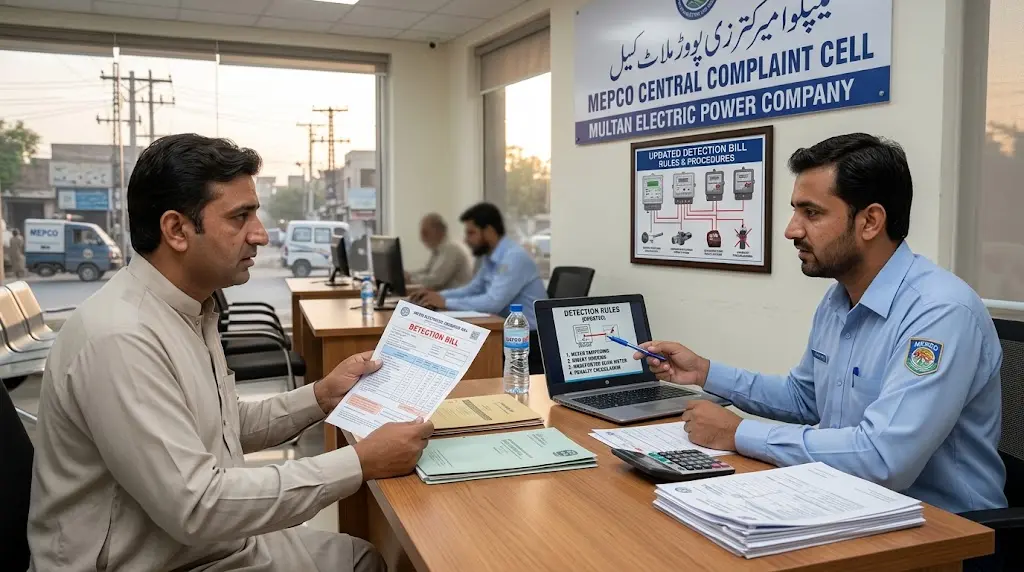
Complaints can be registered through the relevant MEPCO consumer service channels, and the CSM says billing complaints are registered through the Sub-Divisional Office, Consumer Service Center or One-Window Operation in DISCO offices.
The same manual also describes consumer service centers as places for handling different categories of complaints.
If the matter remains unresolved, consumers can use the appropriate regulatory complaint process. NEPRA maintains a dedicated record of MEPCO consumer decisions, including several detection-bill cases in 2026. The record shows decisions dated January, February and August 2026 concerning complaints against MEPCO, including detection-bill disputes.
For broader contact information, you can also review the site’s MEPCO helpline and complaint guide, but for a disputed bill I would still keep the complaint reference and supporting paperwork.
9. The Updated Rules in Plain English
After going through the current CSM and recent MEPCO decisions, I think the simplest way to remember the rules is this:
A detection bill needs a reason, a period, a calculation and supporting evidence.
For a registered consumer, the relevant theft provision limits the charging period to six months. For an unregistered consumer, it allows up to twelve months.
For registered consumers, the calculation follows a priority order: previous billing history, future undisputed consumption when credible previous history is unavailable, and then the load-based formula. Routine units already charged during the detection period are to be adjusted.
Evidence also matters. The CSM requires photographs and/or videos to be recorded for evidence of theft for presentation before the competent forum.
And once an illegal-abstraction case reaches the detection-bill stage, the manual provides for notice, a seven-day response period, review by the DISCO’s review committee when disputed, and a separate detection bill showing the relevant details.
That is a much better framework for checking a detection bill than simply asking whether the amount looks high.
A final side thought: the terminology on these bills can be intimidating. “Detection,” “abstraction,” “load factor,” and “billing history” sound like they’re written for engineers. They’re not impossible to work through. Once each figure is separated and checked against the CSM, the bill becomes a series of questions rather than one giant number.
And if one of those questions doesn’t add up, that is the part worth putting in writing.
FAQs
What is the maximum detection-bill period for a registered MEPCO consumer?
Under Clause 9.1.3 of the revised CSM, the maximum period for charging in the relevant theft provision is up to six months for registered consumers. Unregistered consumers have a maximum period of twelve months.
Does MEPCO have to use my previous consumption history?
For a registered consumer, the CSM places previous consumption or billing history first in the order of priority. Future undisputed consumption is considered when credible previous consumption is unavailable, followed by the load-based formula.
Can a detection bill be reviewed if I disagree with it?
Yes. The CSM provides a review route through the DISCO’s review committee when a consumer disputes the detection bill, and the consumer is to be given a personal hearing.
What evidence is required in a theft-related detection case?
The CSM states that photographs and/or videos are to be recorded as evidence of theft for presentation before the competent forum. Other inspection findings and consumption records can also become relevant when the case is assessed.
How quickly should a detection-bill complaint be settled?
The revised CSM says complaints regarding detection bills are required to be settled by the DISCO within 15 days from the date the complaint is received.
For consumers dealing with a disputed MEPCO detection bill, I would start with the period, then the calculation, then the evidence. That order usually tells you much more than staring at the final amount.


Pingback: MEPCO Confirms Coverage Across 13 South Punjab Districts – MEPCO Bill Check 2026
Pingback: MEPCO Updates Bill Format With a Cleaner New Layout – MEPCO Bill Check 2026
Pingback: MEPCO Meter Reading Wrong? Here Is How to Fix It – MEPCO Bill Check 2026
Pingback: MEPCO Bills Reflect New 2026 NEPRA Tariff Rate – MEPCO Bill Check 2026
Pingback: MEPCO’s Tariff Review Request Rejected by NEPRA – MEPCO Bill Check 2026
Pingback: MEPCO Updates Helpline and Complaint Contact Details – MEPCO Bill Check 2026
Pingback: The History Behind MEPCO’s Net Metering Rules – MEPCO Bill Check 2026