A lot of people assume that changing their electricity company would somehow change the entire net-metering system.
That isn’t really how it works.
I regularly see MEPCO consumers comparing their experience with someone under LESCO, IESCO, FESCO, or another distribution company and wondering why one application appears to move faster, why a meter is installed sooner, or why the billing experience feels different.
The confusion makes sense. Pakistan’s electricity distribution companies operate in different regions and handle their own consumers, but the broader regulatory framework for prosumers is set by NEPRA.
So, MEPCO net metering is not a completely separate solar program.
But that doesn’t mean every consumer’s experience is identical.
1. The Basic Rules Are Largely the Same Across DISCOs
The first thing to understand is that MEPCO does not independently create the country’s core net-metering regulations.
Pakistan’s distribution companies work within the regulatory framework established by NEPRA. The 2026 Prosumer Regulations introduced the current terminology and framework for consumers who both consume electricity and generate electricity through eligible distributed generation systems.
That means a MEPCO consumer and a consumer served by another DISCO are not operating under completely different national net-metering laws.
The general structure involves:
- A qualifying electricity connection
- An eligible distributed generation facility
- Technical review and interconnection requirements
- Approval through the relevant regulatory and DISCO procedures
- A meter capable of recording electricity flowing in both directions
- Billing arrangements based on the applicable rules and tariffs
This is where people usually go wrong. They hear that a friend’s solar application was easier under another DISCO and immediately conclude that the rules must be different.
Sometimes the paperwork experience is different. The actual regulatory framework is another matter.
For MEPCO consumers, this distinction is particularly useful because the company’s service territory is large and covers a substantial number of electricity consumers. Processing conditions can also vary depending on local offices, technical circumstances, and the details of a particular application.
On mepcco-bill.pk, I generally encourage consumers to separate a regulatory issue from a local administrative issue. They are not always the same problem.
2. MEPCO vs Other DISCOs: Where the Real Differences Appear
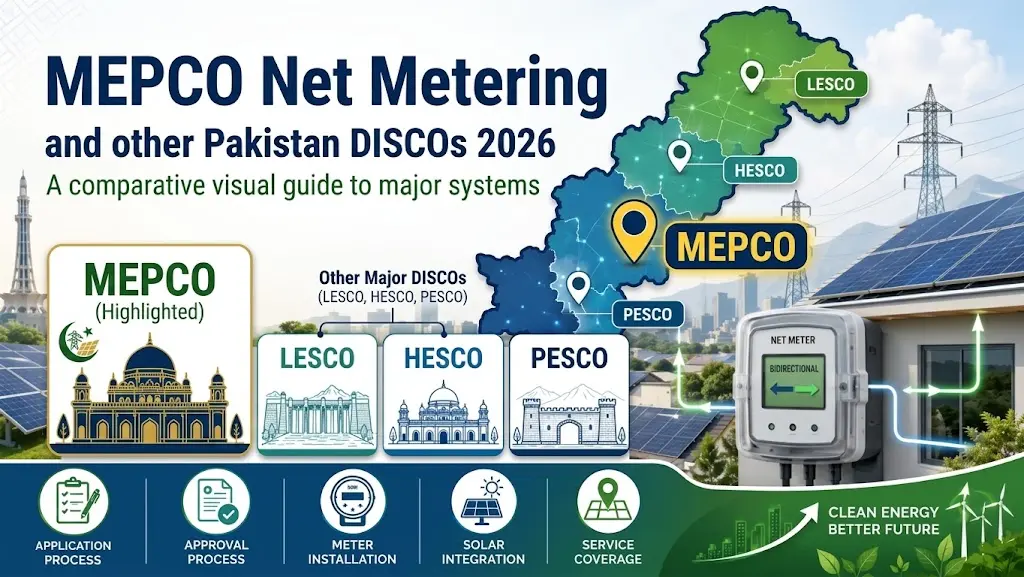
The easiest way to compare MEPCO with other distribution companies is to look beyond the word “net metering.”
The system itself may follow the same national regulations, but the consumer journey can still look different.
| Comparison Area | MEPCO | Other DISCOs |
|---|---|---|
| Core regulatory framework | Governed by NEPRA regulations | Governed by the same NEPRA framework |
| Application handling | Managed through MEPCO’s relevant offices and procedures | Managed by each respective DISCO |
| Technical inspection | Depends on the local network and installation requirements | Depends on the local network and DISCO procedures |
| Processing experience | Can vary by location and case | Can also vary considerably |
| Billing implementation | Based on applicable regulations and tariffs | Based on applicable regulations and tariffs |
| Complaint handling | Starts through relevant MEPCO channels | Starts through the relevant DISCO |
| Local challenges | Network conditions and administrative workload can matter | The same general issue exists across DISCO territories |
That last point deserves more attention than it usually gets.
Two consumers can both have technically similar solar systems and still experience very different timelines. One person may have a straightforward application because the local network assessment is simple. Another may face delays because of documentation, equipment verification, meter availability, or technical issues at the point of interconnection.
So when someone says, “Net metering is faster at another DISCO,” I would want to know what exactly happened before accepting that as a general rule.
Was the system smaller?
Were the documents complete?
Was there a technical issue?
Was the local office dealing with a backlog?
Those details change the comparison.
3. MEPCO’s Biggest Challenge Is Often Scale, Not Different Rules
MEPCO serves a vast geographical area. That matters.
A distribution company handling a large consumer base has to manage ordinary billing issues, new connections, meter replacements, complaints, infrastructure maintenance, and solar interconnection applications at the same time.
Net-metering consumers are part of that wider system.
In practical terms, a MEPCO consumer may therefore experience delays that have less to do with the national net-metering policy and more to do with the administrative or technical circumstances surrounding their particular application.
And this is something consumers sometimes overlook.
A solar installer might promise that the process will be completed within a certain number of days, but the installer does not control every stage. The distribution company and regulatory procedures remain part of the process.
Before investing in a system, it is worth understanding your existing electricity connection properly. Problems with sanctioned load, connection type, or meter information can create complications later. Consumers who already face billing or meter-reading problems should address those issues carefully rather than assuming a new solar installation will automatically solve everything.
The same practical thinking applies when you notice an unexpected issue on your electricity bill. A situation involving arrears, for example, needs to be understood on its own terms, as explained in our guide to why a MEPCO bill may show arrears even after payment.
4. How MEPCO Compares With LESCO, IESCO, FESCO and Other DISCOs
Consumers frequently compare MEPCO with larger or more urban-focused distribution companies.
There is some logic behind this. A consumer’s experience can be influenced by the local infrastructure, staff workload, application volumes, and technical characteristics of the area.
But it is risky to rank every DISCO from “best” to “worst” for net metering without looking at current, measurable data.
A person living in one MEPCO subdivision might have a smooth experience. Someone in another area could encounter delays. The same variation can exist within LESCO, IESCO, FESCO, GEPCO, PESCO, or other distribution companies.
What tends to remain comparable
Across the DISCO system, consumers should expect the following broad principles to matter:
- Compliance with the applicable NEPRA regulations
- Proper technical documentation
- Compatibility of the distributed generation facility
- Inspection and interconnection requirements
- Accurate metering and billing
- Compliance with the relevant agreement and approval process
What can feel different
The local experience can differ because of:
- Application processing workload
- Communication with local offices
- Technical inspections
- Network conditions
- Availability and handling of metering equipment
- Administrative efficiency
- The complexity of the individual installation
That is why I don’t think the question should simply be, “Which DISCO has the best net metering?”
A better question is, “What does my specific connection need before it can be approved?”
It’s a less exciting question, admittedly, but it usually gets closer to the real issue.
5. Billing Is Where MEPCO Consumers Need to Pay Close Attention
Net-metering consumers sometimes focus heavily on getting approval and then stop paying close attention once the system is operational.
That can be a mistake.
Your electricity bill remains an important record of how your connection is being billed. Understanding the import and export figures, applicable charges, adjustments, and any other entries becomes essential after solar interconnection.
MEPCO has also updated aspects of its consumer billing presentation over time, so it is useful to understand what the various entries on a bill actually mean rather than relying only on the total payable amount.
If something appears incorrect, don’t assume it will automatically correct itself next month.
Check the meter readings and relevant bill entries. If there is an obvious problem, keep copies of your bills and supporting documents before approaching the appropriate office.
This is also why an inaccurate meter reading should be taken seriously. Our practical guide on what to do when a MEPCO meter reading is wrong explains the basic steps consumers can take when the recorded information does not appear to match their actual situation.
6. The 2026 Rules Make the Comparison More Complicated
One reason older net-metering comparisons can now be misleading is that the regulatory environment has changed.
Pakistan’s NEPRA Prosumer Regulations, 2026 replaced the older way many consumers discussed net metering and introduced updated arrangements for qualifying prosumers.
The treatment of consumers under earlier agreements and consumers entering the system under newer arrangements also requires careful attention to the applicable regulatory provisions.
So, a person who installed solar several years ago may not necessarily be in exactly the same contractual or billing position as someone applying today.
That matters.
When comparing MEPCO with another DISCO, you should compare consumers who are actually operating under similar circumstances. Comparing an older agreement with a newer application and then blaming the difference on the DISCO would give you the wrong picture.
A useful comparison should consider:
- When the agreement was entered into
- Which regulations and amendments apply
- The type and capacity of the generation system
- The technical characteristics of the electricity connection
- The applicable billing and tariff arrangements
This is one area where outdated information spreads very quickly. Someone may still be sharing advice that was correct under an earlier framework, and the advice sounds convincing because it was once accurate.
But the date matters. The date matters a lot.
7. So, Is MEPCO Better or Worse for Net Metering?
There isn’t an honest one-word answer.
MEPCO is not operating outside the national regulatory structure, so a consumer should not expect an entirely unique version of net metering simply because their electricity company is MEPCO.
Where differences appear, they are more likely to involve the practical side of dealing with a particular distribution company and local electricity network.
For some consumers, MEPCO’s experience will be smooth.
For others, the process may involve more follow-up.
That is also true elsewhere.
I would be cautious about choosing a solar installer based on claims that one DISCO is “easy” and another is “impossible.” Ask for specifics instead. Ask what documents are required, what technical work is included, who handles the application, and what happens if an inspection identifies a problem.
And make sure you understand the status of your own electricity connection before signing anything.
Frequently Asked Questions
Is MEPCO’s net-metering policy different from LESCO’s or IESCO’s?
The core regulatory framework comes from NEPRA, so MEPCO and other DISCOs generally operate within the same national rules. The practical application process and local consumer experience can still differ because each DISCO manages its own service area and administrative operations.
Can a MEPCO consumer compare their solar bill directly with someone using another DISCO?
Not always. The consumers may have different agreement dates, system sizes, electricity usage patterns, tariff circumstances, or applicable regulatory arrangements. A direct comparison is only useful when those factors are reasonably similar.
Why does one net-metering application take longer than another?
The cause can be administrative or technical. Documentation problems, inspection requirements, local workload, network conditions, and equipment-related issues can all affect the timeline.
Are older MEPCO net-metering agreements treated the same as new agreements?
Not necessarily. Regulatory changes and transitional provisions can affect how different groups of consumers are treated. Consumers should check the terms of their own agreement and the regulations applicable to it.
What should I check before applying for net metering with MEPCO?
Start with your connection type, load information, solar system design, technical compatibility, and required documentation. You should also make sure your existing electricity account does not contain unresolved issues that could complicate the process.
For practical MEPCO billing information and updates affecting electricity consumers, visit mepcco-bill.pk.