The first time someone asks me about a MEPCO net metering application, they usually don’t ask about the solar panels.
They ask about the file.
And that makes sense. You can have the right inverter, a properly installed solar system, and everything ready at the property, but if the paperwork is incomplete, the application still gets held up. I have seen people focus so heavily on the technical side that they treat the documents as an afterthought.
That is usually where the trouble starts.
For a MEPCO consumer applying for solar grid connection arrangements, four documents form the practical core of the application: the application itself, the applicant’s identity document, the latest paid electricity bill, and the relevant agreement or undertaking. MEPCO’s published checklist also asks for technical drawings, equipment information, installer documentation and, for certain larger systems or companies, additional certificates and corporate papers.
There is another detail worth knowing before you collect anything. NEPRA notified the Prosumer Regulations, 2026 on February 9, 2026, and the regulatory framework has subsequently been amended. So older guides that simply say “net metering rules” without checking the current framework are not enough by themselves.
1. The MEPCO Net Metering Application
This is the document that starts the process.
MEPCO publishes a net metering application form along with its related schedules and documents. Its net metering material specifically provides application forms and a checklist for filing applications.
The application needs to match the consumer and connection details being submitted. That sounds obvious, but small inconsistencies are exactly the sort of thing that create unnecessary back-and-forth.
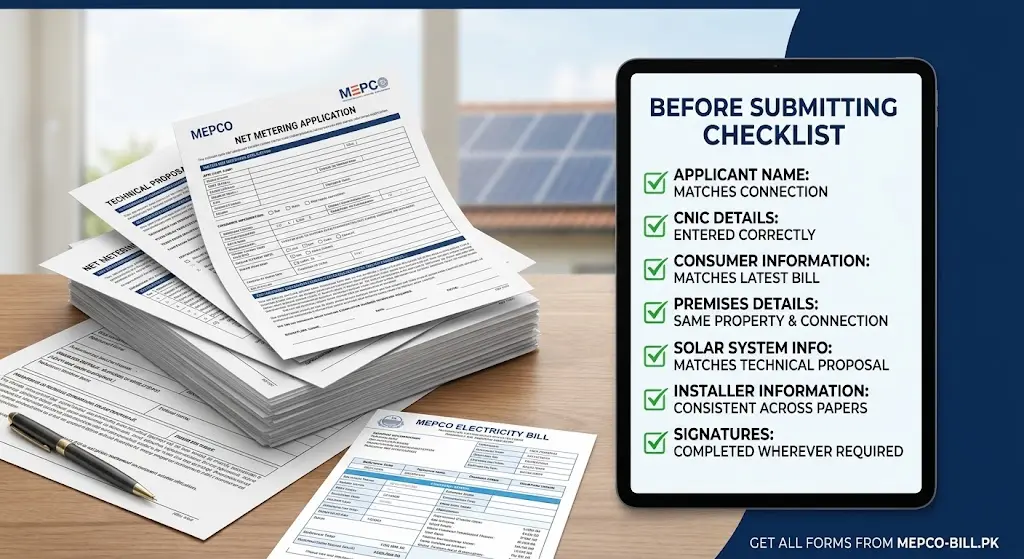
Before submitting it, check:
| Detail | What to check |
|---|---|
| Applicant name | Matches the electricity connection |
| CNIC details | Entered correctly |
| Consumer/reference information | Matches the latest bill |
| Premises details | Same property and connection |
| Solar system information | Matches the technical proposal |
| Installer information | Consistent across submitted papers |
| Signatures | Completed wherever required |
The application is not something I would fill out from memory.
Keep the latest electricity bill beside you while completing it. That way, the consumer information comes directly from the actual MEPCO record rather than from an old bill, handwritten note, or memory.
MEPCO’s published material also identifies a net metering agreement and other related forms as part of its process.
And this is where people usually go wrong: they assume that downloading the form is the same thing as preparing the application. It isn’t. The information across the complete file needs to agree.
A mismatched name, incorrect consumer information, or missing signature is a much less interesting problem to fix than an inverter fault, but it can still stop the paperwork.
2. CNIC of the Applicant
The second document is straightforward, but it needs to be treated as an official part of the application file.
MEPCO’s published checklist requires an attested copy of the applicant’s CNIC. The checklist also refers to CNIC copies for witnesses where applicable.
So don’t simply take a photograph of a CNIC and assume that the application is ready.
Prepare the identification documents in the form required by the current filing process.
The name is especially important.
If the electricity bill is in one person’s name while the person applying for the solar arrangement is someone else, don’t ignore that difference. MEPCO’s checklist specifically says the applicant’s name and the name appearing on the electricity bill should be the same, and directs consumers to update the bill name through the SDO office if they do not match.
That single point can save a lot of wasted time.
For example, suppose the electricity connection is still registered under the previous owner of a house, while the current owner is preparing a solar installation. It is tempting to attach the current owner’s CNIC and move ahead.
The paperwork doesn’t work that way.
First make sure the consumer record and applicant information are properly aligned.
If you’re also dealing with an electricity bill issue before applying, it is worth checking the bill itself rather than assuming the amount or consumer information is correct. I have covered some of those situations on mepcco-bill.pk, including what happens when an electricity bill shows arrears after payment and how billing discrepancies can be handled.
That is a separate problem from net metering, but fixing it before putting together the solar file is usually the cleaner approach.
3. A Copy of the Latest Paid MEPCO Bill
This is the document I would keep closest to the application form.
MEPCO’s filing checklist requires a copy of the last paid electricity bill. It also specifically connects the bill’s name with the applicant’s name.
Use the latest bill you have, and make sure it is actually paid.
The bill provides the basic identity of the existing electricity connection and gives the processing side a current reference for the consumer record.
Before adding it to your file, check these points:
- Applicant/consumer name
- Reference number or consumer information
- Meter details
- Billing information
- Payment status
- Any obvious discrepancy in the connection record
This is also why I don’t recommend using an old bill simply because you already have a clean printed copy sitting at home.
A current application deserves current supporting information.
There is a practical side to this too. If the name on the bill is wrong, fix that first. If the bill has an unexplained issue, deal with that before treating the net metering application as a paperwork-only exercise.
MEPCO consumers who regularly check their bills through services such as mepcco-bill.pk should keep a copy of the latest bill available when beginning the process. It makes checking names and connection details much easier.
One small side thought here: keep digital copies of everything you submit. A PDF folder containing the application, CNIC, paid bill, agreement, diagrams and installer certificates is far more useful six months later than a pile of loose photocopies. And people do lose loose photocopies.
4. Net Metering Agreement and Related Undertaking
The fourth core document is the agreement connected with the solar grid arrangement.
MEPCO’s published net metering material includes a Net Metering Agreement, while its SOP page also lists the application and agreement as separate documents.
The agreement matters because this isn’t simply a request to install solar panels.
There is a formal relationship between the consumer/prosumer and the distribution company concerning the electricity system connected to the grid. The current NEPRA Prosumer Regulations, 2026 define an agreement as the agreement between the licensee and prosumer on the Authority’s approved format.
That wording is worth paying attention to.
It means you should not take an old agreement found on a random website and assume it is automatically the correct version for a new application.
Regulatory documents change. Forms change. Procedures change.
MEPCO’s older published net metering pages still contain references to the previous regulatory framework, including regulations and amendments from 2015 through 2021. At the same time, NEPRA has a 2026 Prosumer framework and later amendments.
So use the current form and agreement required for the application being filed.
That distinction is particularly important in 2026.
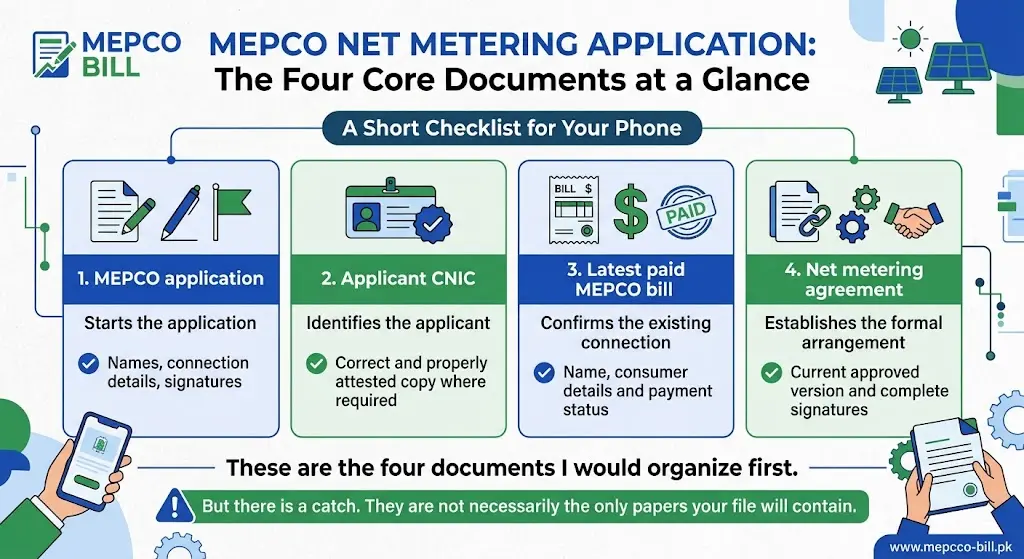
The Four Core Documents at a Glance
If you want a short checklist to save on your phone, use this:
| Document | Main purpose | What to verify |
|---|---|---|
| MEPCO application | Starts the application | Names, connection details, signatures |
| Applicant CNIC | Identifies the applicant | Correct and properly attested copy where required |
| Latest paid MEPCO bill | Confirms the existing connection | Name, consumer details and payment status |
| Net metering agreement | Establishes the formal arrangement | Current approved version and complete signatures |
These are the four documents I would organize first.
But there is a catch.
They are not necessarily the only papers your file will contain.
What Else Can MEPCO Ask For?
This is where a lot of online checklists become misleading.
Saying “you only need four documents” is too simplistic.
MEPCO’s published checklist includes several technical and supporting documents beyond the four core items. These include technical data for solar modules and inverters, schematic or single-line drawings, a site plan showing the external disconnect switch, installer/inspection documentation, and other material depending on the size and ownership structure of the project.
For larger installations, the checklist gets more involved.
For example, MEPCO lists an Electrical Inspector certificate where the distributed generation facility is above 250 kW and a load flow study where the facility is greater than 250 kW. Corporate applicants can also face additional requirements such as CUIN, NTN/STRN, memorandum or articles of association, and an authority letter for the person signing the file.
So the sensible way to think about the paperwork is:
Four core documents + technical/supporting documents based on your application.
That is much closer to what a real file looks like.
A practical supporting-file checklist
For a typical residential application, I would keep these together:
- Completed application
- Applicant CNIC
- Latest paid MEPCO bill
- Required agreement
- Solar panel and inverter technical information
- Single-line diagram
- Site plan where required
- Installer/inspection certificate or other applicable installer documentation
- Any additional form or schedule required by the current MEPCO process
Don’t assume every item applies identically to every consumer. The MEPCO checklist itself distinguishes certain requirements according to system size and whether the applicant is a company.
One 2026 Detail You Should Not Miss
The terminology has changed.
NEPRA notified the National Electric Power Regulatory Authority (Prosumer) Regulations, 2026 in February 2026. The regulations came into force immediately upon notification.
NEPRA’s current website also shows subsequent activity around amendments to those 2026 regulations, including an amendment notified in August 2026.
That matters because somebody following a checklist written several years ago could be working from forms, terminology, or assumptions that no longer describe the complete current process.
This doesn’t mean every old document suddenly becomes useless. Existing approvals and agreements have their own treatment under the regulations and amendments. NEPRA’s materials specifically address approvals and agreements made under the repealed regulations.
For a new applicant, though, I would always verify the current requirements before submitting the file.
And yes, that takes a few extra minutes.
It is still better than preparing an entire solar application around an outdated form.
Common Mistakes That Delay the File
The mistakes are surprisingly ordinary.
Using an old electricity bill.
The latest paid bill is the safer document to prepare.
Ignoring a name mismatch.
If the applicant’s name and electricity bill name don’t match, don’t assume the difference will simply be overlooked. MEPCO’s checklist directly addresses this issue.
Submitting unclear technical documents.
A single-line diagram or equipment specification needs to be readable and consistent with the proposed system.
Using an outdated agreement.
The regulatory framework changed in 2026, so old templates deserve extra scrutiny.
Thinking residential and large commercial applications have identical paperwork.
They don’t. MEPCO’s checklist adds requirements for larger systems and companies.
Keeping only paper copies.
This one isn’t a regulatory requirement, it is just good file management. Scan everything.
If you regularly deal with MEPCO billing, it also helps to understand the ordinary bill before you add a solar arrangement to the picture. I have written about the MEPCO bill format, payment methods and meter-reading problems on the site because those details become useful when checking whether your basic consumer record is already in order.
FAQs About MEPCO Net Metering Documents
1. What are the four main documents needed for MEPCO net metering?
The practical core is the completed application, applicant’s CNIC, latest paid MEPCO electricity bill, and the required net metering/prosumer agreement. MEPCO’s published checklist also contains technical and supporting documents that may be required depending on the application.
2. Does the name on my MEPCO bill have to match my CNIC?
The applicant’s information needs to correspond with the electricity connection. MEPCO’s checklist specifically says the applicant’s name and the name on the electricity bill should be the same, and directs consumers to update the bill name through the SDO office if they do not match.
3. Do I need the latest paid MEPCO bill?
MEPCO’s published checklist calls for a copy of the last paid electricity bill. Using the latest paid bill also makes it easier to confirm that the connection details being submitted are current.
4. Are four documents enough for every solar installation?
No. Four documents are a useful core checklist, not a universal limit. MEPCO also lists technical data, drawings, site information, installer documentation and additional requirements for certain larger systems and company applicants.
5. Do the old net metering forms still apply in 2026?
Don’t assume they do. NEPRA notified the Prosumer Regulations, 2026 and has since published amendments, so a new applicant should verify the current applicable forms and requirements before filing.
A Clean File Saves More Time Than a Perfect Folder Name
Solar installation gets most of the attention because it is the visible part of the project.
The paperwork is quieter.
Still, I would prepare the documents before treating the application as ready. Put the application, CNIC, latest paid bill and current agreement together first. Then add the technical drawings, equipment information and installer documents that apply to your system.
Most importantly, check the names and connection details across the whole file.
That small check catches the kind of problem that otherwise shows up later, after you’ve already spent time getting everything else ready.
For MEPCO consumers, the rules and forms also need to be checked against the current regulatory position rather than relying on an old checklist copied from an earlier year. The official MEPCO material and current NEPRA framework are the better reference points for that.
I keep coming back to the same principle with electricity paperwork: don’t make the file complicated, just make it complete and internally consistent.
For more MEPCO guidance, mepcco-bill.pk also covers everyday issues such as bill checking, payment, meter readings and changes to the MEPCO bill format.