I keep seeing the same assumption around MEPCO bills: pay a few days early and the amount should somehow come down.
It sounds reasonable. After all, some bills, loans, and subscriptions do offer an early-payment discount. Electricity billing in Pakistan works differently.
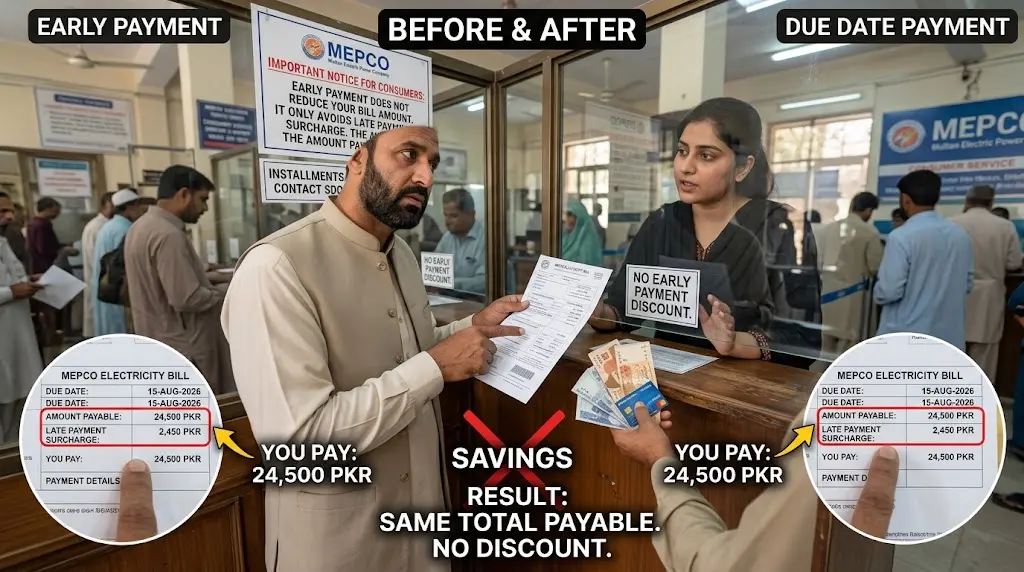
Paying your MEPCO bill early is useful, but the benefit is not a lower tariff or a special reduction in the current bill. The amount printed on your bill is based on the billing calculation, including recorded consumption, applicable tariff components, taxes, duties, surcharges, and other charges. Paying it five days before the due date does not change those calculations.
What early payment does is much simpler. It settles the bill before the deadline and keeps you away from late-payment consequences.
That distinction matters because I’ve seen people look at a bill, pay it early, then expect the next bill to somehow reflect a discount. It doesn’t work that way.
1. The Early-Payment Discount That Isn’t There
Let’s separate two things that are easy to mix up: when you pay and how your bill was calculated.
Your MEPCO bill is generated for a particular billing period. The consumption recorded for that period is used with the applicable tariff and other billing components to arrive at the amount payable. NEPRA’s billing framework describes the amount payable within the due date as the total of the payment items shown on the bill, including applicable arrears. Late Payment Surcharge, or LPS, is associated with payment after the due date.
So if your bill says Rs. 18,500, paying it on the first day you receive it doesn’t turn Rs. 18,500 into Rs. 17,500.
It remains Rs. 18,500.
The timing of your payment doesn’t rewrite the meter reading.
This is where people usually go wrong. They treat the due date as though it is a pricing deadline. It isn’t. It is primarily a payment deadline.
There is a useful way to think about it:
| What happens | Effect on your current bill |
|---|---|
| Pay several days before due date | Bill amount normally stays the same |
| Pay on the due date | Bill amount normally stays the same |
| Pay after due date | Late-payment charges may apply |
| Use fewer electricity units | Future bill may be lower |
| Correct an actual billing error | Bill may be adjusted through the proper process |
| A tariff or government charge changes | Applicable future billing can change |
MEPCO’s own consumer-service material says consumers should pay within the due date to avoid late-payment surcharge. It does not describe an early-payment discount for ordinary electricity bills.
So paying early is a risk-management habit, not a discount strategy.
2. What Actually Determines the Amount on Your MEPCO Bill
If paying early doesn’t lower the bill, what does?
The first number I would look at is consumption.
This sounds obvious, but it gets overlooked surprisingly easily. A household can see a higher rupee amount and immediately assume that the tariff has increased or that MEPCO has made a mistake. Before making that assumption, compare the current and previous meter readings and check the billing period.
The difference in units is usually much more informative than staring at the final payable amount.
The bill can also contain several components besides the basic electricity consumption charge. Depending on the consumer category and applicable tariff, there can be fixed or variable charges, government taxes, surcharges, adjustments and other items.
NEPRA’s published tariff material shows that electricity billing is not simply a matter of multiplying every customer’s units by one universal price. Tariff categories and applicable components differ, while adjustments can also affect the amount billed.
This is why two households using different amounts of electricity, or even two consumers in different tariff categories, should not expect the same per-unit calculation.
And there is another detail worth remembering.
The date you pay is not the date your electricity was consumed.
Your bill is tied to its billing period. Paying it early simply clears the amount that has already been calculated.
If you want to understand the numbers before paying, the updated MEPCO bill layout makes some of these checks easier. I recently looked at the redesigned format and the placement of the reference number, billing period, meter information, due date, and total payable amount is much easier to follow. You can read more about that in our guide to the MEPCO bill’s updated format.
That simple check can prevent a lot of unnecessary confusion.
3. What You Actually Gain by Paying Early
There is still a very good reason to pay your MEPCO bill before the due date.
You reduce the chance of paying extra because of delay.
NEPRA’s Consumer Service Manual says consumers should pay within the due date to avoid Late Payment Surcharge. It also sets out procedures for payment through banks, post offices and other available channels.
Current notified tariff terms also provide for LPS when a bill is not paid in full within the due date. The applicable terms provide for 5% LPS for the next three days and 10% thereafter on the amount billed excluding government taxes and duties, subject to the conditions stated in the notification.
That makes early payment worthwhile for a completely different reason.
Suppose you receive your bill on Monday and the due date is the following week. You have enough money available and pay it on Tuesday. You haven’t received a discount.
But you’ve removed one problem from your list.
You don’t have to remember it again on the due date. You don’t have to worry about forgetting it during a busy week. You also reduce the chance that a failed payment attempt, bank issue, or simple oversight pushes you beyond the deadline.
I’ve found that this is the more practical way to look at early payment. It buys you certainty, not a cheaper electricity rate.
There is a small side thought here: people sometimes spend more time searching for a supposed early-payment discount than they would spend checking why their units increased. That’s backwards. If you want a lower bill, consumption and the actual billing components deserve your attention first.
And yes, I know, paying early feels like it should earn something. But the electricity bill isn’t a restaurant loyalty card.
4. Early Payment vs Lower Consumption
This is probably the most useful distinction for someone trying to reduce household electricity costs.
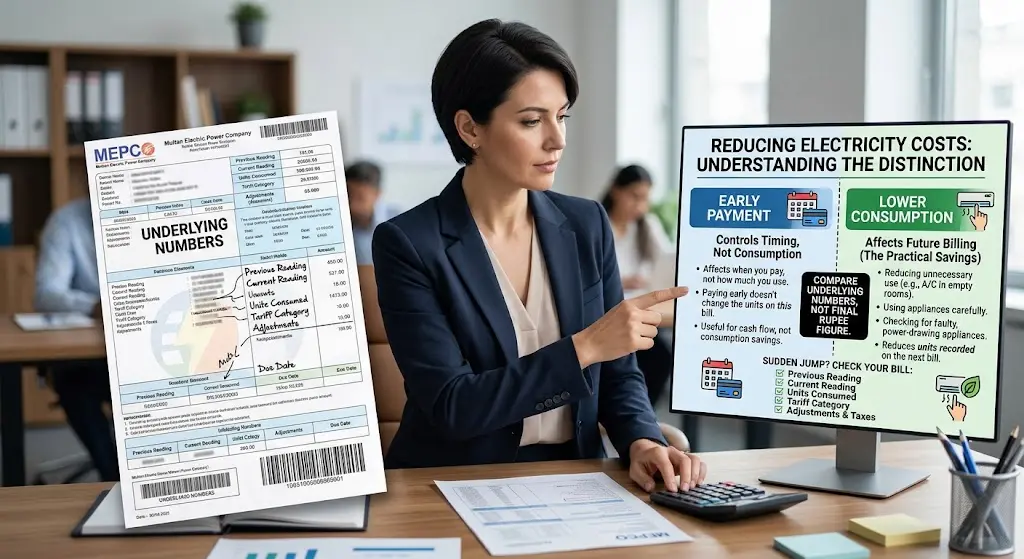
Early payment controls the payment timing. Lower consumption affects future billing.
They are completely different actions.
If your current bill is already generated, paying it early does not normally change its consumption figure. But reducing unnecessary electricity use during the next billing period can reduce the number of units recorded on the next bill.
That is where the practical savings conversation belongs.
For example, leaving an air conditioner running in an empty room has nothing to do with when you pay the bill. Switching it off when it isn’t needed affects consumption. Using appliances more carefully affects consumption. Checking whether a faulty appliance is drawing excessive power affects consumption.
The payment date doesn’t.
The same principle applies when a consumer sees a sudden jump from one month to another. Don’t start with the payment date. Start with the bill.
Check:
- Previous meter reading
- Current meter reading
- Units consumed
- Billing period
- Tariff category
- Fixed charges, where applicable
- Taxes and surcharges
- Any adjustment shown on the bill
- Arrears, if any
- Due date and amount payable
The redesigned bill format is useful here because the important information is separated more clearly. Our MEPCO bill format guide explains where these major pieces of information appear.
This is also why I don’t recommend comparing only the final rupee figure from two bills.
Compare the underlying numbers.
A bill can rise because consumption increased. It can also change because applicable charges or adjustments changed. Those are different situations and they need different explanations.
5. The Real Cost of Waiting Until After the Due Date
If early payment doesn’t give you a discount, should you simply wait until the last possible day?
I wouldn’t make that a habit.
There is nothing wrong with paying on the due date if the payment is successfully made within the allowed time. But waiting until the last minute introduces an avoidable risk.
A payment can fail. An app can have a technical problem. A bank transaction can take time to reflect. Someone can simply forget.
MEPCO-related payment guidance also recommends keeping evidence of payment, particularly when paying electronically. That is sensible. A screenshot, receipt, or transaction confirmation gives you something to refer to if the payment status doesn’t update as expected.
NEPRA’s Consumer Service Manual specifically recognizes online payment and other payment channels, while its payment provisions emphasize paying within the due date to avoid LPS.
So my preferred approach is straightforward:
Pay early if it makes your life easier, but don’t expect an early-payment discount.
If you prefer paying on the due date, make sure you don’t leave yourself with a payment problem at the last moment.
If you’re using online services to check the bill before paying, keep the 14-digit reference number available. It is one of the basic identifiers used for retrieving billing information, and our MEPCO consumer guides use the same approach.
6. What to Do When a Bill Looks Too High
This is where paying early and checking the bill become two separate decisions.
If the bill looks normal, pay it before the due date and keep the payment record.
If it looks unusually high, don’t assume that paying it early will somehow fix the problem.
First check the meter reading.
Then compare the current bill with your previous bill. Look at the number of units, not just the rupee amount. Check whether there are arrears or additional billing items.
If the meter reading printed on the bill doesn’t match the meter reading at your premises, that is a much more useful piece of information when making a complaint than simply saying, “My bill is too high.”
This is a point I come back to repeatedly because it makes consumer complaints clearer.
MEPCO’s complaint channels are intended for issues including billing concerns, meter-related problems, power-supply complaints and other service matters. Our MEPCO helpline and complaint contacts guide explains the available contact information and the kind of details worth having ready.
And if the problem involves an inspection or detection bill, that’s a different matter again. A detection bill is not simply a normal monthly bill that became expensive because you paid late. It can arise from inspection findings and requires its own review process.
In other words, identify the problem before deciding what action to take.
7. Three Common Assumptions That Need Correcting
There are three ideas I would separate whenever someone asks whether paying early reduces a MEPCO bill.
Assumption 1: “The earlier I pay, the bigger the discount.”
For an ordinary MEPCO electricity bill, there is no general early-payment discount built into the normal billing process. Paying early simply means the amount is settled before the due date.
Assumption 2: “The due date is when the bill price expires.”
No. The due date is the deadline for payment. The amount payable within the due date is already shown on the bill.
Assumption 3: “If my bill is high, paying it early will prevent the next bill from being high.”
Payment timing and electricity consumption are separate. Paying the current bill early doesn’t reduce the units you consume during the next billing period.
There are exceptions to almost every billing situation when a correction, adjustment, installment arrangement, tariff change, or regulatory decision is involved, so I wouldn’t treat a simple rule as a substitute for reading the actual bill.
But for ordinary monthly billing, the principle is quite clean.
Paying early protects you from being late. It does not make electricity cheaper.
8. A Better Habit for MEPCO Consumers
I prefer a very simple routine.
When the new bill arrives, check the reference number, billing period, meter readings, units consumed, total payable amount and due date.
If everything looks reasonable, pay it when convenient, preferably with enough time before the deadline to deal with a failed transaction if one occurs.
Then save the payment confirmation.
If something looks wrong, investigate that issue instead of assuming early payment will change the amount.
That approach also makes the MEPCO online bill-checking process more useful. You’re not just downloading a duplicate copy to see a number. You’re checking the information that produced that number.
The same habit becomes even more useful as MEPCO introduces newer metering and billing technology. Our coverage of MEPCO smart AMI meters explains why automated metering can provide more detailed information about consumption and meter status.
The technology might change. The basic consumer habit doesn’t.
Check what was recorded. Check how it was billed. Then pay.
That is much more reliable than looking for a discount that isn’t part of the ordinary bill.
Frequently Asked Questions
Does paying my MEPCO bill before the due date reduce the amount?
No. Paying early does not normally reduce the amount already printed on the bill. The main advantage is that you settle the bill before the due date and avoid applicable late-payment consequences.
Is there a discount for paying a MEPCO bill several days early?
There is no general early-payment discount for ordinary MEPCO electricity bills. Any special adjustment or concession would need to come from an applicable notified policy rather than simply paying a few days earlier.
Why did my MEPCO bill increase even though I paid the previous bill early?
Payment timing doesn’t determine the next month’s consumption. Check the new bill’s meter readings, units consumed, billing period, tariff components, adjustments, taxes, and any arrears before deciding that the increase is a billing error.
Is it better to pay on the due date or a few days earlier?
Paying a few days earlier is sensible if it helps you avoid forgetting or dealing with a failed payment at the last minute. Paying on the due date is also fine when the payment is successfully made within the permitted deadline.
What happens if I pay my MEPCO bill after the due date?
Late Payment Surcharge can apply under the applicable tariff terms. Current notified terms provide for LPS after the due date, with the applicable rate and calculation subject to the notified conditions.
For ordinary billing, I would keep the rule simple: paying early can save you from a late charge, but it doesn’t create a discount on the electricity you’ve already been billed for.
That distinction saves a lot of confusion, and it also tells you where to look when a bill really does seem too high. Don’t look at the payment date first. Look at the units, readings and charges.