MEPCO Tariff Appeal Rejected by NEPRA: Here Is Why
MEPCO asked NEPRA to look again at several parts of its newly determined tariff structure. The request was not about one small billing adjustment. It covered investment allowances, operating and maintenance expenses, and the way revenue requirements were matched with investment and T&D-loss targets.
On June 8, 2026, the National Electric Power Regulatory Authority declined MEPCO’s Motions for Leave for Review. The decision followed a hearing held on March 5, 2026, after MEPCO challenged parts of the tariff determinations issued on January 7, 2026.
That sounds straightforward, but the details matter.
The decision does not mean that every tariff issue involving MEPCO has permanently disappeared. In particular, NEPRA said some investment questions could be dealt with through the separate Investment Plan proceedings, with future tariff adjustments reflecting any revisions that are eventually approved.
For consumers trying to understand what this means for MEPCO bills, the distinction is worth knowing.
1. What MEPCO Asked NEPRA to Review
MEPCO’s original Multi-Year Tariff determinations covered five financial years, from FY 2025-26 through FY 2029-30. NEPRA issued separate determinations for MEPCO’s distribution and supply functions on January 7, 2026, and those tariffs were subsequently notified by the Federal Government.
MEPCO then filed Motions for Leave for Review against those determinations.
According to NEPRA’s decision, the main areas contested by MEPCO were:
| Issue raised by MEPCO | What MEPCO argued |
|---|---|
| Investment | The provisional investment allowed for FY 2025-26 and FY 2026-27 was below the amount requested |
| O&M expenses | Several operating expense allowances were considered insufficient |
| Revenue requirement | MEPCO questioned the relationship between revenue requirements, investment and T&D-loss parameters |
| X-factor | MEPCO requested that the X-factor not be applied during the MYT period |
These issues were raised in separate review motions covering distribution and supply tariffs, but NEPRA found that the arguments were sufficiently similar to address them together.
The first major disagreement concerned investment.
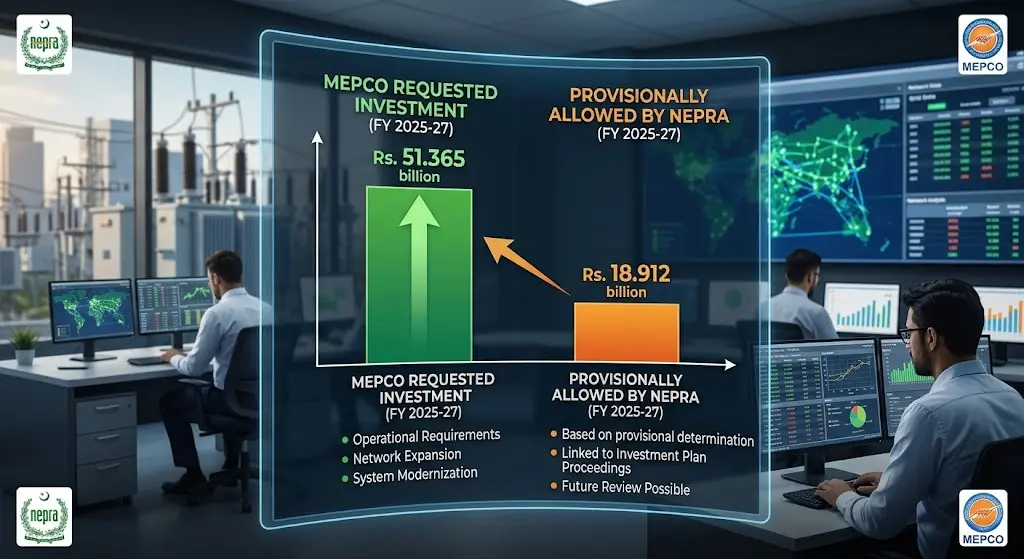
MEPCO told NEPRA that it had requested Rs. 51.365 billion for the first two years, while only Rs. 18.912 billion had been allowed provisionally for those two years. MEPCO argued that this level was insufficient for operational requirements, network expansion and modernization.
That is a substantial difference, and it explains why the review request attracted attention.
2. Why MEPCO Wanted More Investment
MEPCO did not simply argue that it needed more money. Its submission connected the requested investment with system modernization and loss reduction.
In its review motion, MEPCO pointed to improvements in T&D losses and recovery performance during FY 2024-25. It stated that T&D losses had fallen from 15.2% to 13.3%, while recovery performance increased from 98.62% to 100.51%. MEPCO associated these improvements with significant financial gains.
It then presented a revised five-year investment plan of Rs. 119.022 billion.
The proposed investment included projects involving:
- defective meter replacement
- AMI deployment
- APMS installations
- ERP systems
- a centralized data center
- GIS mapping
- scanning meters
- system strengthening
- distribution transformer augmentation
- safety improvements
- anti-theft measures
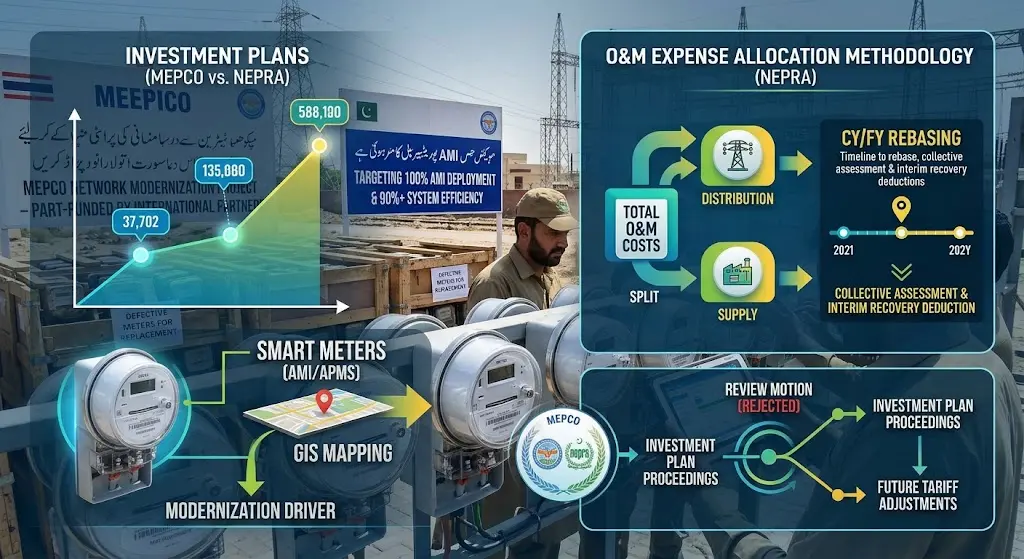
MEPCO specifically highlighted Rs. 41.7 billion for defective meter replacement, Rs. 11.96 billion for APMS deployment, Rs. 7.07 billion for AMI expansion and Rs. 3.77 billion for a centralized data center.
There was also a practical argument behind the request.
MEPCO told NEPRA that some technology and modernization projects were already connected with reform programs and foreign-funded initiatives. It argued that delays could create contractual and financial consequences. MEPCO also referred to damage from floods and said that more than 60,000 defective meters required replacement.
This is where the case becomes more complicated than simply saying NEPRA “cut MEPCO’s budget.”
NEPRA’s response was that the investment amounts in the tariff determination were provisional and that the final position was linked to the separate Investment Plan proceedings.
In other words, NEPRA did not treat the review motion as the final place to settle every investment question.
The Authority stated that MEPCO could raise these issues during the Investment Plan proceedings and that revisions resulting from those proceedings could be reflected in future tariffs.
That distinction is important for anyone following future MEPCO tariff developments.
3. The O&M Expense Dispute Was More Technical Than It Looked
The second major issue involved operation and maintenance expenses.
MEPCO challenged allowances for repair and maintenance, travelling, and vehicle maintenance. It argued that the amounts approved for these areas were inadequate when compared with its audited FY 2024-25 expenses. MEPCO also requested an N-CPI adjustment and challenged continuation of the X-factor.
At first glance, some of MEPCO’s comparisons looked fairly simple.
But this is where people usually go wrong when reading tariff decisions: comparing two numbers without checking the period and methodology behind them.
NEPRA explained that the expenses had been assessed collectively for MEPCO’s distribution and supply functions and then allocated between those functions. Therefore, looking only at the distribution side could create an incomplete comparison.
The Authority gave a more detailed explanation of the figures.
For FY 2025-26, NEPRA said total O&M costs of Rs. 53.501 billion had been allowed. For FY 2026-27, a provisional assessment of Rs. 57.639 billion was approved, representing an overall increase of around 8%.
For the three expenses MEPCO specifically questioned, the figures included:
| Expense | FY 2025-26 | CY 2026 |
|---|---|---|
| Repair & maintenance | Rs. 2,104 million | Rs. 2,039 million |
| Travelling | Rs. 1,284 million | Rs. 1,026 million |
| Vehicle maintenance | Rs. 742 million | Rs. 741 million |
NEPRA explained that CY 2026 overlaps two financial-year periods. Six months of CY 2026 belong to the first half of FY 2026-27, while January to June 2026 is connected to the earlier financial year.
There was another adjustment in the calculation.
NEPRA said the amount attributable to these expenses that was considered to have already been recovered through interim tariff arrangements during July to December 2025 was deducted when determining the amount for January to June 2026.
So a direct comparison between the FY and CY figures could give the impression that costs had simply been reduced.
The accounting period was doing more work than that.
NEPRA ultimately stated that the O&M argument did not justify reviewing the earlier determination and that the X-factor would continue because it applied uniformly across the sector.
4. The FY Versus CY Issue Created Another Disagreement
The third issue was the relationship between the revenue requirement and other tariff parameters.
MEPCO pointed out that some parameters, including provisional investment and T&D-loss targets, had been set on a financial-year basis. At the same time, the corresponding revenue requirement was determined for calendar year 2026.
MEPCO argued that this difference created practical difficulties when trying to match the revenue requirement with investment levels, T&D-loss targets and audited financial information.
This is a technical point, but it has a very practical lesson.
Tariff numbers are not always directly comparable simply because they appear next to each other on a document.
A financial year and a calendar year don’t cover the same period. Once a tariff calculation crosses those boundaries, the underlying methodology becomes important.
MEPCO requested clarification about how the rebasing from financial-year parameters to the calendar-year revenue requirement had been performed.
NEPRA responded that MEPCO itself had requested rebasing of the consumer-end tariff for CY 2026. Still, the Authority decided to conduct a session with all DISCOs to explain the methodology used for tariff assessment on a calendar-year basis and to outline future data requirements.
That means this part of the dispute was not simply dismissed without explanation. NEPRA addressed the concern by explaining that a broader methodological session would be held.
5. So Why Was MEPCO’s Tariff Review Rejected?
The wording of the NEPRA decision is important.
NEPRA did not say that MEPCO had no issues worth discussing. Instead, after considering the arguments, the Authority concluded that there was no justification to review the impugned determinations.
The review motions were therefore declined.
There were several reasons behind that conclusion.
For investment, NEPRA considered the approved amounts provisional and linked to the separate Investment Plan proceedings. That meant the investment issue could be reconsidered through the appropriate regulatory process rather than through the review motion itself.
For O&M expenses, NEPRA considered the comparison presented by MEPCO incomplete because the costs had been assessed collectively across distribution and supply before allocation.
For the apparent difference between financial-year and calendar-year figures, NEPRA explained the methodology and said it would hold a session to provide further clarification to DISCOs.
And regarding the X-factor, NEPRA decided to continue it because it was being applied uniformly across the sector.
So the headline “MEPCO tariff appeal rejected” leaves out an important part of the story.
The decision was a rejection of the review motions, but it did not prevent future tariff adjustments arising from separate proceedings or approved changes in relevant parameters.
6. What This Means for MEPCO Consumers
For an ordinary MEPCO consumer, the first question is usually simple: does this decision immediately change my electricity bill?
The June 8 decision itself is not a new consumer bill rate announcement. It is a regulatory decision on MEPCO’s review motions against its MYT determinations.
NEPRA’s records show that MEPCO’s MYT determinations were issued on January 7, 2026, while the review decision was issued on June 8, 2026. The review decision was then intimated to the Federal Government for notification under Section 31(7) of the NEPRA Act.
Consumers should therefore avoid assuming that every change appearing on a later MEPCO bill is directly caused by this review decision.
Electricity bills can incorporate several tariff-related adjustments and regulatory components at different times.
For someone checking a bill, the useful approach is to look at the actual billing period, tariff category, units consumed, applicable rates and any separate adjustment shown on the bill.
MEPCO consumers who are also following smart-meter developments may find the site’s coverage of [MEPCO smart meters] particularly useful, especially because investment and modernization were among the subjects raised in the tariff review.
Likewise, changes connected with tariff rates should be distinguished from issues such as arrears, detection bills or estimated readings. Those are separate billing questions and should not automatically be attributed to the June 2026 review decision.
7. Where People Commonly Misread This Decision
There are three mistakes I would avoid.
The first is calling the case a simple “tariff increase request.”
MEPCO’s review motions covered several technical components of its MYT determinations, including investment, O&M expenses and revenue-requirement methodology.
The second mistake is assuming that a rejected review means every disputed investment amount is permanently frozen.
That is not what NEPRA’s decision says. The Authority specifically connected the provisional investment allowances with the separate Investment Plan proceedings and stated that future revisions could be reflected in tariffs.
The third mistake is comparing FY and CY figures without checking the underlying period.
That was central to the O&M discussion. NEPRA explained that the calendar-year calculation contained a six-month overlap and that previous interim tariff recovery had affected the amount allocated to the first half of 2026.
This is also why a bill reader should be careful with screenshots and social-media summaries. A single number taken out of a tariff decision can tell a very different story from the full calculation.
8. What Could Happen Next With MEPCO Tariff Matters
The June decision leaves several areas open to future regulatory developments.
The clearest example is investment.
NEPRA stated that the investment allowances were provisional and that MEPCO could raise the relevant matters in the Investment Plan proceedings. Any revisions resulting from those proceedings could subsequently be reflected in MEPCO’s tariffs.
NEPRA’s MEPCO tariff records also show separate decisions concerning MEPCO’s Distribution Investment Plan and losses assessment for the FY 2025-26 to 2029-30 control period.
That is worth watching because it provides a separate regulatory route for issues that MEPCO tried to raise in its review.
For readers of mepcco-bill.pk, this distinction matters. A tariff review decision, an investment-plan decision, a fuel adjustment, and a quarterly tariff adjustment are not interchangeable events.
They can all affect electricity billing, but they arise through different regulatory processes.
And that is probably the most useful way to read this particular NEPRA decision: not as the end of every MEPCO tariff dispute, but as the Authority’s decision on a specific set of review requests against the January 2026 MYT determinations.
Frequently Asked Questions
Did NEPRA reject MEPCO’s tariff review request?
Yes. On June 8, 2026, NEPRA declined the review motions filed by MEPCO against its Distribution and Supply MYT determinations for FY 2025-26 to FY 2029-30.
What were MEPCO’s main objections?
MEPCO challenged the investment allowances for FY 2025-26 and FY 2026-27, certain O&M expense allowances, the relationship between revenue requirements and investment/T&D-loss parameters, and continuation of the X-factor.
How much investment did MEPCO request?
MEPCO told NEPRA that it had requested Rs. 51.365 billion for the first two years, compared with Rs. 18.912 billion allowed for those two years. It later sought approval of a revised five-year investment plan of Rs. 119.022 billion.
Does the rejected review mean MEPCO can never receive additional investment allowances?
No. NEPRA said the investment allowances were provisional and linked to the separate Investment Plan proceedings. It stated that revisions resulting from those proceedings could be reflected in future tariffs.
Does this decision automatically mean my MEPCO bill will increase?
Not by itself. The decision concerns MEPCO’s review motions against its MYT determinations. Consumer bills can also reflect other tariff decisions and adjustments, so the specific billing period and charges on an individual bill need to be examined separately.
For ongoing MEPCO billing information, mepcco-bill.pk remains focused on explaining bill-related changes in plain language rather than treating every tariff announcement as the same type of adjustment.