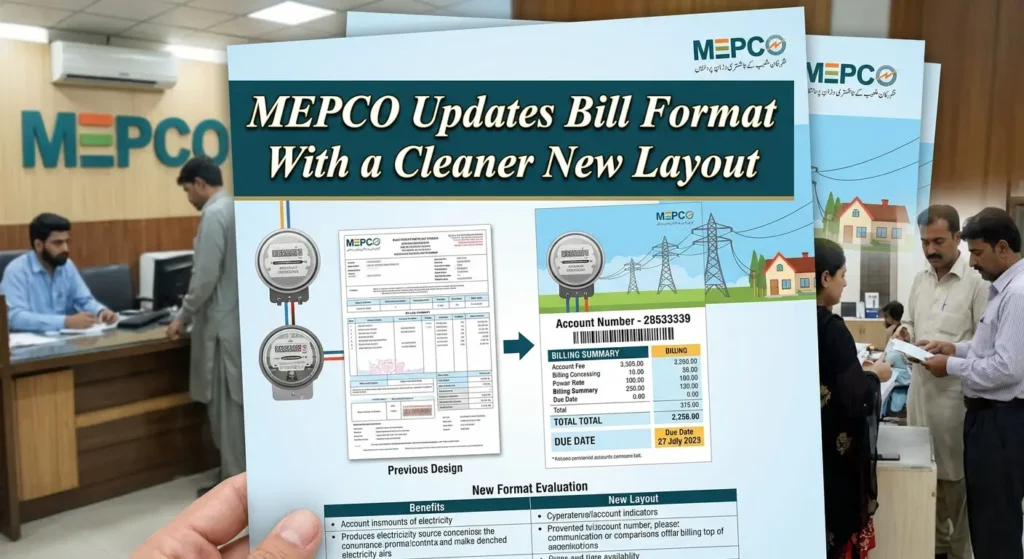
MEPCO Tariff Hike: What NEPRA Approved
A MEPCO bill can change even when the number of units on the meter barely moves. That is the part that catches people off guard.
A few rupees added to the per-unit cost, a quarterly adjustment appearing on the bill, or a fuel charge carried into a later billing month can make a familiar bill look completely different. The difficult part is knowing whether you are looking at a new base tariff, a temporary adjustment, or another charge that has simply arrived later.
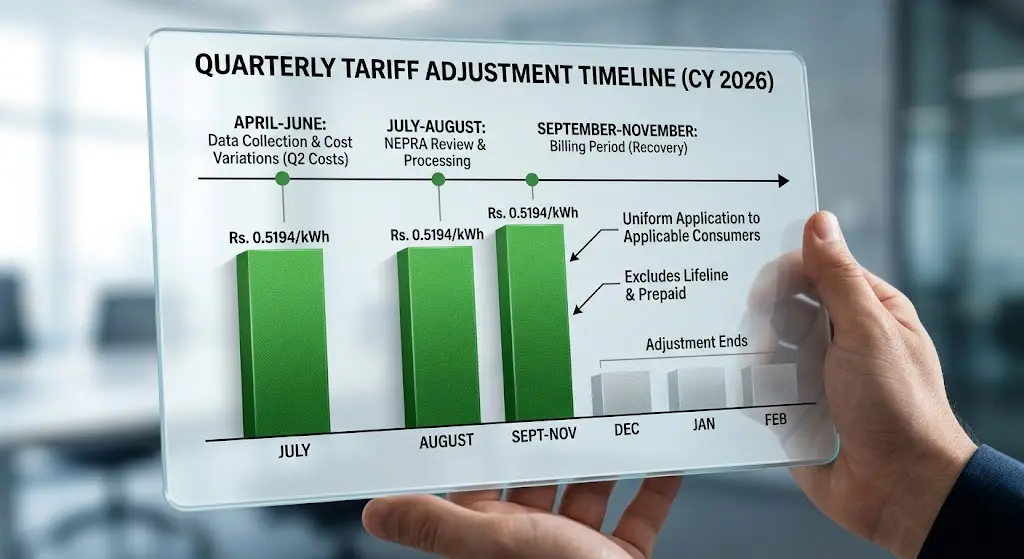
For the latest 2026 adjustment, the distinction matters. NEPRA approved a positive quarterly adjustment of Rs. 0.5194 per kWh for XWDISCO consumers, including MEPCO consumers, for billing over three months, September, October and November 2026. The decision states that lifeline consumers, units billed under the Incremental Consumption Package, and prepaid consumers are excluded from this particular adjustment.
So, when someone says, “MEPCO has increased the tariff,” I would first look at what actually changed on the bill.
1. What NEPRA Actually Approved
The September 2026 decision is a quarterly tariff adjustment, not simply a blanket announcement that every MEPCO consumer’s basic electricity rate has been permanently increased by Rs. 0.5194 per unit.
That distinction is easy to miss.
NEPRA’s decision concerns the second quarter of calendar year 2026, covering April through June. XWDISCOs submitted adjustment requests based on variations in power purchase price, capacity charges, variable operation and maintenance costs, use of system charges, market operator fees, transmission and distribution losses, and other components of the approved tariff mechanism.
After examining the information and hearing stakeholder comments, NEPRA approved an overall positive adjustment of Rs. 12.669 billion across the relevant distribution companies. The resulting uniform consumer impact was calculated at Rs. 0.5194/kWh.
For a household trying to understand its MEPCO bill, the practical point is simpler:
| Item | What the September 2026 decision means |
|---|---|
| Adjustment | Rs. 0.5194 per kWh |
| Billing period | September to November 2026 |
| Type | Quarterly tariff adjustment |
| Applied to | Consumer categories covered by the decision |
| Excluded | Lifeline consumers, qualifying incremental-consumption units, prepaid consumers |
| Basis | Costs and variations from the second quarter of CY 2026 |
NEPRA also says the adjustment was intended to be applied uniformly to consumers of the relevant XWDISCOs.
This is why the word “hike” needs a little care. A temporary or periodic adjustment appearing on a bill is not automatically the same thing as a permanent revision of the underlying base tariff.
That difference becomes even more useful when you compare one bill with another.
Why the adjustment appeared months later
The costs being adjusted relate to an earlier quarter. In this case, the second quarter of calendar year 2026 means April, May and June.
NEPRA’s decision explains that XWDISCOs submitted their quarterly adjustment requests after that period and that the authority reviewed the underlying information before determining the consumer-end impact.
So the timing can feel strange:
April to June costs → regulatory review → September to November billing impact
That does not mean MEPCO suddenly consumed more electricity in September.
It means a previously calculated difference is being recovered through the approved adjustment mechanism.
2. How Much Could the MEPCO Bill Increase?
The easiest way to understand Rs. 0.5194 per kWh is to multiply it by the units to which the adjustment applies.
For example, before considering taxes and other bill components:
- 100 applicable units × Rs. 0.5194 = Rs. 51.94
- 200 applicable units × Rs. 0.5194 = Rs. 103.88
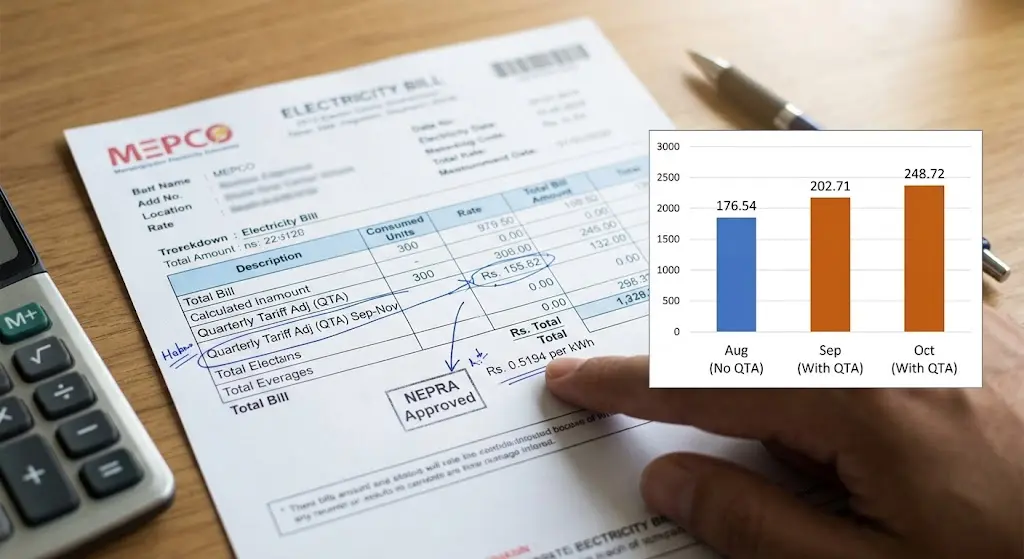
- 300 applicable units × Rs. 0.5194 = Rs. 155.82
- 500 applicable units × Rs. 0.5194 = Rs. 259.70
- 1,000 applicable units × Rs. 0.5194 = Rs. 519.40
Those figures are only the direct adjustment calculation. The final amount visible on a customer’s bill can differ because electricity bills contain other components, including taxes, duties, previous balances, fixed charges and other applicable adjustments.
And this is where people usually go wrong.
They see a bill that is Rs. 300 or Rs. 500 higher and assume the entire increase came from the quarterly adjustment. It doesn’t necessarily work that way.
A bill is a combination of several moving parts.
If the number of units increased, a fuel adjustment was added, a previous balance remained unpaid, or another applicable charge changed, the total bill can rise by considerably more than the direct quarterly adjustment.
For readers who are already seeing an unexpected amount, the site’s guide on [why a MEPCO bill doubled in one month] can help separate consumption changes from billing adjustments. Why Your MEPCO Bill Doubled This Month
The Rs. 0.5194 figure is not the whole electricity tariff
This is worth repeating because tariff terminology gets confusing quickly.
A consumer’s electricity bill is not calculated by taking the number of units and multiplying it by Rs. 0.5194.
The Rs. 0.5194 is the approved quarterly adjustment rate described in the September 2026 NEPRA decision. It sits within the wider billing structure rather than replacing the applicable energy tariff.
That is also why two bills with similar consumption can still have different totals.
3. Why NEPRA Made This Quarterly Adjustment
The adjustment mechanism exists because the reference assumptions used in tariff calculations do not always match actual costs.
NEPRA’s decision says the XWDISCO requests for the April to June 2026 quarter included variations involving capacity charges, variable O&M, Use of System Charges and Market Operator Fee, the impact of power purchase price on incremental consumption, and transmission and distribution losses connected with monthly fuel charge adjustments.
These are not charges invented by MEPCO on an individual customer’s bill.
They come through the regulated tariff adjustment process.
NEPRA also examined actual power purchase information supplied by CPPA-G for the quarter. The authority stated that the information and certification supplied by CPPA-G and the DISCOs were relied upon for determining the quarterly adjustment, with later corrections to be reflected through subsequent adjustments if an error or omission is identified.
That last part is easy to overlook.
A tariff adjustment is not simply a number picked by looking at one household’s electricity consumption. It is the result of a much larger accounting and regulatory process.
The role of power purchase costs
Electricity distribution companies purchase electricity through the national power system. Changes in the cost of that power and related components can feed into periodic adjustments.
NEPRA’s September decision specifically discusses the actual power purchase costs billed by CPPA-G during April, May and June 2026 and the information used to calculate the quarterly adjustment.
This is also why a consumer reading a bill may encounter terms such as FCA and QTA and assume they are interchangeable.
They aren’t.
A Fuel Charges Adjustment and a Quarterly Tariff Adjustment are different mechanisms, even though both can change the amount a consumer ultimately pays.
4. MEPCO Consumers Need to Separate QTA, FCA and Base Tariff
If I were checking a MEPCO bill after hearing news about a “tariff hike,” I would not stop at the total amount.
I would look at the individual billing components.
Here is a useful way to separate them:
| Bill component | What it generally represents | Why it matters |
|---|---|---|
| Base energy tariff | Applicable electricity rate under the notified tariff structure | Forms the core energy charge |
| FCA | Fuel cost adjustment | Reflects approved changes related to fuel and power generation costs |
| QTA | Quarterly tariff adjustment | Reflects approved periodic cost variations |
| Fixed charges | Applicable fixed component for the consumer category | Can affect bills even when units change little |
| Taxes and duties | Government-imposed billing components | Increase the final payable amount |
| Arrears | Previous unpaid amount | Adds to the current payable balance |
The exact treatment depends on the applicable consumer category and current notifications.
NEPRA’s September decision is particularly clear that the Rs. 0.5194/kWh quarterly adjustment is billed from September through November 2026, rather than becoming a permanent standalone rate for every future month.
That makes the billing period important.
If you check a bill from December and expect the same QTA line to continue automatically, you could end up misunderstanding the bill.
And, slightly off the main point but useful, this is one reason I prefer looking at the actual bill rather than relying entirely on social-media screenshots of “new electricity rates.” A screenshot rarely tells you which month the adjustment covers or which consumer categories are exempt.
5. What About MEPCO’s Wider 2026 Tariff?
There is another layer to the story.
NEPRA has a separate 2026 record for MEPCO’s Multi-Year Tariff determinations covering FY 2025-26 through FY 2029-30. The authority’s MEPCO tariff page lists the January 7, 2026 determinations for both MEPCO’s supply tariff and distribution tariff.
NEPRA also recorded a review process involving MEPCO’s motions for leave for review, with a decision dated June 8, 2026 and a related notification issued in July.
That is separate from the September quarterly adjustment.
This distinction matters because several different tariff decisions can appear in news reports during the same year. A consumer may see a headline about a tariff determination, another headline about a quarterly adjustment, and then another about a monthly fuel adjustment.
They don’t necessarily refer to the same change.
MEPCO consumers who want to understand the background to the tariff review can also see the site’s article about the [MEPCO tariff review request rejected by NEPRA]. MEPCO Tariff Review Request Rejected by NEPRA
For bill checking, the practical habit is to identify the exact notification or adjustment first, then compare it with the billing month.
6. What MEPCO Customers Should Check on the Bill
You don’t need to understand every line of a NEPRA determination to check whether your bill reflects the latest adjustment correctly.
Start with the basics.
Check the billing month
The September 2026 quarterly adjustment is scheduled for September, October and November bills. NEPRA says that if bills for the applicable period were issued before notification, the adjustment could be applied in a subsequent month.
So the date on the bill matters.
Check your consumer category
The Rs. 0.5194/kWh adjustment does not apply in exactly the same way to every consumer. Lifeline consumers, qualifying incremental-consumption-package units and prepaid consumers are excluded from this particular quarterly adjustment.
Check the units
Compare the current meter reading and consumed units with your previous bill.
A tariff adjustment and higher consumption are two different things. If your units rose from 200 to 450, the bill could increase substantially even without considering the QTA.
Check other adjustments
Look for FCA, previous arrears, taxes, fixed charges and any other line items.
This is especially useful when the bill appears much higher than the simple Rs. 0.5194 calculation would suggest.
For readers dealing with a reading problem at the same time, the guide on [how to fix a wrong MEPCO meter reading] covers the separate issue of consumption data and meter readings. MEPCO Meter Reading Wrong? Here Is How to Fix It
7. The Difference Between a Tariff Hike and a Quarterly Adjustment
This is probably the most useful distinction to keep in mind.
A tariff determination establishes or revises the applicable tariff structure. A quarterly adjustment modifies the amount recovered from consumers based on the mechanism and cost variations specified in the applicable tariff determinations.
The September 2026 decision is explicitly titled as a periodic adjustment for the second quarter of CY 2026. NEPRA then approved a uniform rate of Rs. 0.5194/kWh for three months.
So calling it a “MEPCO tariff hike” is understandable in everyday language, but it is more precise to describe the specific September change as a quarterly tariff adjustment.
That wording makes a real difference when you’re trying to understand why the bill changed.
The same applies when comparing a bill from June with one from September. A difference in the total does not automatically prove that MEPCO’s basic tariff changed by the same amount.
8. What the September to November Adjustment Means for Your Bill
For an ordinary consumer covered by the decision, the direct calculation is straightforward:
Applicable units × Rs. 0.5194 = quarterly adjustment amount before other bill effects
Suppose a customer has 300 applicable units.
300 × 0.5194 = Rs. 155.82
For 500 applicable units:
500 × 0.5194 = Rs. 259.70
Those are useful reference numbers, not complete bill totals.
Taxes and other applicable components can affect the amount ultimately payable. The adjustment also does not apply to the excluded categories specified by NEPRA.
The adjustment is scheduled for three billing months, September, October and November 2026. NEPRA specifically considered a suggestion to spread it over four months but retained the three-month implementation period because the authority’s approved amount was substantially lower than the amount originally requested by the XWDISCOs.
That is one of the more useful details in the official decision because it explains why the adjustment period is three months rather than four.
For someone simply checking a bill, though, the takeaway is simpler: if your bill falls within the applicable period and consumer category, look for the quarterly adjustment and compare the units against the Rs. 0.5194/kWh figure.
FAQs
Is the Rs. 0.5194 MEPCO tariff permanent?
No. The September 2026 NEPRA decision describes Rs. 0.5194/kWh as a quarterly adjustment for September, October and November 2026. It is not described in that decision as a permanent replacement for the underlying tariff.
Does every MEPCO consumer have to pay the Rs. 0.5194 adjustment?
No. NEPRA specifically excludes lifeline consumers, units billed under the Incremental Consumption Package and prepaid consumers from this particular adjustment.
Why did my MEPCO bill increase by more than Rs. 0.5194 per unit?
Because the quarterly adjustment is only one component of the bill. Consumption, FCA, taxes, fixed charges, arrears and other applicable billing components can affect the final amount.
Does the September 2026 adjustment relate to electricity used in September?
Not directly. The adjustment is based on the second quarter of calendar year 2026, April through June, and is then billed during September through November 2026.
Where can I check if my MEPCO bill has another adjustment?
Start with the bill’s individual line items rather than the total alone. If you see a higher amount, compare the consumed units, adjustment entries, taxes and any previous balance before assuming the entire difference is a tariff increase.
There is a practical lesson in all of this. A higher MEPCO bill does not tell you, by itself, what changed. The billing month, consumer category, units and individual adjustment lines tell the fuller story.
For the September to November 2026 period, NEPRA’s approved quarterly adjustment is Rs. 0.5194 per applicable kWh, and that is the figure worth keeping beside your bill when checking the calculation.
For more MEPCO billing information and updates, visit mepcco-bill.pk.