MEPCO Net Metering Contract Now Limited to 5 Years
The seven-year solar agreement that many MEPCO consumers remember is no longer the standard for new prosumer agreements.
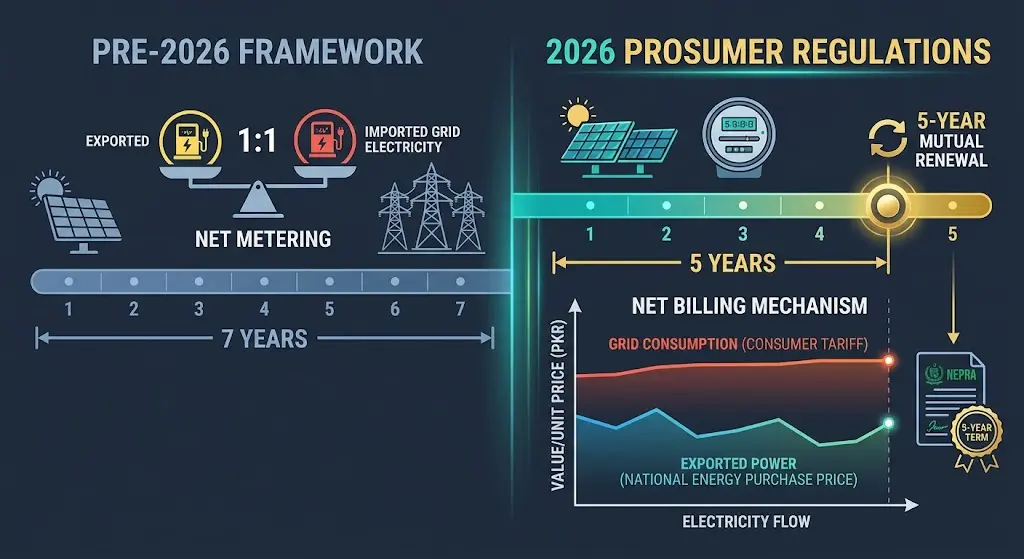
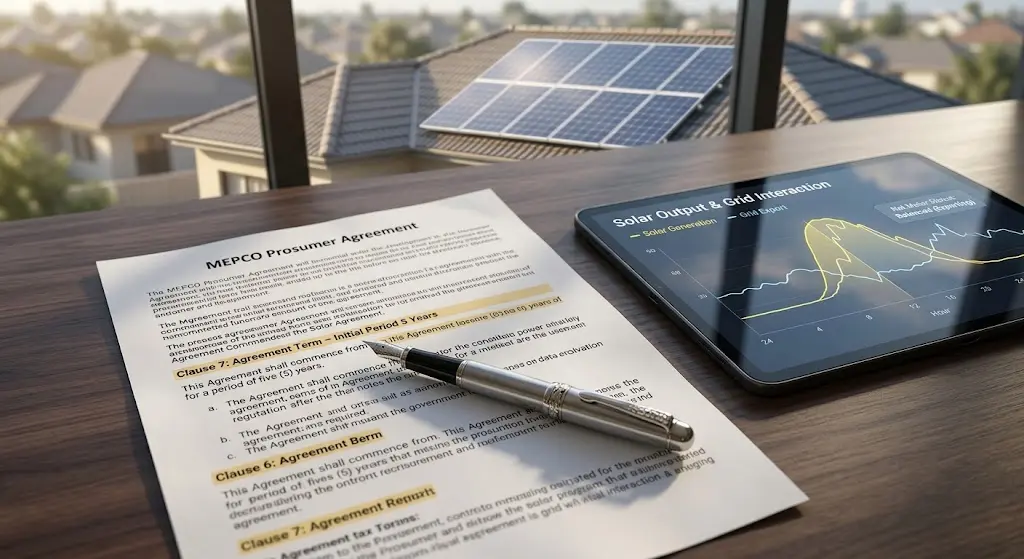
Under Pakistan’s 2026 Prosumer Regulations, the agreement between a prosumer and the distribution licensee has an initial term of five years, replacing the earlier seven-year arrangement. The agreement can be renewed for another five-year period with mutual consent.
That sounds like a small change on paper. It isn’t.
For someone considering a solar installation, the contract period affects how long the regulatory arrangement remains in place before renewal becomes relevant. It also matters when estimating the long-term economics of a system, especially because the 2026 framework changed the way exported and imported electricity are treated.
There is another detail that gets lost in short social-media posts: the five-year term is part of a much wider shift from the previous net-metering model to the new prosumer and net-billing framework.
1. The Seven-Year Agreement Has Been Replaced
Under the previous arrangement, solar consumers commonly understood their agreement as lasting seven years. The 2026 Prosumer Regulations changed that period.
Regulation 7 of the February 9, 2026 regulations states that the agreement between the prosumer and the licensee has a term of five years from the date the distributed-generation facility is commissioned. After the initial period, it may be renewed for another five years with mutual consent.
So the basic change looks like this:
| Solar agreement | Earlier arrangement | 2026 Prosumer Regulations |
|---|---|---|
| Initial contract term | 7 years | 5 years |
| Renewal | Based on applicable previous rules | Another 5 years with mutual consent |
| Starting point | Existing regulatory framework | Date of commissioning of the distributed-generation facility |
| Billing framework | Net metering | Net billing under the 2026 Prosumer Regulations |
The important wording here is new agreements.
A consumer should not automatically assume that an existing seven-year agreement has suddenly become a five-year agreement simply because new regulations were issued.
Existing arrangements have their own transitional treatment, and that is one of the areas where solar information online gets mixed up.
2. Why the Five-Year Term Matters to MEPCO Consumers
A solar system is normally considered a long-term household or business investment. Panels, inverters, protection equipment, meters and installation work all have costs that extend well beyond the first few months.
The agreement term therefore becomes part of the calculation.
Suppose someone is planning a grid-connected solar installation and expects to export a meaningful amount of electricity. They cannot simply calculate the equipment cost against today’s electricity bill and assume the same regulatory treatment will continue indefinitely.
The agreement now has a five-year initial term.
At the end of that period, renewal is possible, but the regulations describe renewal as another five-year term with mutual consent.
That does not mean a consumer should assume that every future renewal will automatically happen on identical terms.
This is where people usually go wrong. They treat the contract duration as if it were the same thing as the physical life of the solar panels.
It isn’t.
Your panels may continue producing electricity for many years. The regulatory agreement governing your relationship with the distribution company is a separate matter.
For an MEPCO consumer, keeping the actual agreement and commissioning documents is therefore sensible. Don’t rely on the date printed on an old website article.
3. The Five-Year Contract Came With a Bigger Change: Net Billing
The contract period did not change in isolation.
The 2026 regulations also moved the framework away from the older one-to-one net-metering approach and toward net billing.
Under the new arrangement, electricity supplied by the distribution licensee to the prosumer is billed at the applicable consumer tariff. Electricity supplied by the prosumer to the licensee is treated according to the applicable national average energy purchase price mechanism.
That distinction is important.
Under the old way of thinking about net metering, many consumers focused on exported units cancelling imported units. The new framework separates the economic treatment of electricity flowing in the two directions.
A simple example helps.
Imagine a home uses electricity from MEPCO during the evening and produces more solar electricity than it needs during some daylight hours.
The electricity consumed from the grid is not simply valued in the same way as electricity exported by the solar system.
Instead:
| Electricity flow | 2026 framework |
|---|---|
| Electricity imported from MEPCO | Charged at the applicable consumer tariff |
| Electricity exported to the distribution licensee | Purchased under the applicable prosumer net-billing mechanism |
| Agreement term for a new prosumer | 5 years |
| Renewal | Another 5 years with mutual consent |
This is why the five-year change should be discussed together with the billing change.
Looking at the contract period while ignoring the billing mechanism gives only half the picture.
The MEPCO Net Metering Rules Updated Under NEPRA 2026 guide on mepcco-bill.pk also explains the distinction between the older terminology and the 2026 prosumer framework.
4. What Happens When the Five Years Are Over?
The regulations don’t say that the solar system must be removed after five years.
That’s another misunderstanding worth clearing up.
The five-year period applies to the agreement between the prosumer and the distribution licensee. The regulations provide for renewal for another five-year term with mutual consent.
So, in practical terms, there are several different dates a solar owner should keep track of:
- The date the application and approval process was completed.
- The date the distributed-generation facility was commissioned.
- The date the agreement began.
- The date the initial five-year term expires.
- The date any renewal becomes effective.
These dates are not interchangeable.
And this is one reason I would keep a digital copy of the agreement alongside your MEPCO bills.
It sounds like a minor administrative detail until you need to prove when an agreement started.
A folder containing the application, approval documents, commissioning information, agreement, meter details and monthly bills gives you something concrete to refer back to.
That is generally more useful than trying to reconstruct the history from an installer’s WhatsApp messages several years later.
5. What About People Who Already Have Seven-Year Agreements?
This is probably the most important distinction for existing MEPCO solar consumers.
A person who already has a valid agreement should not read the five-year rule and immediately assume that the remaining term of their existing agreement has been shortened.
The 2026 regulatory framework included transitional provisions for arrangements made under the previous rules, and subsequent amendments addressed how existing agreements are treated. Reporting on the regulatory changes also distinguished existing consumers from new applicants.
In other words, there is a difference between:
An existing agreement: the terms and transitional provisions applicable to that agreement need to be checked.
A new agreement under the 2026 framework: the standard initial term is five years.
That distinction matters for anyone who already has a solar connection.
If you have an older MEPCO net-metering agreement, look at the agreement itself before assuming that the new five-year term has replaced it.
The date of the agreement and the regulatory provisions governing it matter.
For consumers trying to reconstruct their solar billing history, keeping previous MEPCO bills is useful as well. The bills can help establish when changes in meter readings, exported electricity or billing treatment appeared.
6. The August 2026 Amendment Changed Another Part of the Process
There is a newer development that MEPCO solar applicants should know about.
NEPRA’s official record shows that it notified S.R.O. 1330(I)/2026 on August 6, 2026, amending the Prosumer Regulations. The amendment removed the need for NEPRA concurrence for distributed-generation facilities of up to 25 kW, with the relevant distribution licensee handling the approval instead.
For an MEPCO consumer with a qualifying system, this makes the approval route different from what older guides describe.
But don’t make the mistake of reading “NEPRA concurrence is no longer required” as “no approval is required.”
Those are two different things.
The distribution company still has a role in the connection and interconnection process, and the applicable technical requirements remain relevant. Current reporting on the August amendment also describes the change as an exemption from NEPRA concurrence for systems up to 25 kW, rather than the removal of the entire approval process.
So the current picture has several moving parts:
| Question | Current position |
|---|---|
| New agreement term | 5 years |
| Possible renewal | Another 5 years with mutual consent |
| Older existing agreement | Check its own terms and transitional provisions |
| Systems up to 25 kW | NEPRA concurrence no longer required under the August amendment |
| Approval for qualifying smaller systems | Handled by the relevant distribution licensee |
| Exported electricity | Treated under the 2026 net-billing mechanism |
That is a lot of regulatory change in one year.
7. Where Solar Applicants Usually Misread the Five-Year Rule
There are three recurring mistakes.
Mistake 1: Assuming five years means the solar system expires
It doesn’t.
The five-year period is the agreement term. It does not mean the panels stop working after five years.
Mistake 2: Assuming every existing consumer has been moved to five years
That conclusion doesn’t follow from the new agreement rule.
Existing agreements require separate consideration under the applicable transitional provisions.
Mistake 3: Looking only at the contract and ignoring the billing mechanism
The contract duration is important, but it is not the only change.
The 2026 framework also changed the treatment of imported and exported electricity. The electricity purchased from the grid and the electricity supplied to the distribution licensee are handled differently under the new net-billing arrangement.
And there is a fourth mistake I would add: relying on an installer who is still using a 2024 or 2025 application checklist.
Rules changed during 2026. An old PDF can look perfectly professional and still be outdated.
Before signing anything, check the current regulatory requirements and the documents being used for your actual application.
8. What I Would Keep Before Signing a New MEPCO Solar Agreement
I would keep the paperwork boring and complete.
Start with your recent MEPCO bills. Then keep your reference number, customer information, sanctioned load and meter details together.
For the solar side, keep the proposed system capacity, technical documents, application, approval correspondence and final agreement.
Once the system is commissioned, save the commissioning date and meter information too.
A basic record should contain:
- Recent MEPCO electricity bills
- Consumer reference number
- Meter information
- Sanctioned load
- Solar system capacity
- Application documents
- Approval or concurrence documents where applicable
- Commissioning information
- Signed prosumer agreement
- Meter installation details
- Subsequent monthly bills
It sounds excessive when everything is going smoothly.
It isn’t.
If a billing question appears two years later, these records give you something to compare. The MEPCO information published through mepcco-bill.pk is intended to help consumers understand these billing and regulatory changes, but the actual agreement for your connection remains the document that matters for your individual case.
And yes, keep a backup.
A cloud folder with clearly named PDF files is much easier to search than a drawer full of papers.
9. What the Five-Year Change Means for Someone Considering Solar Now
For a new MEPCO solar applicant, the five-year agreement should be included in the financial calculation from the beginning.
That doesn’t mean someone should calculate the entire value of solar from the contract period alone. Panel production, self-consumption, electricity tariffs, system size, financing, maintenance, equipment warranties and the treatment of exported electricity all affect the calculation.
But the regulatory agreement is one of the inputs.
The old seven-year assumption should not simply be copied into a new spreadsheet.
Use the current five-year term for a new agreement under the 2026 framework, then separately consider what renewal means after that period.
The same caution applies to the value of exported electricity. A calculation based on one-to-one net-metering assumptions does not accurately describe the 2026 net-billing arrangement.
That is the practical difference between reading a headline and reading the regulation.
For readers following MEPCO developments, the change also shows why older solar guides need to be dated. NEPRA issued the main Prosumer Regulations in February and subsequently issued amendments, including the August 6 notification.
The rules have moved during the year.
So has the information consumers need.
FAQs
Are new MEPCO net-metering contracts now five years?
Under the 2026 Prosumer Regulations, the agreement between a prosumer and the distribution licensee has an initial term of five years from the commissioning date of the distributed-generation facility. It can be renewed for another five years with mutual consent.
What happened to the old seven-year contract?
The seven-year term belongs to the earlier regulatory arrangement. The 2026 Prosumer Regulations specify a five-year initial agreement for the new framework.
Does my existing seven-year solar agreement automatically become five years?
Not necessarily. Existing agreements need to be considered under their own terms and the applicable transitional provisions. A new five-year agreement rule should not automatically be applied to an older agreement without checking its documents.
Can a five-year prosumer agreement be renewed?
Yes. The 2026 regulations provide for another five-year term after expiry, subject to mutual consent between the prosumer and licensee.
Do solar systems of 25 kW or less still need NEPRA concurrence?
The August 6, 2026 amendment removed the NEPRA concurrence requirement for distributed-generation facilities of 25 kW or below. The relevant distribution licensee handles the approval instead. This does not mean that the entire connection process disappears.
Is the five-year contract the only major change in 2026?
No. The 2026 framework also shifted new prosumers from the older net-metering approach toward net billing, with electricity imported from the grid and electricity exported to the licensee treated differently.
For MEPCO consumers, the safest approach is to keep the actual agreement, commissioning date and billing records together and check the latest NEPRA rules when applying, renewing or questioning a solar connection.