
A tariff review does not always end with a revised tariff. Sometimes it ends with the regulator saying that the original determination stands.
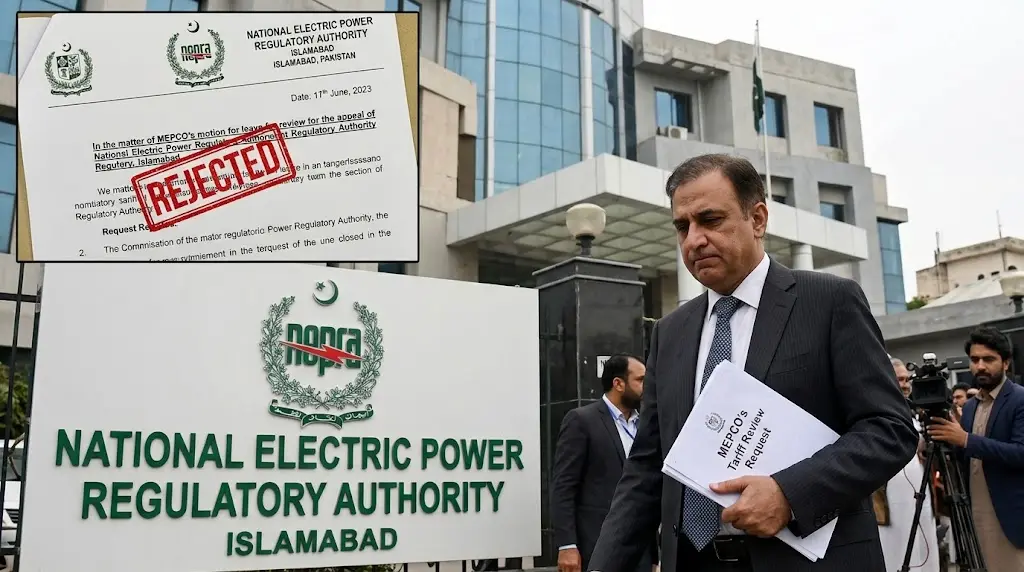
That is what happened to Multan Electric Power Company Limited (MEPCO) in June 2026. The National Electric Power Regulatory Authority (NEPRA) rejected MEPCO’s Motions for Leave for Review against its distribution and supply tariff determinations for the five-year period from FY2025-26 to FY2029-30. The decision was issued on June 8, 2026, and the federal government later notified it through S.R.O. 1146(I)/2026 on July 8.
For ordinary MEPCO consumers, this sounds like a technical regulatory dispute. It is, but there is a practical side to it. The decision affects the framework under which MEPCO’s costs, investments, efficiency targets and other tariff-related matters are handled during the five-year control period.
I have found that this is where readers usually get confused. A review motion is not the same thing as a completely new tariff petition. MEPCO was asking NEPRA to reconsider specific parts of determinations that had already been made.
And NEPRA decided that the reasons presented did not justify changing those determinations.
1. What NEPRA Actually Rejected
MEPCO’s review motions were connected to the distribution and supply tariff determinations issued by NEPRA on January 7, 2026. Those determinations established the company’s Multi-Year Tariff, or MYT, for FY2025-26 through FY2029-30. The federal government subsequently notified the tariff framework through an SRO dated January 13, 2026.
MEPCO challenged several parts of the determinations.
The major issues included:
- Investment approvals for the first two years of the control period
- Operation and maintenance expense allowances
- The continued application of the X-Factor efficiency mechanism
- The relationship between revenue requirements, investment approvals and loss targets
- The use of different time bases for some tariff calculations and targets
The distinction matters because NEPRA did not reject MEPCO’s entire tariff petition. The regulator rejected MEPCO’s request to reopen the relevant determinations.
NEPRA’s own MEPCO tariff page records the June 8 review decision and the subsequent July 8 notification. It also lists the original January 7 distribution and supply determinations that formed the basis of the review.
| Issue raised by MEPCO | NEPRA’s position |
|---|---|
| Investment approvals | Remain provisional and subject to separate investment proceedings |
| Operation and maintenance costs | Existing methodology retained |
| X-Factor | Continued as part of the efficiency framework |
| Revenue and target calculations | Objection not accepted |
| Overall review request | Both motions declined |
This is the part worth remembering if you follow MEPCO tariff news. The word “rejected” does not mean every future investment request from MEPCO has been rejected.
There is a difference.
2. Why MEPCO Challenged the Investment Amount
The investment issue was one of the more substantial parts of the dispute.
MEPCO told NEPRA that it had requested Rs51.365 billion in investment for the first two years of the five-year control period. NEPRA’s tariff determination provisionally allowed Rs18.912 billion. MEPCO argued that the approved amount was not enough for the scale of its network and consumer base.
MEPCO also submitted a revised five-year Distribution Investment Plan valued at Rs119.022 billion.
That plan included several areas that are becoming increasingly familiar to electricity consumers:
- Rehabilitation and strengthening of high- and low-tension networks
- Replacement of defective meters
- Advanced Metering Infrastructure
- Smart metering
- Outage management systems
- Data centres
- Enterprise resource planning
- Geographic information system mapping
- Anti-theft measures
Some of the individual proposed allocations were substantial. MEPCO cited Rs41.7 billion for replacing defective meters, Rs11.96 billion for advanced outage management systems, Rs7.07 billion for expanding Advanced Metering Infrastructure and Rs3.77 billion for a centralised data centre.
Here is where people usually go wrong: they see the lower provisional investment figure and assume that NEPRA has permanently blocked the entire difference.
That is not what the decision says.
NEPRA explained that the investment amounts included in the tariff determination were provisional. The final investment position would be dealt with separately through proceedings concerning MEPCO’s investment plan. Any resulting changes could then be incorporated into the tariff.
So the Rs18.912 billion figure should not automatically be treated as the final answer on every rupee of MEPCO’s five-year investment programme.
3. The Numbers Behind MEPCO’s Argument
MEPCO’s review case was not based only on future plans. The company also pointed to improvements in its operating performance.
According to the information presented during the review proceedings, MEPCO reported that transmission and distribution losses declined from 15.2% to 13.3% during FY2024-25. The company associated this reduction with savings of around 358 gigawatt-hours and an estimated financial benefit of Rs9.8 billion.
MEPCO also reported an improvement in its recovery rate, from 98.62% to 100.51%, and estimated an additional financial benefit of around Rs11.8 billion.
Combined, MEPCO estimated the financial gains from improved losses and recoveries at approximately Rs21.6 billion.
Those numbers help explain why MEPCO wanted NEPRA to reconsider parts of the tariff framework. The company was essentially arguing that its performance and system requirements justified a different treatment in some areas.
NEPRA did not accept that argument as sufficient grounds for reopening the determinations.
For someone following MEPCO’s broader operations, this is also why investment, losses and tariff regulation cannot really be looked at as three separate subjects. They are connected. A utility needs investment to improve its network, regulators measure performance against targets, and those decisions eventually feed into the financial structure of the company.
That connection is easy to miss when you are simply checking a monthly electricity bill.
4. What Happened to MEPCO’s O&M Expense Objection
Operation and maintenance expenses were another point of disagreement.
MEPCO challenged allowances relating to areas such as repairs and maintenance, travelling and vehicle maintenance. The company argued that the allowances did not sufficiently reflect inflation and its operational requirements.
NEPRA took a different view.
The regulator said that some of MEPCO’s objections arose from a misunderstanding of the tariff-setting methodology. According to NEPRA, costs were first assessed collectively for MEPCO’s distribution and supply functions and then allocated between those two businesses.
NEPRA approved Rs53.501 billion in operation and maintenance expenses for FY2025-26 and a provisional Rs57.639 billion for FY2026-27. The figures represented an overall increase of roughly 8%.
That detail is useful because a headline saying “MEPCO review rejected” can make it sound as if NEPRA simply dismissed every request without changing or assessing anything.
The actual process was more specific.
NEPRA considered MEPCO’s arguments and maintained that the methodology already accounted for the relevant costs.
For readers who follow MEPCO bill information through mepcco-bill.pk, this distinction is useful. A company’s approved regulatory costs do not translate into a simple one-to-one change in the amount printed on an individual consumer’s bill. Consumer-end tariffs also involve the wider uniform tariff framework, adjustments and government notifications.
5. Why NEPRA Kept the X-Factor
MEPCO also asked NEPRA to remove the X-Factor efficiency mechanism from its tariff framework.
The request was rejected.
NEPRA’s position was that the efficiency benchmark was applied uniformly across the power sector and had already been part of MEPCO’s previous Multi-Year Tariff framework.
The X-Factor is significant because it links the regulatory framework to expected efficiency improvements. In simple terms, a distribution company is not treated as though its costs will automatically rise without consideration of efficiency.
This is one reason tariff determinations can become complicated. A utility may have legitimate costs, but the regulator also has to consider whether the company is improving its performance.
MEPCO’s reported reduction in T&D losses was therefore relevant to the wider discussion, but it did not persuade NEPRA to remove the X-Factor from the approved framework.
The regulator also rejected MEPCO’s objection concerning the use of a calendar-year basis for revenue requirements while investment and loss targets were considered on a financial-year basis. NEPRA noted that MEPCO had itself originally requested rebasing of consumer-end tariffs to a calendar-year framework.
NEPRA did, however, indicate that it would hold a separate session with distribution companies to explain the tariff assessment methodology and future data requirements.
That is a small but useful detail. Not every disagreement between a DISCO and regulator ends with one side simply being told that it is wrong. Sometimes the regulator also changes how information and methodology are communicated for future proceedings.

6. What This Means for MEPCO Consumers
For a household consumer, the immediate question is usually much simpler: does this decision mean my next MEPCO bill will suddenly increase?
The answer is no, not simply because the review motion was rejected.
The June decision concerns MEPCO’s regulatory tariff determinations and the company’s request for review. The federal government notification and the wider consumer-end tariff framework determine how approved tariff decisions are implemented. NEPRA’s record shows that the January determinations were subsequently notified, while the June review decision was itself forwarded for official notification.
Consumers should therefore avoid treating a regulatory review headline as a direct bill calculator.
Your actual bill still depends on factors such as electricity consumption, applicable consumer category, tariff rates, taxes, duties, adjustments and other charges appearing under the applicable billing framework.
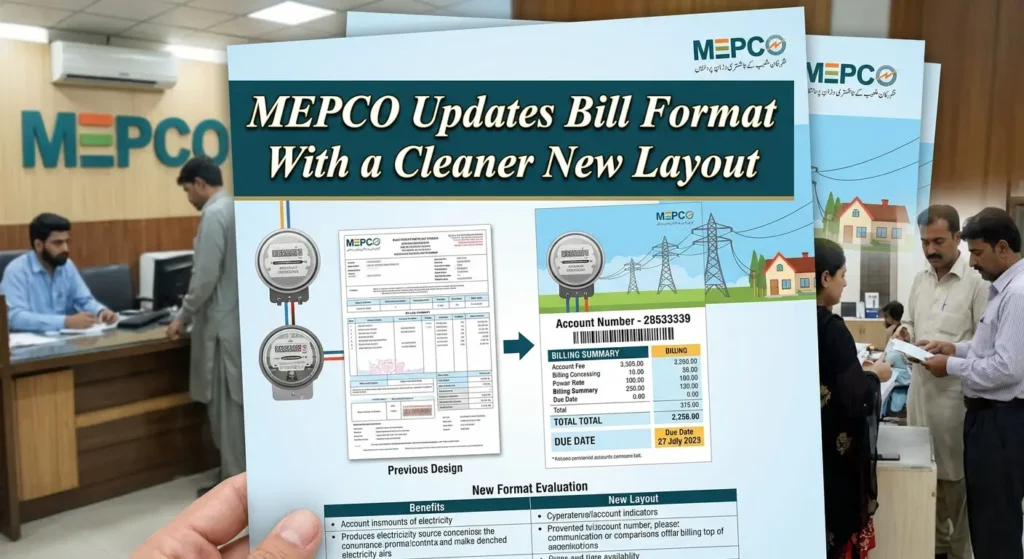
If you’re trying to understand those charges rather than just the headline tariff news, the site’s guide on the [MEPCO bill format and cleaner new layout] can be useful for identifying the different sections of a bill. MEPCO bill format and cleaner new layout
And if the issue is not tariff but a disputed charge, that is a different conversation altogether. The [MEPCO detection bill guide] explains that category of billing issue separately. MEPCO detection bill guide
7. The Bigger MEPCO Picture
I think the more interesting part of this decision is what it says about MEPCO’s next few years.
The company wants significant investment in network rehabilitation, metering, data systems and operational technology. NEPRA, meanwhile, is keeping the tariff framework tied to regulatory methodology and efficiency expectations.
Those two positions are not necessarily incompatible.
A stronger network should eventually improve reliability, reduce technical losses and make billing data more useful. Better meters and data systems can also improve visibility into consumption and losses. But investment has to pass through the regulatory process, and the regulator still has to decide what belongs in the tariff and when.
This is why the separate investment proceedings mentioned by NEPRA deserve attention. The June review decision did not close that door. It simply said the investment question raised by MEPCO did not provide a reason to reopen the tariff determinations themselves.
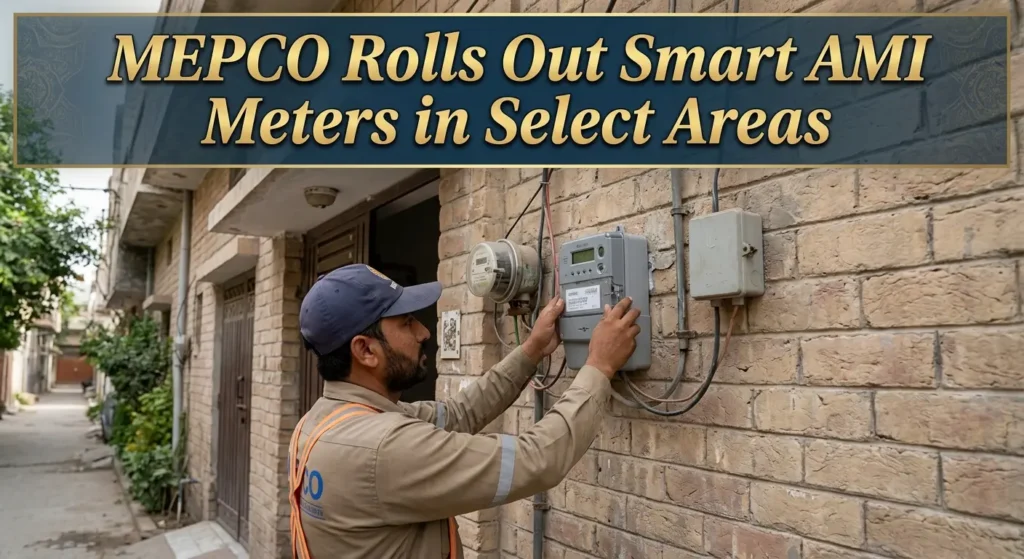
MEPCO consumers should also keep an eye on developments around smart metering and AMI. The company’s investment plan specifically included these areas, and they could eventually affect how consumption information, outages and network performance are managed.
For readers who want to follow those developments, the [MEPCO smart AMI meter update] provides useful background on the company’s smart-meter rollout. MEPCO smart AMI meter update
There is another practical resource worth keeping nearby too. MEPCO-related complaints and contact procedures change over time, so the [updated MEPCO helpline and complaint contacts] are worth checking before relying on an old number found elsewhere online. Updated MEPCO helpline and complaint contacts
8. What Happens After the Rejection?
NEPRA concluded that MEPCO had not provided grounds warranting a review of the tariff determinations and therefore declined both motions. The decision was sent to the federal government for publication in the official Gazette under Section 31(7) of the NEPRA Act.
That gives us a fairly clear regulatory position for now.
The five-year MYT framework remains in place, while the investment questions raised by MEPCO have a separate route through the investment-plan proceedings.
The regulator’s MEPCO tariff record also shows that the June 8 review decision was followed by S.R.O. 1146(I)/2026 on July 8, formally notifying the decision.
So I would not read this as the end of MEPCO’s requests for investment or operational changes. It is better understood as the end of this particular attempt to reopen the January tariff determinations.
That distinction matters.
MEPCO can still have future regulatory proceedings. Its investment requirements can still be examined. Tariff adjustments can still occur through the established process. What NEPRA rejected here was the company’s argument that the existing MYT determinations should be reviewed on the grounds presented.
For consumers, the sensible approach is to watch the actual notifications and tariff adjustments rather than reacting to every headline about a tariff petition or review.
And when you check your MEPCO bill, the amount printed there is still the most useful starting point for understanding what you are actually being charged.
Frequently Asked Questions
Did NEPRA reject MEPCO’s entire tariff?
No. NEPRA rejected MEPCO’s Motions for Leave for Review against the existing distribution and supply tariff determinations. The underlying five-year MYT framework remained in place.
When did NEPRA reject MEPCO’s review request?
The Authority issued its decision on June 8, 2026. NEPRA’s MEPCO tariff record shows that the decision was subsequently notified through S.R.O. 1146(I)/2026 on July 8, 2026.
How much investment did MEPCO request?
MEPCO said it had requested Rs51.365 billion for investment during the first two years of the control period, while NEPRA provisionally allowed Rs18.912 billion. MEPCO also submitted a revised five-year Distribution Investment Plan of Rs119.022 billion.
Did NEPRA reject MEPCO’s future investment plans?
Not exactly. NEPRA said the investment amounts in the tariff determinations were provisional and would be finalised separately through proceedings concerning MEPCO’s investment plan. Any resulting changes could later be incorporated into the tariff.
Will this review rejection automatically increase my MEPCO bill?
No. A rejected tariff review motion does not by itself mean that every consumer’s next bill will increase. Individual bills depend on the applicable tariff, consumption, taxes, adjustments and other charges under the prevailing billing framework.
For ongoing MEPCO information, I keep the focus on practical details at mepcco-bill.pk, especially when a regulatory decision eventually affects what consumers see on their bills.

Pingback: MEPCO Tariff Hike: What NEPRA Approved – MEPCO Bill Check 2026