Mepcco-Bill’s Guide to MEPCO Net Metering in 2026
A solar installation can look simple from the outside. Panels go on the roof, a meter is installed, electricity starts moving in two directions, and the expectation is usually that the monthly MEPCO bill will fall sharply.
The paperwork tells a different story.
During 2026, the rules surrounding solar connections changed, and the terminology changed with them. NEPRA introduced the Prosumer Regulations, 2026, while later amendments changed parts of the approval process. That has left many MEPCO consumers reading older guides that no longer describe the current position.
The detail that causes the most confusion is the difference between net metering and net billing. They are not simply two names for the same arrangement.
For anyone planning solar under MEPCO, the capacity of the system, the approval route, the treatment of exported electricity, and the status of an existing agreement all matter.
1. The 2026 MEPCO Solar Rules Changed More Than the Name
The first thing I would check is the date on any solar guide you are reading.
NEPRA notified the National Electric Power Regulatory Authority (Prosumer) Regulations, 2026 on February 9, 2026 through S.R.O. 251(I)/2026. NEPRA’s legal record also lists subsequent amendments, including S.R.O. 709(I)/2026 dated April 28 and S.R.O. 1330(I)/2026 dated August 6, 2026.
That matters because an article written before these changes can easily mix the old net-metering system with the newer prosumer framework.
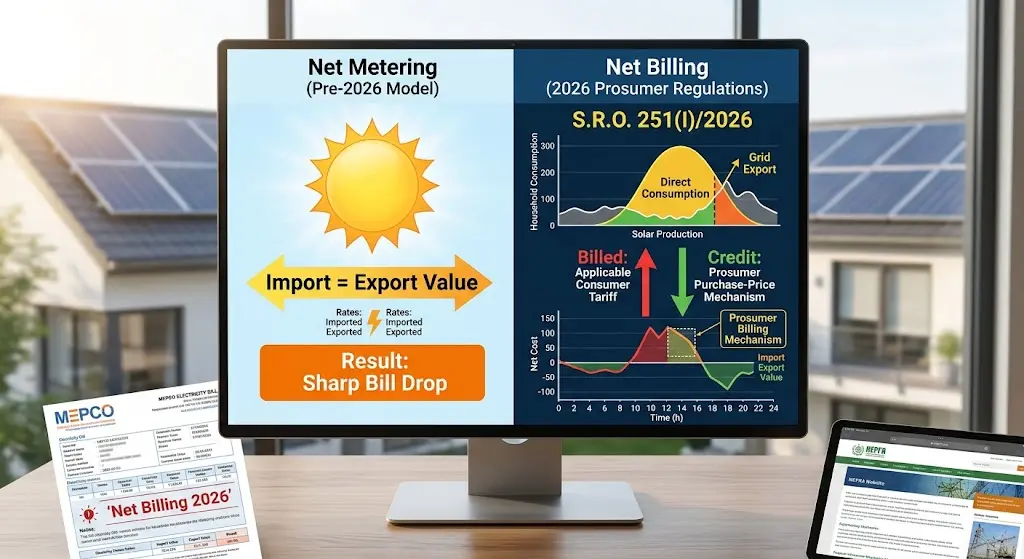
The 2026 regulations use a net-billing arrangement. Under that framework, electricity supplied by the distribution licensee to a prosumer is billed according to the applicable tariff, while electricity supplied by the prosumer to the licensee is treated separately under the applicable purchase-price mechanism.
So the simple idea of:
Solar units exported = exactly the same value as grid units imported
is not a safe way to calculate a new solar connection under the 2026 framework.
NEPRA’s current legal archive confirms that the February regulations remain part of the 2026 framework and that an August amendment was subsequently issued.
The basic 2026 position
| Issue | 2026 position |
|---|---|
| Main regulatory framework | NEPRA Prosumer Regulations, 2026 |
| Original notification | February 9, 2026 |
| Important later amendment | August 6, 2026 |
| Solar system up to 25 kW | NEPRA concurrence requirement removed under the August amendment |
| Approval for qualifying systems | Relevant distribution licensee |
| Imported electricity | Billed under the applicable tariff |
| Exported electricity | Treated under the applicable prosumer billing mechanism |
| Existing agreements | Transitional provisions need to be considered |
The important distinction is between simplifying the approval route and removing the regulatory requirements altogether. The August amendment did the former. It did not turn a grid-connected solar installation into an installation that can simply be connected without following the applicable process.
2. Net Billing Is Different From the Older Net-Metering Model
This is where people usually go wrong.
For years, many electricity consumers understood net metering as a straightforward exchange. You consume electricity from the grid, your solar system produces electricity, excess generation goes back to the grid, and the exported units offset imported units according to the applicable rules.
That mental model is no longer enough for a new 2026 application.
The Prosumer Regulations introduced a different treatment for electricity flowing in each direction.
When your home takes electricity from MEPCO, that imported electricity is billed according to the applicable consumer tariff.
When your distributed-generation facility supplies electricity to the distribution licensee, that exported electricity is treated under the applicable purchase-price mechanism.
Those two values do not simply have to be identical.
This matters when you calculate the expected financial return of a solar system.
Imagine a house that produces a large amount of electricity during the middle of the day. If the occupants are away at work and school, much of their household demand may happen later in the evening. The solar panels still generate electricity, but the timing of generation and consumption is different.
That is one reason I would not calculate a solar system using only its expected monthly production.
Look at your actual consumption pattern too.
A household using most of its electricity during daylight hours has a different situation from a household whose largest loads run after sunset.
And this is one of those small details that can get lost in a sales conversation. A panel installer may be focused on system size, panel efficiency and inverter capacity. The consumer is ultimately dealing with a bill that reflects electricity consumption, imports, exports and the applicable regulatory treatment.
For background on how the rules developed, the MEPCO site’s guide to the history of net-metering rules provides another useful reference point.
3. What the 25 kW Change Means for MEPCO Consumers
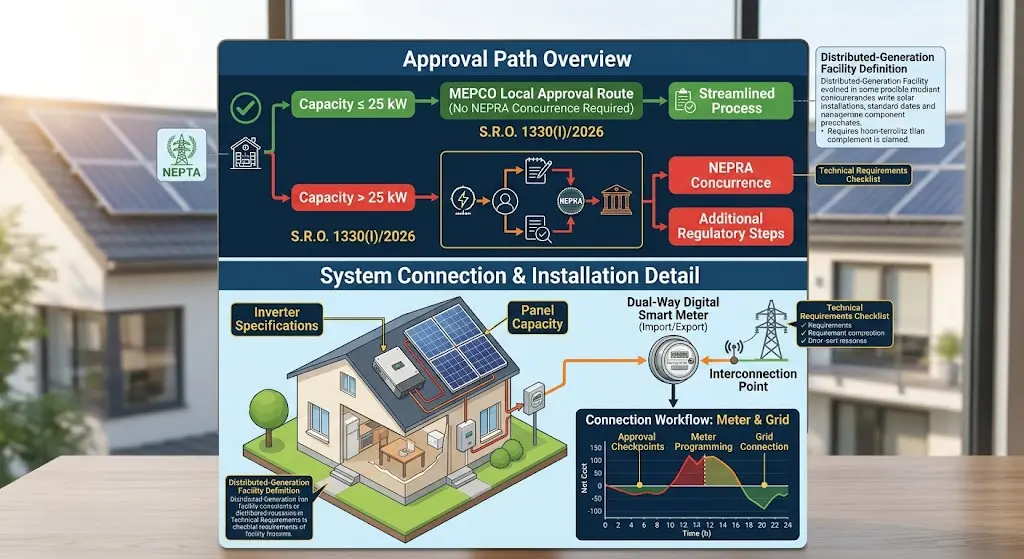
The August 2026 amendment deserves particular attention because of the 25 kW threshold.
Under the amendment, qualifying distributed-generation facilities with a capacity of up to 25 kW no longer require concurrence from NEPRA itself. The relevant distribution licensee handles the approval.
For an MEPCO consumer, that puts MEPCO’s role directly into the practical approval process.
NEPRA’s legal page lists S.R.O. 1330(I)/2026 dated August 6, 2026 as an amendment to the Prosumer Regulations, 2026.
But there is an important qualification here.
The removal of the separate NEPRA concurrence requirement does not mean that a consumer can install a grid-connected solar system and connect it without meeting the applicable technical and interconnection requirements.
Those are separate issues.
A person might see the phrase “NEPRA approval is not required up to 25 kW” and interpret it as:
I can install a 20 kW system and connect it directly to the MEPCO network.
That is not what the amendment means.
A better way to understand the change is:
- Determine whether the proposed system falls under the applicable distributed-generation framework.
- Check its actual capacity.
- If it is within the qualifying 25 kW threshold, the separate NEPRA concurrence requirement does not apply in the same way.
- Follow the approval process handled by the relevant distribution licensee.
- Meet the applicable technical and interconnection requirements.
- Understand how billing will work under the current Prosumer Regulations.
That distinction is worth keeping in mind before signing an installation contract.
4. Existing Solar Connections Need a Different Look
A new applicant and an existing solar consumer should not automatically be treated as though they are in the same position.
Here’s where people usually go wrong: they read a new regulation and immediately apply it to an agreement that was already executed under an earlier regulatory framework.
The 2026 regulations include transitional provisions dealing with approvals, licences, concurrences and agreements made under the repealed regulations.
NEPRA’s published amendment material specifically addresses valid agreements executed under the earlier regulations and provides for their treatment under the earlier rate and mechanism for the applicable term of those agreements.
That makes the agreement itself important.
If you already have a solar connection, keep the original documents. Don’t rely only on what a neighbour, installer or Facebook post says about the current rules.
Check:
- The date of your agreement
- The applicable regulatory framework
- The term of the agreement
- The approved system capacity
- Your meter and connection details
- Your recent MEPCO bills
- Any approval or concurrence documents you received
This sounds like paperwork for paperwork’s sake, but it isn’t.
If there is ever a question about how your solar export is being treated, the actual agreement gives you something concrete to compare against the bill.
I have always found electricity records easier to understand when everything is kept together. A folder containing bills, approvals and connection documents is much more useful than trying to reconstruct the history from old WhatsApp messages.
5. Your Solar System Size Matters More Than You Think
The 25 kW threshold is not just a number to remember for an article.
It can affect the approval route.
A system designed at 25 kW and another designed above that threshold should not be treated as automatically identical from a regulatory perspective.
This is particularly relevant when an installer recommends a system close to the limit.
Don’t rely only on the number of solar panels.
The actual capacity and the definitions used by the applicable regulations matter. Panel capacity, inverter specifications and the regulatory definition of the distributed-generation facility should be considered together rather than reduced to a casual statement such as “it’s under 25 kW.”
That is another place where a consumer can get caught between technical language and sales language.
If your installer tells you that the system is “under 25 kW,” ask them to put the proposed capacity and relevant equipment details in writing.
It takes a few minutes.
It can save a much longer conversation later.
The current NEPRA framework defines distributed-generation facilities in connection with solar, wind and biogas generation and sets out the regulatory structure for prosumers.
6. How I Would Prepare Before Applying Through MEPCO
I would start with the electricity bill, not the solar brochure.
Keep your latest MEPCO bills available and identify the information connected with your electricity account. Your reference number and other consumer details are useful when dealing with billing records and applications.
Then look at your actual electricity use.
Don’t just ask how many units your house consumes in a month. Look at when those units are consumed. A family running air conditioning mainly in the evening has a different load pattern from a house where major appliances operate throughout the afternoon.
Next, decide what system capacity you are considering.
The 25 kW threshold deserves specific attention under the August 2026 amendment.
After that, verify the current requirements with the relevant distribution company and compare them with the documents your installer is asking you to sign.
I would also keep copies of:
- The application
- System specifications
- Approval documents
- Agreement
- Meter information
- Installation records
- Recent MEPCO bills
This is where the information published by Mepcco-Bill can be useful alongside official regulatory sources. The site is intended to make MEPCO billing information easier to understand, but regulatory decisions should still be checked against the current NEPRA record.
And save digital copies.
A clearly named PDF folder is boring, but when you need a document six months later, boring is good.
7. Three Solar Mistakes That Keep Causing Confusion
There are three mistakes I would avoid.
Mistake 1: Using an old export rate
An old article might quote a particular net-metering rate and present it as though it applies to every solar applicant.
The 2026 Prosumer Regulations changed the framework. Imported electricity and exported electricity are treated separately under the new arrangement.
So an old rate should never be copied into a new solar calculation without checking the applicable current rules.
Mistake 2: Treating 25 kW as a free pass
The August amendment simplifies the approval route for qualifying systems up to 25 kW.
It does not remove the technical requirements associated with connecting distributed generation to the distribution system.
That’s an important difference.
Mistake 3: Assuming every solar customer has the same agreement
A consumer who entered into an agreement under an earlier framework may be subject to transitional provisions that are different from those applicable to a new applicant.
The date and terms of the agreement matter.
This is why I would rather spend five minutes checking the actual paperwork than give someone a neat answer based only on the latest headline.
8. Why Your MEPCO Bill May Still Show Charges After Solar Export
One of the most common expectations around solar is that once enough electricity is exported, the electricity bill should automatically become zero.
That’s not a reliable assumption.
Solar generation, household consumption and grid export are three related but different things.
Your panels can produce electricity without all of that electricity being exported. Some generation is consumed directly by appliances in the home. Some excess electricity may flow toward the distribution system. At the same time, the house may import electricity at other hours.
The final bill therefore depends on the applicable billing arrangement and the different components appearing on the account.
This is why a solar consumer can still see charges even after exporting electricity.
The exact treatment depends on the applicable regulatory framework, tariff and connection arrangement.
If a bill looks unexpected, don’t immediately assume that the meter is wrong.
First compare the meter information, import and export readings, billing period and applicable charges. If something still doesn’t make sense, use the relevant MEPCO complaint or billing process rather than relying on a generic solar calculator.
Mepcco-Bill also publishes guidance on what happens to a MEPCO bill after solar export, which can help consumers understand why exported electricity does not automatically mean that every charge disappears.
9. What Has Actually Changed During 2026?
The easiest way to understand the year is as a sequence rather than one single rule change.
| Date | Development |
|---|---|
| February 9, 2026 | NEPRA notified the Prosumer Regulations, 2026 |
| April 28, 2026 | S.R.O. 709(I)/2026 was notified |
| August 6, 2026 | S.R.O. 1330(I)/2026 amended the Prosumer Regulations |
| Current position | Consumers need to consider the amended 2026 framework and applicable transitional provisions |
NEPRA’s legal archive currently lists all three developments under the Prosumer Regulations, 2026.
That timeline explains why older search results can be confusing.
An article published before February describes an older regulatory environment.
An article published shortly after February may describe the initial 2026 framework but miss later amendments.
And an article written before August cannot reflect the August amendment.
So always check the publication date when reading about MEPCO net metering.
10. What MEPCO Consumers Should Keep in Mind
I don’t think the most useful way to approach solar in 2026 is to search for one sentence saying whether net metering is “still available.”
The more useful questions are specific.
What type of connection do you have?
Are you applying for a new system or already operating under an older agreement?
What is the actual capacity of the proposed distributed-generation facility?
How will imported electricity be billed?
How will exported electricity be treated?
Which approval route applies to your system?
Those questions produce a much clearer picture.
The 2026 framework is not static history either. NEPRA’s legal and news pages show amendments and related regulatory activity throughout the year, so a consumer should use the latest applicable notification rather than relying on a guide that was written months earlier.
For MEPCO consumers, the practical approach is fairly simple: keep your bills, keep your agreement, confirm your system capacity, and check the current regulatory requirements before making a major solar decision.
That approach is less exciting than a promise of a zero bill, but it gives you something much more useful: a clear idea of what your own connection is actually governed by.
FAQs
Does MEPCO still have net metering in 2026?
The 2026 NEPRA framework uses a prosumer and net-billing arrangement rather than simply continuing the older net-metering model for new applications. Imported electricity and exported electricity are treated separately under the applicable framework.
Do I need NEPRA concurrence for a solar system of 25 kW or less?
The August 6, 2026 amendment removed the NEPRA concurrence requirement for qualifying distributed-generation facilities up to 25 kW. The relevant distribution licensee handles the applicable approval route.
Does the 25 kW change mean I can connect solar without approval?
No. Removing the separate NEPRA concurrence requirement does not remove the applicable technical, interconnection or distribution-company requirements. An MEPCO consumer still needs to follow the process applicable to the connection.
What happens if I already have an older net-metering agreement?
Existing agreements need to be considered separately because the 2026 framework contains transitional provisions for arrangements made under the earlier regulations. The date and terms of the agreement are important.
Is exported solar electricity worth exactly the same as electricity purchased from MEPCO?
Not under the basic 2026 net-billing framework. Imported electricity is billed under the applicable consumer tariff, while electricity supplied by the prosumer to the licensee is treated under the applicable purchase-price mechanism.
For the latest regulatory position, check the current NEPRA Prosumer Regulations and subsequent amendments before signing a new solar agreement or relying on an older net-metering calculation.
For more MEPCO billing and electricity information, visit mepcco-bill.pk.