
MEPCO Peak Hours 2026 – Timings, Schedule & How to Save Electricity
MEPCO peak hours are the hours of the day when electricity demand is usually at its highest. During these hours, consumers using Time of Use (TOU) meters may be charged a different rate for electricity compared with off-peak hours.
Knowing the MEPCO peak hours 2026 schedule can help you plan when to run high-power appliances such as air conditioners, washing machines, water pumps, electric irons, and heaters. Even a few simple changes in your daily routine can help you use electricity more efficiently.
If you are checking your electricity usage or trying to understand why your monthly bill has increased, you can first check your MEPCO bill online and review the units consumed, billing period, and other charges.
This guide explains the current peak-hour schedule, how TOU billing works, which appliances should be used outside peak hours, and practical ways to reduce electricity consumption.
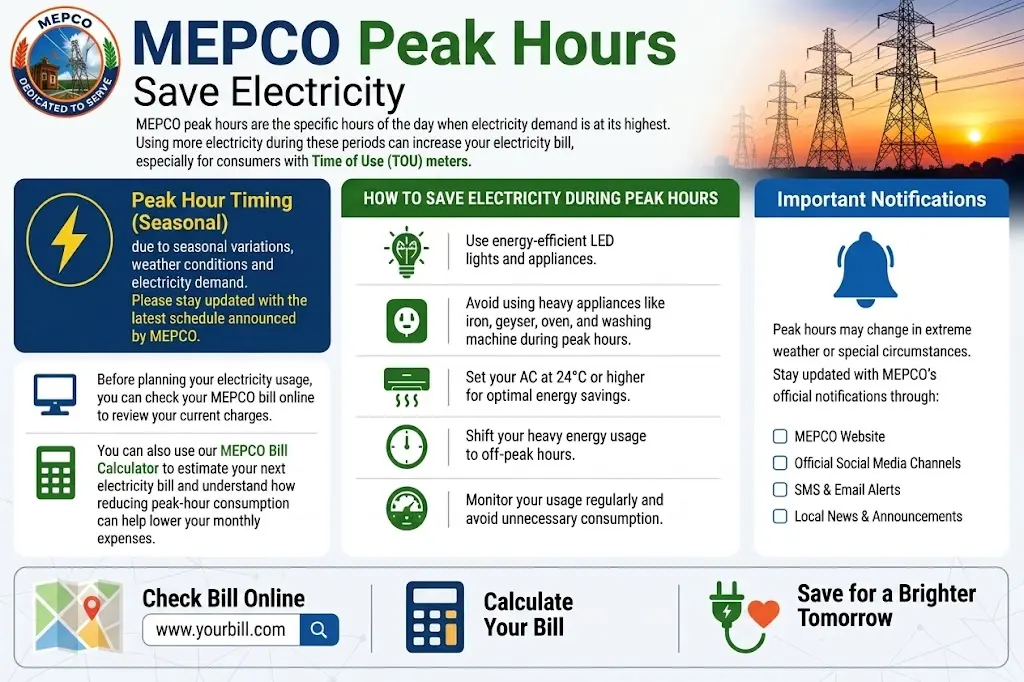
What Are MEPCO Peak Hours?
The MEPCO peak-hour schedule changes during different parts of the year. According to the applicable NEPRA tariff schedule, peak and off-peak periods are divided into four seasonal periods.
| Months | Peak Hours | Off-Peak Hours |
|---|---|---|
| Dec – Feb | 5:00 PM – 9:00 PM | Remaining 20 hours |
| Mar – May | 6:00 PM – 10:00 PM | Remaining 20 hours |
| Jun – Aug | 7:00 PM – 11:00 PM | Remaining 20 hours |
| Sep – Nov | 6:00 PM – 10:00 PM | Remaining 20 hours |
What are MEPCO peak hours right now?
For September through November 2026, the applicable peak period is generally:
6:00 PM to 10:00 PM
During December, the schedule changes to 5:00 PM to 9:00 PM.
Because electricity tariffs and related rules can be revised, consumers should check the latest official information before making long-term billing decisions. NEPRA publishes tariff decisions and notifications on its official website. Check the latest NEPRA tariff information.
What Are MEPCO Peak Hours?
Peak hours are the periods when electricity demand is particularly high. More people are using lights, air conditioners, fans, cooking appliances, water pumps, and other electrical equipment at the same time.
This creates a higher demand on the electricity system.
For consumers with TOU meters, electricity consumed during peak hours can have a different rate from electricity used during off-peak hours. This is why the timing of electricity use can matter when you are trying to control your monthly bill.
For example, a household may need to use an air conditioner every evening. If the AC is running continuously during the peak period, the household may use a significant amount of electricity during the time when peak rates apply to its tariff category.
This does not mean that every MEPCO consumer automatically pays a separate peak-hour rate. The effect depends on the consumer category, meter type, and applicable tariff.
Why Does MEPCO Have Peak Hours?
Electricity demand is not the same throughout the day.
At certain times, a large number of households, businesses, and other consumers use electricity simultaneously. Evening hours are particularly important because people return home, switch on lights and fans, use appliances, prepare meals, and operate cooling or heating equipment.
Peak-hour pricing and TOU structures are used to encourage consumers who can shift flexible electricity use to other times of the day.
The basic idea is simple:
- More electricity is used during peak periods.
- The electricity system has to handle greater demand.
- Consumers with TOU tariffs may face higher peak-period charges.
- Moving flexible consumption to off-peak hours can help manage both usage and cost.
How Does Time of Use (TOU) Billing Work?
A TOU meter records electricity consumption according to the applicable time periods.
Instead of treating every unit consumed during the day in exactly the same way, TOU billing separates consumption into peak and off-peak periods.
For example, if a consumer has a TOU connection and uses a high-power appliance during peak hours, those units may be billed at the applicable peak rate. If the same appliance can be operated during an off-peak period, the applicable off-peak rate may be different.
This is particularly useful for consumers who can control when certain appliances operate.
However, the exact tariff depends on the consumer category and the rates applicable to that connection. It is therefore better to check the tariff shown on your bill rather than assuming that all MEPCO consumers have the same peak and off-peak rates.
Are MEPCO Peak Hours the Same All Year?
No. The peak-hour schedule changes during the year.
This is one reason why simply remembering one fixed time, such as 7 PM to 11 PM, can cause confusion.
The seasonal schedule is:
- December–February: 5 PM to 9 PM
- March–May: 6 PM to 10 PM
- June–August: 7 PM to 11 PM
- September–November: 6 PM to 10 PM
The official NEPRA tariff material lists these four periods for TOU peak and off-peak timing.
So, if you are planning your electricity use in September 2026, for example, the relevant peak period is 6 PM to 10 PM.
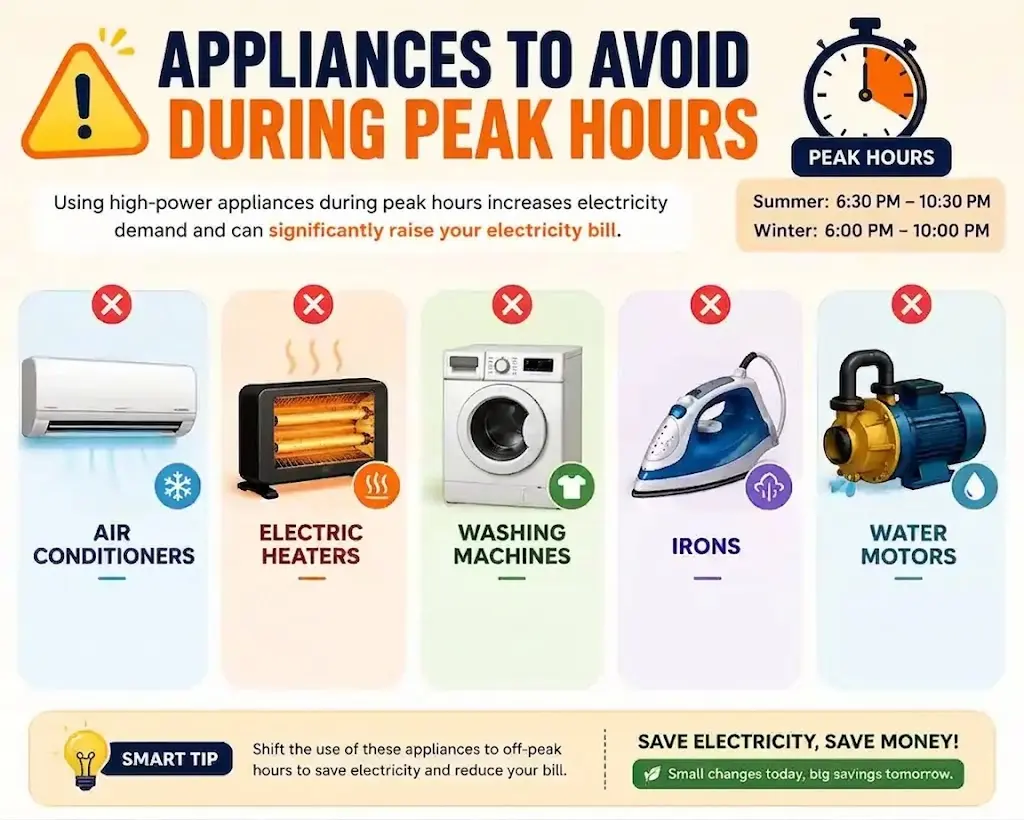
Appliances to Avoid During MEPCO Peak Hours
You do not need to stop using every electrical appliance during peak hours. The main goal is to reduce unnecessary use of appliances that consume a lot of electricity and can easily be operated at another time.
1. Air Conditioners
Air conditioners can be one of the largest sources of electricity consumption in a home, particularly during hot weather.
If possible, cool the room before the peak period begins and avoid setting the temperature unnecessarily low. An inverter AC can also help reduce electricity consumption when used correctly.
2. Electric Heaters
Electric heaters can draw considerable power. During winter, try to use heating equipment efficiently and avoid running multiple high-power heaters at the same time.
3. Washing Machines
A washing machine does not usually need to operate during peak hours. If your daily routine allows it, run the machine earlier in the day or later at night.
4. Electric Iron
An electric iron is another high-wattage appliance that can easily be used outside peak hours.
Instead of ironing clothes every evening during peak time, choose an off-peak period and complete several items together.
5. Water Pumps
Water motors and pumps can consume a noticeable amount of electricity while running. If your household water system allows it, operate the pump outside peak hours.
6. Electric Cooking Appliances
Electric ovens, hot plates, kettles, and other high-power cooking appliances can also add to electricity consumption. Where practical, avoid unnecessary use during peak hours.
How to Reduce Your MEPCO Electricity Bill During Peak Hours
Reducing your bill does not always require buying new appliances. In many cases, changing when and how you use existing appliances can make a difference.
Use Heavy Appliances Before Peak Hours
If you normally wash clothes around 7 PM, try moving the washing machine to the afternoon.
The same approach can be used for:
- Washing machines
- Electric irons
- Water pumps
- Vacuum cleaners
- High-power kitchen appliances
- Other flexible electrical equipment
Use Your AC Efficiently
Air conditioning can become a major part of the electricity bill during hot months.
Keep doors and windows closed while the AC is running, clean filters regularly, and avoid setting the thermostat to an unnecessarily low temperature.
A moderate temperature setting can reduce electricity consumption while still keeping the room comfortable.
Switch Off Unused Appliances
A television, computer, charger, fan, or other appliance does not need to remain switched on when nobody is using it.
Make a habit of checking rooms before going to bed or leaving the house.
Replace Old Bulbs With LED Lights
LED bulbs generally use less electricity than traditional incandescent bulbs and can last longer.
Replacing frequently used lights with efficient LED alternatives is one of the simpler ways to reduce everyday electricity consumption.
Avoid Running Several Heavy Appliances Together
Running an AC, water pump, washing machine, iron, and other high-load appliances at the same time can create a large increase in electricity demand.
Whenever possible, spread these activities throughout the day.
Use Natural Light During the Day
If a room receives enough sunlight, there may be no need to keep lights switched on.
Opening curtains and using natural daylight can reduce unnecessary lighting consumption.
Simple Daily Schedule for Saving Electricity
A little planning can make peak-hour management much easier.
For example, a household could use the following routine:
| Appliance or Activity | Better Time |
|---|---|
| Washing machine | Morning or afternoon |
| Electric ironing | Before peak hours |
| Water pump | Before or after peak hours |
| Vacuum cleaner | Daytime |
| High-power kitchen appliances | Outside peak hours where practical |
| AC | Use efficiently and avoid unnecessary cooling during peak period |
| Lights | Use LED bulbs and switch off unused lights |
This is not a compulsory schedule. Every household has different needs, so the best approach is to identify which appliances consume the most electricity and move the flexible ones away from peak hours.
Benefits of Avoiding Peak-Hour Electricity Use
Changing your electricity habits can provide several benefits, particularly for consumers who are on applicable TOU tariffs.
Lower Electricity Costs
Moving flexible high-power consumption to off-peak periods can reduce the amount of electricity used during peak-rate periods.
The actual saving depends on your tariff, units consumed, consumer category, and other bill components.
Better Energy Management
Knowing when you use electricity makes it easier to identify waste.
For example, if your household runs the washing machine, iron, and water pump every evening, moving those activities to daytime hours may reduce peak-period consumption.
Less Unnecessary Consumption
Peak-hour planning encourages people to think about whether an appliance really needs to be running at that moment.
More Efficient Household Routine
Once your family gets used to a simple schedule, it becomes easier to manage appliances without making major changes to your lifestyle.
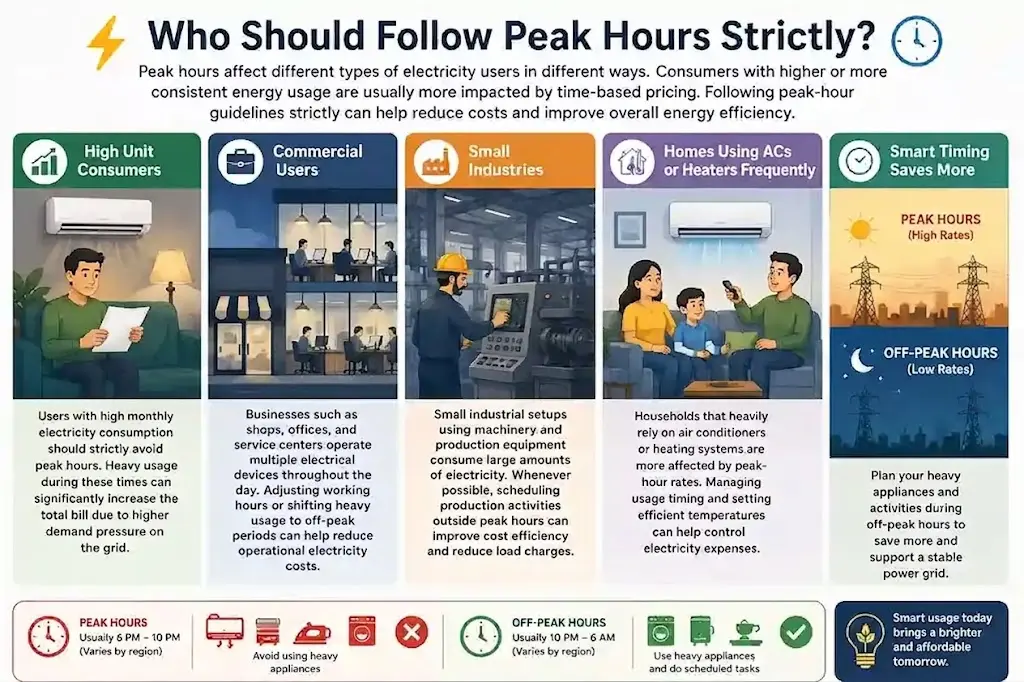
Who Should Pay More Attention to Peak Hours?
Peak-hour planning can be useful for many consumers, but it is especially important for households and businesses with higher electricity usage.
Households With Heavy AC Usage
Homes that use air conditioners for several hours every day can consume a large number of units, particularly during summer.
Managing AC operation and other high-power appliances can help control electricity consumption.
High-Unit Consumers
Consumers with high monthly electricity consumption should pay close attention to their usage pattern. Even small changes in daily consumption can add up over an entire billing cycle.
Commercial Consumers
Shops, offices, workshops, and other businesses often operate multiple electrical devices.
Where business operations allow it, some high-power activities can be moved outside peak periods.
Small Industrial Users
Small industrial units may operate motors, machinery, compressors, pumps, and other high-load equipment. For applicable TOU consumers, scheduling flexible operations outside peak periods may help manage electricity costs.
Common Mistakes That Increase Electricity Consumption
Many people know that electricity is expensive but do not pay attention to when and how they use it.
Here are some common mistakes.
Running the AC Unnecessarily
Leaving an AC running in an empty room wastes electricity. Before leaving a room for an extended period, switch it off if cooling is not required.
Using the Iron During Peak Hours
Ironing is usually an activity that can easily be moved to another time.
Doing several loads of ironing together during an off-peak period may be more practical than using the iron every evening.
Running Multiple Heavy Appliances Together
Using several high-power appliances simultaneously can quickly increase household electricity demand.
Try to spread heavy electrical activities across different times.
Ignoring the Seasonal Schedule
The peak period is not identical throughout the year.
For 2026, the schedule changes between four seasonal periods, so consumers should not rely on an old timetable.
Assuming Every Consumer Has the Same Tariff
Peak-hour pricing mainly matters for applicable TOU tariff consumers. Do not assume that every residential connection is billed in exactly the same way.
Check your bill and applicable tariff category before estimating savings.
Does Using Electricity During Peak Hours Always Increase the Bill?
Not necessarily for every consumer.
This is an important point that is often misunderstood.
Peak-hour rates are particularly relevant to consumers whose tariff uses Time of Use pricing. Other consumers may have different billing structures.
Your final MEPCO bill can include several components, including electricity charges, taxes, adjustments, duties, and other applicable charges. Therefore, simply multiplying your units by one assumed rate may not give you the exact bill amount.
If you want to understand your current charges, start by checking your latest MEPCO online bill.
How Can I Check My MEPCO Bill Before Changing My Usage?
You can review your current bill online and look at the units consumed and other billing information.
Checking your bill regularly is useful because it gives you a better idea of how much electricity your household is using each month.
You can also compare your current consumption with previous bills. If your units have increased, think about what changed during that billing period.
For example:
- Did you start using an AC for longer hours?
- Did you buy a new electrical appliance?
- Was the weather unusually hot?
- Did your family spend more time at home?
- Were heavy appliances used more frequently?
Finding the reason behind higher consumption is often more useful than simply trying to cut electricity use everywhere.
Practical Tips for Lower Electricity Consumption
Here are some simple habits that can help throughout the year:
- Use heavy appliances outside peak hours where possible.
- Turn off lights in empty rooms.
- Use LED bulbs.
- Keep AC filters clean.
- Avoid unnecessarily low AC temperature settings.
- Switch off fans when leaving a room.
- Do not leave chargers connected when they are not needed.
- Use washing machines with full or appropriate loads.
- Operate water pumps only when necessary.
- Avoid using several high-power appliances at the same time.
- Make use of natural daylight.
- Check your electricity bill every month.
- Compare current units with previous months.
- Check your meter reading if the bill seems unusually high.
- Use the applicable peak-hour schedule when planning flexible electricity use.
MEPCO Peak Hours vs Off-Peak Hours
The simplest difference is the time at which electricity consumption occurs.
Peak hours are the designated periods when demand is higher and TOU tariffs may apply a higher rate.
Off-peak hours cover the remaining hours outside the designated peak period.
For example, during September to November, the peak period is 6 PM to 10 PM. The remaining hours are considered off-peak for the TOU schedule.
This does not mean that electricity becomes free or that there are no charges outside peak hours. It simply means that a different TOU period applies where such a tariff is applicable.
MEPCO Peak Hours 2026: Quick Summary
Here is the complete schedule in a simple format:
| Season | Months | Peak Hours |
|---|---|---|
| Winter Period | December – February | 5 PM – 9 PM |
| Spring Period | March – May | 6 PM – 10 PM |
| Summer Period | June – August | 7 PM – 11 PM |
| Autumn Period | September – November | 6 PM – 10 PM |
The official tariff material identifies these seasonal peak periods for TOU billing.
For September 2026, the applicable period is 6 PM to 10 PM.
Frequently Asked Questions About MEPCO Peak Hours
What are MEPCO peak hours in summer 2026?
For June through August, the listed TOU peak period is 7:00 PM to 11:00 PM.
What are MEPCO peak hours in September 2026?
For September through November, the peak period is 6:00 PM to 10:00 PM.
What are MEPCO peak hours in winter?
From December through February, the listed peak period is 5:00 PM to 9:00 PM.
Do peak hours increase the electricity bill?
They can increase the electricity cost for consumers whose applicable tariff uses TOU peak and off-peak rates. However, not every MEPCO consumer has the same tariff structure.
How can I avoid peak-hour electricity charges?
If you have a TOU meter, shift flexible high-power activities such as washing, ironing, pumping water, or other suitable activities to off-peak hours.
Is 7 PM to 11 PM always the MEPCO peak time?
No. The peak period changes according to the season. The official schedule lists different timings for December–February, March–May, June–August, and September–November.
Does using an AC during peak hours always mean a higher bill?
Not necessarily for every consumer. The effect depends on your meter and applicable tariff. For TOU consumers, however, electricity used during the peak period can be charged at the applicable peak rate.
Can I save money by using appliances after peak hours?
If you are on an applicable TOU tariff, moving flexible high-power consumption to an off-peak period can help reduce the amount of electricity billed at the peak rate.
Final Words
Understanding MEPCO peak hours 2026 can make it easier to manage your electricity use and avoid unnecessary consumption during high-demand periods.
The most important thing is to remember that peak hours are seasonal. From June to August, the listed peak period is 7 PM to 11 PM, while September to November uses 6 PM to 10 PM. December through February changes to 5 PM to 9 PM, and March through May uses 6 PM to 10 PM.
If you have a TOU meter, try moving flexible high-power activities outside peak hours whenever your routine allows it. Washing clothes, ironing, running water pumps, and using other heavy appliances can often be planned for another part of the day.
You should also check your electricity bill regularly instead of relying only on estimates. Reviewing your units and charges can help you understand where your electricity is going and whether your usage has changed.
For more information and to check your electricity billing details online, visit MEPCO Bill. For official tariff decisions and regulatory updates, you can also refer to NEPRA.