
A MEPCO bill tells you more than the amount you need to pay. The company name printed on it also tells you which distribution network is responsible for your electricity connection.
I have seen this point create confusion, particularly when someone moves between cities in Punjab or receives a bill for a property in another district. People sometimes assume that all electricity customers in Punjab fall under the same distribution company. They don’t.
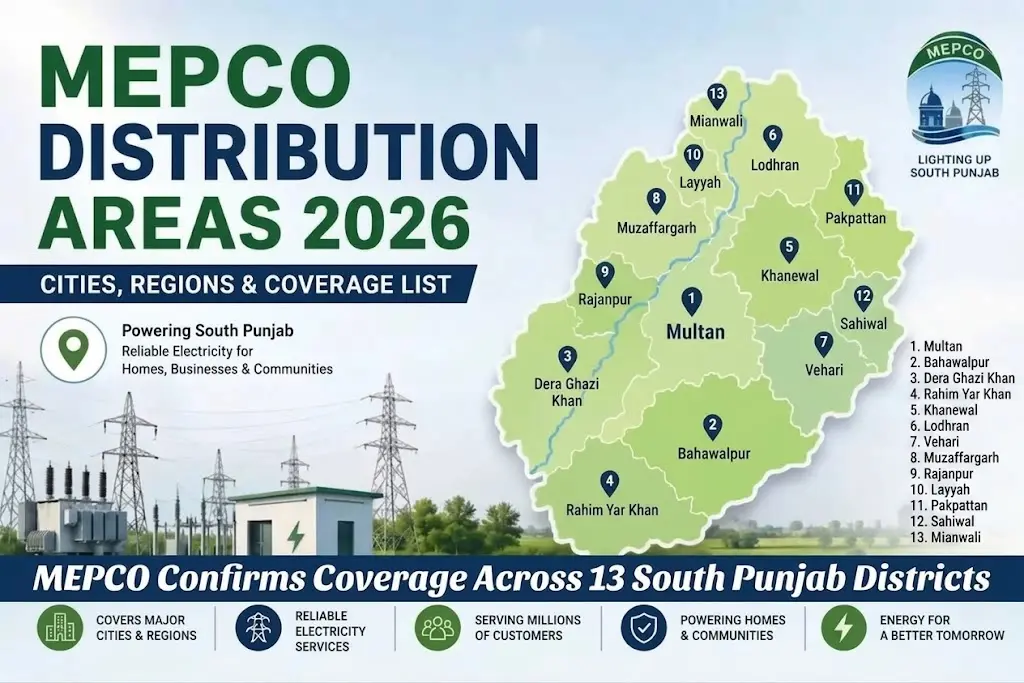
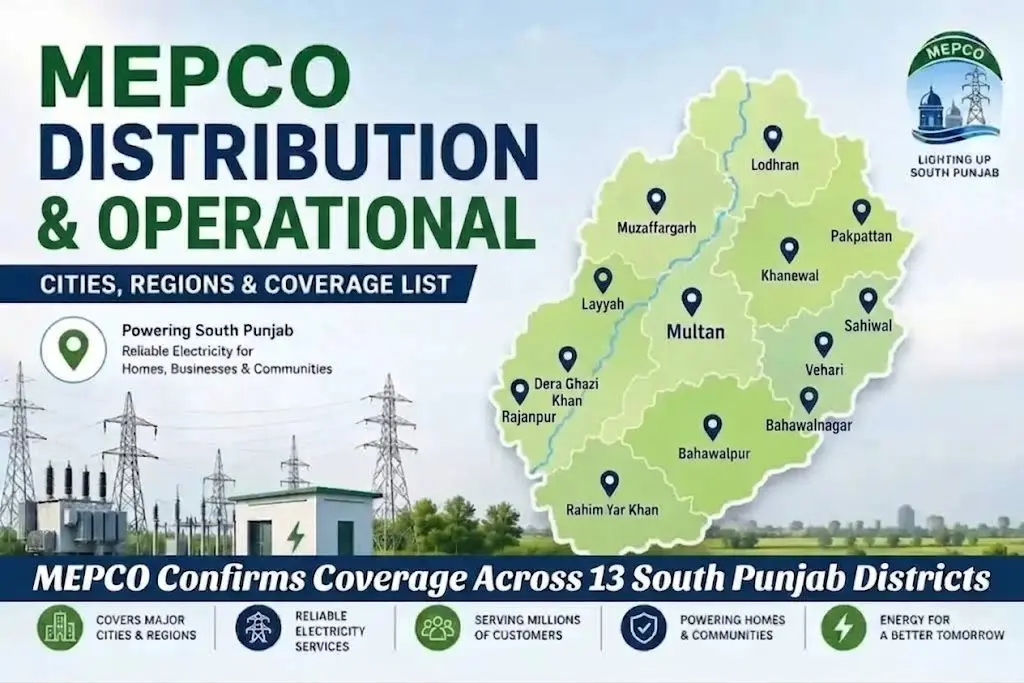
MEPCO’s service territory remains centered on South Punjab, and the company officially operates across 13 administrative districts. That list includes some of the region’s biggest cities as well as large rural areas, which makes MEPCO’s operating territory unusually broad. MEPCO’s own published information identifies these 13 districts as its service area, and its 2024 annual report continues to describe the company as serving 13 districts in Southern Punjab.
For someone simply trying to check a bill, report a fault, or understand why a particular electricity office handles their connection, knowing that coverage matters.
1. The 13 districts that fall under MEPCO
The official list is straightforward, although the geography is much more complicated than the list makes it look.
MEPCO operates in:
| No. | District | Commonly associated areas |
|---|---|---|
| 1 | Multan | Multan city, Shujabad and surrounding areas |
| 2 | Muzaffargarh | Muzaffargarh, Kot Addu and surrounding areas |
| 3 | Layyah | Layyah and surrounding areas |
| 4 | Dera Ghazi Khan | D.G. Khan, Taunsa and nearby areas |
| 5 | Rajanpur | Rajanpur and nearby areas |
| 6 | Lodhran | Lodhran and surrounding areas |
| 7 | Bahawalpur | Bahawalpur and surrounding areas |
| 8 | Rahim Yar Khan | R.Y. Khan, Khanpur, Sadiqabad and nearby areas |
| 9 | Khanewal | Khanewal, Mian Channu and nearby areas |
| 10 | Sahiwal | Sahiwal, Chichawatni and surrounding areas |
| 11 | Pakpattan | Pakpattan and Arifwala areas |
| 12 | Vehari | Vehari, Burewala and Mailsi areas |
| 13 | Bahawalnagar | Bahawalnagar, Chishtian and Haroonabad areas |
MEPCO’s official history page names the same 13 administrative districts. The 2024 annual report also lists Multan, Khanewal, Sahiwal, Pakpattan, Vehari, Bahawalnagar, Bahawalpur, Rahim Yar Khan, Lodhran, Muzaffargarh, Dera Ghazi Khan, Rajanpur and Layyah as its geographic service territory.
That consistency is useful. It means the “13 districts” figure isn’t simply something repeated by bill-checking websites. It appears in MEPCO’s own corporate documentation and in its regulatory material.
The NEPRA distribution licence is particularly useful here because it formally identifies the geographical territory within which MEPCO is authorized to conduct distribution activities. The licence’s district schedule identifies the same 13 districts.
2. Why 13 districts does not mean 13 separate electricity systems
This is where people usually get a little mixed up.
A district is a geographical and administrative unit. MEPCO’s electricity network is organized through operational circles, divisions, subdivisions, feeders and grid stations. So a consumer in one district isn’t simply dealing with a single “district office” that handles everything.
The company has to operate a large network across cities, smaller towns and rural communities. MEPCO’s own material describes its service territory as predominantly rural, with domestic consumers making up a substantial share of its customer base.
That matters when you are trying to understand a complaint or service issue.
A fault affecting one feeder is not necessarily a district-wide problem. A scheduled shutdown in one subdivision doesn’t mean every consumer in that district will lose electricity. And an office handling a particular connection depends on the operational structure behind that connection.
I’ve found that this distinction makes MEPCO information much easier to understand. The district tells you broadly where the service territory is. The feeder, subdivision and division tell you much more about what happens to a particular connection.
There is a similar issue with the phrase “WAPDA bill.” People still use it in everyday conversation, but MEPCO is a separate distribution company. Its corporate history records that it was incorporated in 1998 after the restructuring and corporatization of Pakistan’s power sector.
So if your electricity bill says MEPCO, the relevant distribution company for that connection is MEPCO.
3. The coverage stretches across a surprisingly large part of South Punjab
Look at the district list on a map and the scale becomes clearer.
The territory extends from Sahiwal and Pakpattan in the east and north-eastern portion of the service area toward Rahim Yar Khan in the southwest, while the western side reaches Dera Ghazi Khan and Rajanpur. Bahawalpur, Bahawalnagar, Lodhran, Multan, Khanewal, Vehari, Muzaffargarh and Layyah fill out the middle of the territory.
NEPRA’s published licence schedule gives the total geographical area covered by the listed districts as 104,768.40 square kilometres.
That is one reason the MEPCO network shouldn’t be thought of as a single urban electricity system.
The requirements of a consumer in central Multan are not identical to those of a consumer in a remote rural part of Rajanpur or Rahim Yar Khan. Distances, feeder arrangements, agricultural demand, weather conditions, load patterns and the location of grid infrastructure all affect how the distribution network operates.
MEPCO’s 2024 annual report describes the company as serving about 8.3 million consumers across the 13 districts.
That figure also gives some context to the scale of the operation. Millions of individual connections are spread over a very large territory, so consumer services need to work through multiple levels of the organization rather than through one central office alone.
And this is one reason I recommend keeping your bill details handy. Your reference number and connection information are much more useful for identifying a specific account than simply telling a complaint center that you live in “South Punjab.”
4. Which areas are close to other distribution companies?
MEPCO’s territory has some unusual boundaries.
Its official and regulatory descriptions show that the service territory reaches areas close to several other distribution companies. NEPRA describes MEPCO’s licensed operating area as extending from Sahiwal to Sadiqabad, Bahawalnagar to Bahawalpur, and Taunsa Sharif to Rajanpur, with the territory bordering other regions served by different distribution companies.
MEPCO’s own LinkedIn company profile also describes the company as touching the operating areas of HESCO, PESCO, QESCO, FESCO and LESCO.
That explains why someone living relatively close to a district boundary shouldn’t guess which company supplies their property.
The same city or nearby locality names don’t automatically tell you which distribution company handles a particular electricity connection.
The safer approach is simple: check the company name printed on the electricity bill and the information associated with the connection.
A quick way to identify the responsible distribution company
| What you have | What it tells you |
|---|---|
| Electricity bill | Shows the distribution company |
| Reference number | Identifies the electricity connection for billing purposes |
| Meter information | Helps match the physical connection with the account |
| Billing office details | Indicates the relevant consumer service structure |
| Feeder or subdivision information | Helps identify the local network responsible for supply |
This is also where a lot of online information gets unnecessarily complicated.
You don’t need to memorize every MEPCO division just to check a monthly bill. Start with the bill itself. If there is a technical complaint, then the relevant subdivision or complaint channel becomes more important.
5. What the 13-district confirmation means for consumers
For most consumers, the practical meaning is fairly simple: if your connection is located within one of these 13 districts and falls within MEPCO’s licensed service territory, MEPCO is the distribution company responsible for that connection.
That affects more than the name on the bill.
It determines where you direct complaints, which distribution network handles outages and maintenance, which company issues the electricity bill, and which organization is responsible for distribution-related services in your area.
This is why the coverage information is useful even if you normally only visit a bill-checking website to find a duplicate statement.
At mepcco-bill.pk, I keep coming back to the same principle: consumer information should answer the practical question first. If you know which company handles your connection, many of the next steps become easier.
For example, if you’re trying to understand an unusual charge, it helps to first establish that the bill actually belongs to MEPCO. If you’re dealing with a suspected detection bill, the issue is different again. I have explained the subject in more detail in the guide to MEPCO detection bills and their charges.
That particular internal reference is useful because billing disputes and distribution responsibilities are easy to mix together, and they shouldn’t be treated as the same thing.
6. Where people usually go wrong with MEPCO coverage
The biggest mistake is treating “MEPCO coverage” as though it means every location in an entire division or nearby city automatically belongs to MEPCO.
It doesn’t.
Distribution boundaries are based on the authorized service territory and the actual electricity network. A property near a boundary deserves a little more care than a property clearly located in the middle of Multan or Bahawalpur.
Another common mistake is assuming that a nearby electricity company can handle the problem because its office is physically closer.
That isn’t how the distribution responsibility works.
If your connection is a MEPCO connection, the fact that another DISCO has an office closer to your home doesn’t transfer responsibility for your bill or supply.
But there is another mistake worth mentioning. Consumers sometimes see a change in their bill format, payment method or online service and assume that the electricity distribution territory has changed too.
Those are separate matters.
For example, MEPCO has introduced changes and updates affecting consumer-facing services over time. A newer bill layout does not, by itself, mean that your connection has moved from one distribution company to another.
I also recommend being careful with unofficial websites that publish district lists containing conflicting numbers. MEPCO’s official corporate material and NEPRA’s licensing information consistently identify 13 districts, so that is the figure I would use when discussing the company’s formal service territory.
And yes, I had to catch myself here because there is a temptation to make this more complicated than it is. For a normal consumer, the important point is simply to identify the company responsible for the connection and then use the correct channel for the issue.
7. What consumers should keep with their MEPCO records
You don’t need a folder full of paperwork for an ordinary electricity connection, but a few details are worth keeping somewhere safe.
Your latest bill is the obvious starting point. From it, you can usually find the reference number, consumer information, meter details, billing period and payable amount.
If you regularly check bills online, keeping the reference number available saves time.
If you’re dealing with a complaint, keep the complaint number or acknowledgement as well. A vague memory that you called an office last Tuesday isn’t nearly as useful as a recorded complaint reference.
For consumers who are dealing with updated billing information, I also recommend checking the actual bill rather than relying on an old screenshot or copied figure from another website.
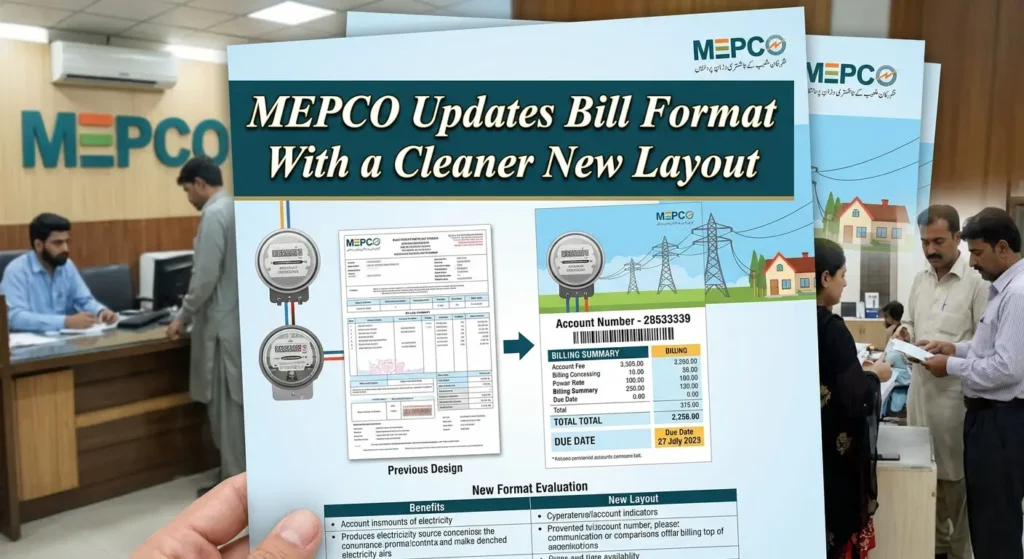
MEPCO-related billing and payment information changes from time to time. My guide on MEPCO bill payment methods goes into the different payment routes consumers may encounter, while the MEPCO bill format guide explains what consumers should look for on the newer statement layout.
One small detail makes a difference here: don’t confuse information about the electricity distribution company with information about the billing platform or payment service. Several organizations and systems can be involved in getting a bill from the network to the consumer.
The company responsible for distribution remains the key starting point.
8. What the coverage tells us about MEPCO’s role in South Punjab
The 13-district footprint says something broader about the way electricity distribution works in this part of Punjab.
MEPCO is not serving a compact metropolitan area. Its territory includes major urban centers, agricultural districts, smaller towns and large rural communities.
Its 2024 annual report identifies the company as the largest distribution network company by service territory and places its consumer base at about 8.3 million.
That scale makes network planning a substantial operational task.
MEPCO has also been involved in distribution improvement projects. One project document describes work intended to strengthen electricity supply and reduce problems such as overloading and voltage drop through expansion and rehabilitation of selected 11 kV feeders.
For consumers, that technical language has a very practical meaning.
The electricity reaching your house doesn’t come from an abstract district label. It travels through a physical network of grid stations, transmission and distribution lines, transformers, feeders and local infrastructure.
So when MEPCO talks about its 13-district jurisdiction, it is describing the geographic area within which that large system operates.
Frequently Asked Questions
How many districts does MEPCO officially cover?
MEPCO officially operates across 13 administrative districts of Southern Punjab. The same 13-district coverage is reflected in MEPCO’s corporate information and its NEPRA distribution licence.
Which districts are included in the MEPCO service area?
The districts are Multan, Muzaffargarh, Layyah, Dera Ghazi Khan, Rajanpur, Lodhran, Bahawalpur, Rahim Yar Khan, Khanewal, Sahiwal, Pakpattan, Vehari and Bahawalnagar.
Does living near another district mean my electricity comes from a different company?
Not necessarily. Distribution responsibility depends on the actual licensed service territory and network serving your connection, not simply on which district or company office appears geographically closest.
Is MEPCO the same as WAPDA?
No. MEPCO is a separate electricity distribution company that was incorporated in 1998 as part of Pakistan’s power-sector restructuring. The terms are still mixed in everyday conversation, but a MEPCO electricity bill relates to the MEPCO distribution network.
Why is knowing my MEPCO district useful?
It helps you understand which distribution company is responsible for your electricity connection and where distribution-related complaints should be directed. Your bill’s reference number and connection details are even more useful when dealing with a specific account.
The 13-district figure is not a new boundary created by a single consumer notice. It is part of MEPCO’s established licensed service territory, and the company’s more recent corporate reporting continues to identify the same 13 districts.
For consumers, that’s probably the most useful part of the confirmation. If your electricity connection is within MEPCO’s territory, the company responsible for that distribution network is clear, and knowing that makes everything from billing questions to outage complaints a little less confusing.
Pingback: MEPCO Updates Bill Format With a Cleaner New Layout – MEPCO Bill Check 2026
Pingback: MEPCO Updates Helpline and Complaint Contact Details – MEPCO Bill Check 2026